

Why hallmarked silver matters: the UK consumer's guide
Hallmarked silver is the only form of silver that carries an independent, government-backed guarantee of its precious metal content. Under the Hallmarking Act 1973, any silver item above the minimum UK weight threshold sold in the UK must carry an official hallmark applied by a recognised Assay Office, or the seller is breaking the law. That single mark tells you the item has been physically tested, not just labelled by whoever made it.
Here is what a hallmark actually confirms at a glance:
- The silver purity has been independently verified (sterling silver at 92.5%, Britannia silver at 95.8%)
- The item was tested and marked by one of four official UK Assay Offices
- A registered sponsor’s mark links the piece to its maker, creating a traceable record
- The hallmark cannot be self-applied; it is stamped only after testing passes
- Any silver item sold without a hallmark above the weight threshold is being sold illegally
A “925” stamp pressed on by a manufacturer is not a hallmark. It is a declaration with no independent verification behind it. The difference between hallmarked vs unmarked silver is, at its core, the difference between a verified fact and an unverified claim.
How British hallmarking began and why it still matters
Hallmarking in Britain has a history going back several centuries, making it one of the oldest consumer protection systems in the world. The British Hallmarking Council traces its origins to a time when silver coins were being debased and buyers had no reliable way to verify what they were actually receiving. The solution was a centralised testing system run by independent assay offices, whose job was to test metal and stamp only what passed.
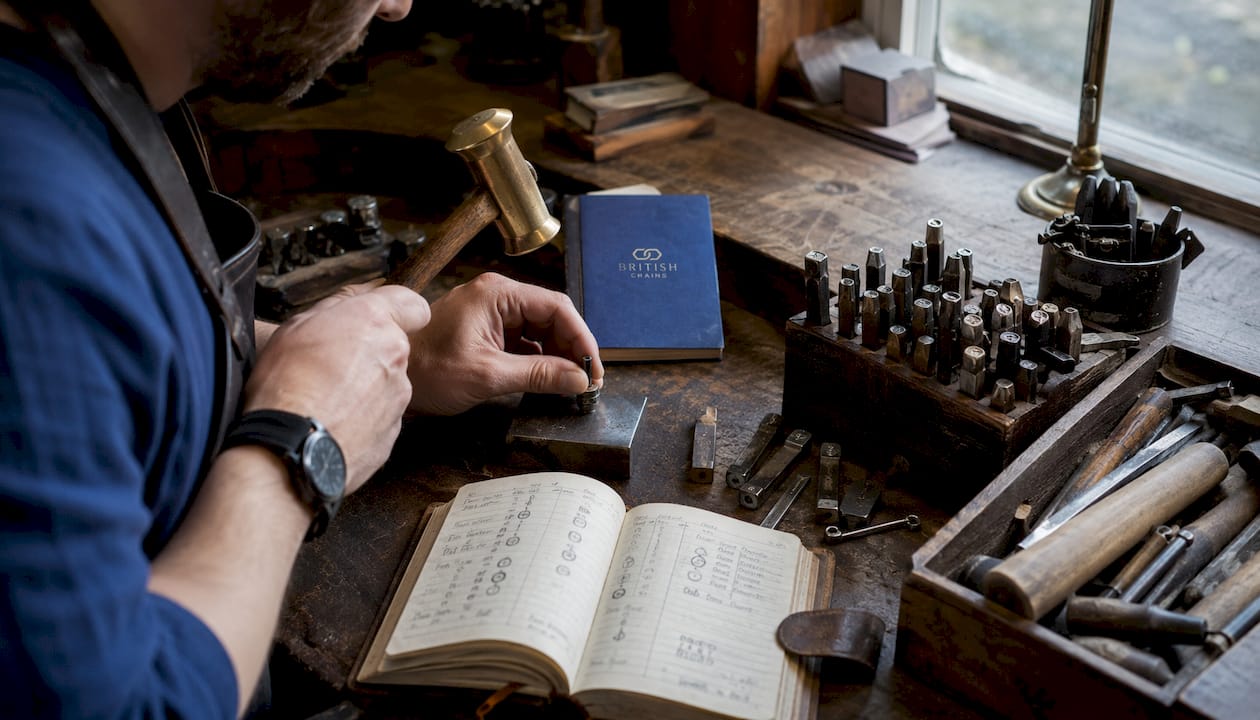
Over the centuries, that system evolved from a simple quality mark into a legally mandated framework. The Hallmarking Act 1973 codified what had been developing for centuries, setting weight thresholds, defining approved purity standards, and placing criminal liability on sellers who misdescribe unhallmarked goods. Four Assay Offices, in London, Edinburgh, Sheffield, and Birmingham, carry that responsibility today.
What makes the British system unusual is its independence. The Assay Office testing your silver chain has no commercial relationship with the maker. That separation is the whole point.
- A long tradition of consumer protection spanning many centuries
- Formalised under the Hallmarking Act 1973 with criminal penalties for non-compliance
- Four independent Assay Offices: London, Edinburgh, Sheffield, Birmingham
- Applies equally to new and pre-owned silver items described as silver
- Covers all sales channels, including online, market stalls, and physical retail
What the different marks on British silver actually mean
A British hallmark is not a single symbol. It is a set of component marks, each carrying distinct information, and reading them together tells you everything you need to know about a piece.
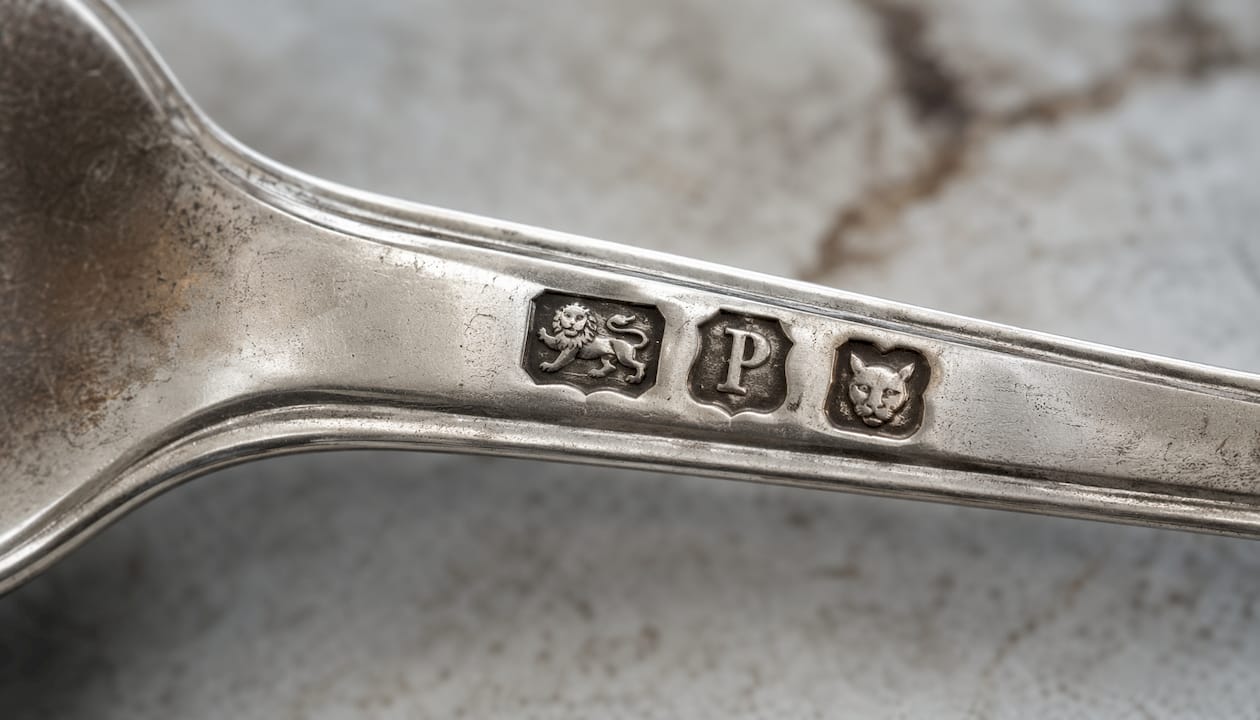
| Mark | What it shows | Example |
|---|---|---|
| Standard (purity) mark | Silver fineness verified by testing | Lion passant (sterling, 925); Britannia figure (958) |
| Assay Office (town) mark | Which office tested and marked the item | Leopard’s head (London); Thistle (Edinburgh) |
| Date letter | Year of hallmarking | A letter in a shaped shield, cycling annually |
| Sponsor’s mark | Registered maker or importer | Unique initials in a shaped cartouche |
| Optional commemorative mark | Special series or jubilee marks | Millennium, coronation, or royal anniversary marks |
The lion passant is the most widely recognised symbol in British silver. It denotes sterling silver purity at 925 parts per thousand, meaning 92.5% pure silver alloyed with other metals for strength. Britannia silver, marked with a seated figure, sits higher at 95.8% purity and is less common in everyday jewellery.
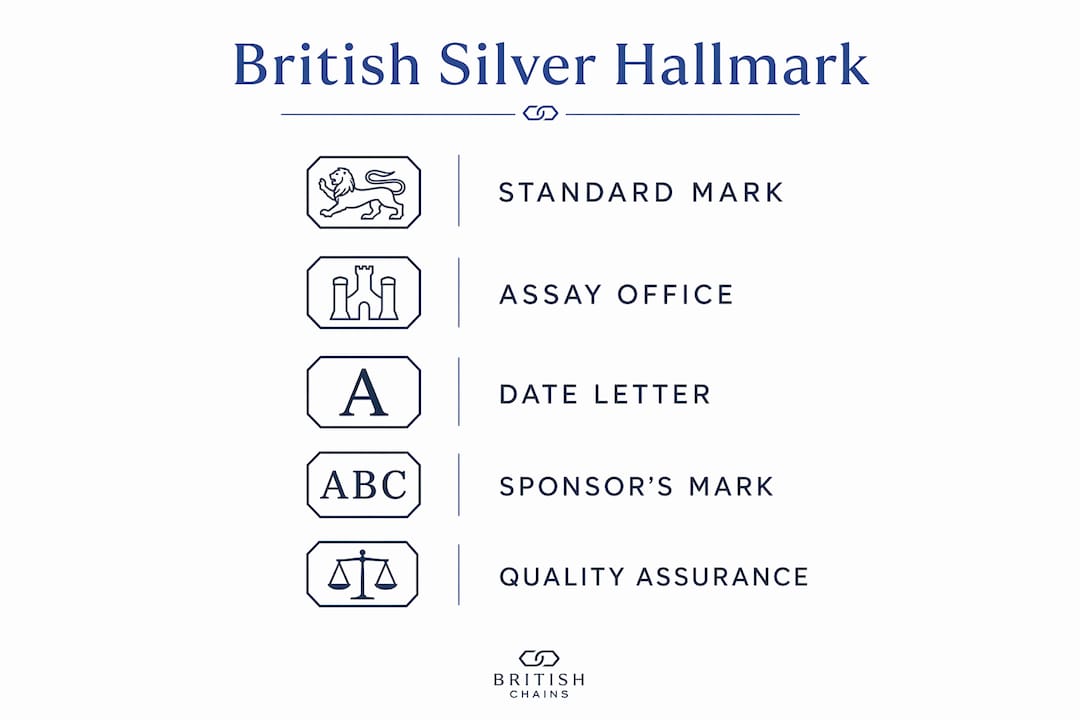
Edinburgh uses a thistle rather than the lion passant as its standard mark, which catches many buyers off guard. The function is identical; only the symbol differs. A full guide to Edinburgh hallmark silver is worth reading if you are buying Scottish-made pieces.
Date letters are particularly useful for antique and vintage silver. Each Assay Office ran its own date letter sequence, so the same letter in a different shield shape can indicate a different year and office. Cross-referencing the town mark with the date letter is the standard approach for dating a piece accurately.
What UK law actually requires sellers to do
The legal position is straightforward. Selling unhallmarked silver above 7.78 grams while describing it as silver is a criminal offence under the Hallmarking Act 1973. That applies whether you are a high street jeweller, an online retailer, or someone selling at a craft fair.
| Requirement | Detail |
|---|---|
| Weight threshold | Silver items over 7.78 grams must be hallmarked |
| Who must hallmark | Any business selling silver described as silver in the UK |
| Where hallmarks are applied | Only by one of four recognised UK Assay Offices |
| Sales channels covered | Physical retail, online, market stalls, gallery shops |
| Pre-owned items | Same rules apply; description triggers the requirement |
| Penalty | Criminal offence; Trading Standards enforcement |
The law also covers description in its broadest sense. A verbal assurance, a written product listing, or even a manufacturer’s fineness stamp on the piece itself can constitute a “description” under the Act. So a seller who writes “925 sterling silver necklace” in an online listing is legally obliged to have that item hallmarked if it exceeds the weight threshold, regardless of whether they stamped “925” on the metal themselves.
Exemptions exist, but they are narrow. Items below 7.78 grams are not required to carry a hallmark, though sellers still cannot misdescribe their purity. Certain antique items and articles intended for export may also qualify for exemption, but these do not cover the vast majority of silver jewellery sold to UK consumers.
- Items below the legal minimum weight are exempt from mandatory hallmarking
- Sellers of exempt items still cannot falsely describe purity
- Antique and export exemptions exist but are tightly defined
- Online sales carry identical legal obligations to physical retail
- Trading Standards enforces the Act and investigates complaints
How to tell whether a hallmark is genuine
Only marks applied by a UK Assay Office after formal testing count as official hallmarks. A “925” stamp, a “Sterling” engraving, or any mark applied by the manufacturer is not a hallmark, regardless of how official it looks. The Edinburgh Assay Office is explicit on this point: informal at-home tests such as the magnet test, the ice test, or the ring test are unreliable and produce false results often enough to be useless for verification.
Genuine hallmarks have specific characteristics worth checking:
- The full set of marks is present: purity, town, date letter, and sponsor’s mark
- Marks are struck cleanly and consistently, not scratched or painted on
- The purity mark matches a recognised standard (lion passant for 925, Britannia for 958)
- The town mark corresponds to one of the four UK Assay Offices
- The sponsor’s mark appears in a shaped cartouche registered with an Assay Office
Pro Tip: If you are buying a high-value piece and want absolute certainty, request professional XRF (X-ray fluorescence) testing from a reputable Assay Office. It is the only method that definitively confirms silver content, and the Edinburgh and London Assay Offices both offer this service.
Forged or imitation marks do exist, particularly on imported pieces. A common tell is a hallmark that looks complete at first glance but uses incorrect shield shapes, mismatched symbols, or a town mark that does not correspond to any recognised UK office. If the marks do not match the known formats for London, Edinburgh, Sheffield, or Birmingham, treat the piece as unverified.
Why assay offices and the British Hallmarking Council underpin consumer trust
The British Hallmarking Council oversees the hallmarking system and sets the standards that all four Assay Offices operate under. Its role is not to test silver directly but to maintain the integrity of the system, including the registers of sponsor’s marks that link every hallmarked piece to its registered maker.
Experts at the London and Edinburgh Assay Offices consistently highlight one point: hallmarking removes the buyer’s dependence on the seller’s word. You do not need to trust the retailer’s description when an independent body has already tested the metal and staked its reputation on the mark.
The sponsor’s mark is a detail that often goes unnoticed but carries real weight. Every registered maker has a unique mark on file with their Assay Office. If a problem ever arises with a piece, that mark creates a direct line of accountability back to the manufacturer. It is a permanent record, not a sticker that can be peeled off.
The practical benefits of buying hallmarked silver
Hallmarking protects you in ways that go beyond the obvious. The most direct benefit is purity assurance: you know exactly what you are buying. Sterling silver at 925 parts per thousand behaves differently from lower-grade alloys in terms of durability, tarnishing, and skin reaction. Buying hallmarked sterling silver means those properties are guaranteed, not assumed.
There is also a health dimension that rarely gets mentioned. UK government guidance notes that fake or misdescribed jewellery sometimes contains dangerous heavy metals. A hallmark eliminates that risk by confirming the item meets legal purity standards.
For gifts, the hallmark carries its own kind of assurance. When you give someone a piece of hallmarked silver, you are giving them something with a verifiable standard behind it, not just a retailer’s claim. That matters particularly when buying online, where you cannot physically inspect the piece before purchase.
How to spot a forged or imitation hallmark
Counterfeit hallmarks are more common on imported silver than on domestically produced pieces, and they tend to follow recognisable patterns. The most frequent issue is a piece bearing a “925” stamp alongside symbols that superficially resemble official marks but do not correspond to any registered UK Assay Office format.
Look for these warning signs:
- A lion passant that faces the wrong direction or has incorrect proportions
- A date letter in a shield shape not used by any UK Assay Office
- A town mark that does not match London, Edinburgh, Sheffield, or Birmingham
- Marks that appear engraved or scratched rather than struck with a punch
- No sponsor’s mark, or a sponsor’s mark in a format that does not match registered cartouche shapes
The practical test is cross-referencing. The Silver Society maintains identification resources for British silver marks, and the Assay Offices themselves can verify marks on request. If a seller cannot confirm which Assay Office applied the hallmark, that is a meaningful gap.
What each symbol in a British hallmark tells you
The symbols within a British hallmark are standardised, but their visual forms vary by Assay Office and era. Understanding the core set gives you a reliable framework for reading any piece.
The standard mark is the most important. For sterling silver, it is the lion passant: a walking lion facing left, shown in profile. Edinburgh uses a thistle. Both confirm 92.5% silver content. Britannia silver uses a seated figure of Britannia and confirms 95.8% purity.
The Assay Office mark tells you where the piece was tested. The leopard’s head belongs to London; the thistle to Edinburgh; an anchor to Birmingham; a crown to Sheffield (though Sheffield’s mark has changed over time). Each shape is distinctive enough to identify with a loupe.
The date letter cycles through the alphabet in a shaped shield, with the shield shape and typeface changing each cycle. Different offices ran different cycles, so the same letter can mean different years depending on the town mark alongside it.
The sponsor’s mark is two or more letters in a shaped cartouche, unique to the registered maker or importer. It is the accountability mark, the one that makes the whole system traceable.
How hallmarking affects the value and resale of silver
Hallmarked silver commands higher resale prices than unmarked silver or pieces bearing only manufacturer stamps. The reason is straightforward: buyers and dealers can verify what they are buying without relying on the seller’s word. That independent certification removes a layer of risk from the transaction.
For antique and vintage silver, the hallmark is often the primary determinant of value. A complete set of marks, including a legible date letter and sponsor’s mark, allows precise attribution and dating, both of which affect price. A piece with worn or incomplete marks is harder to attribute and typically sells for less, even if the silver content is identical.
For contemporary jewellery, the hallmark signals quality and legal compliance. Retailers who sell hallmarked pieces are demonstrating that their stock has passed independent testing, which is a meaningful differentiator when buying online. A hallmarked 925 silver chain holds its value better than an unmarked equivalent because its purity is a documented fact rather than a claim.
Limitations and exceptions you should know about
The hallmarking system is thorough, but it has boundaries. The 7.78 gram weight threshold means that small silver items, thin chains, earrings, and certain pendants, may not carry a hallmark even when sold legitimately. This does not mean they are low quality; it means the legal requirement does not apply at that weight.
Antique silver made before 1 January 1900 is exempt from the requirement to carry a UK hallmark, though many antique pieces carry foreign hallmarks or assay marks from their country of origin. These are not UK hallmarks and do not carry the same legal guarantees, though they may still be informative.
Imported silver presents a particular challenge. Pieces made outside the UK and imported for sale must be hallmarked by a UK Assay Office before being described as silver in the UK market. Some imported pieces carry foreign fineness marks that look official but have not been through UK assay testing. The legal obligation falls on the UK seller to have the piece hallmarked before sale, not on the buyer to detect the gap.
One further limitation: hallmarking confirms purity at the point of testing. It does not guarantee the condition of the piece, its craftsmanship, or its durability over time. Those qualities depend on the maker, which is exactly why the sponsor’s mark matters as much as the purity mark.
Britishchains: hallmarked sterling silver made in Britain
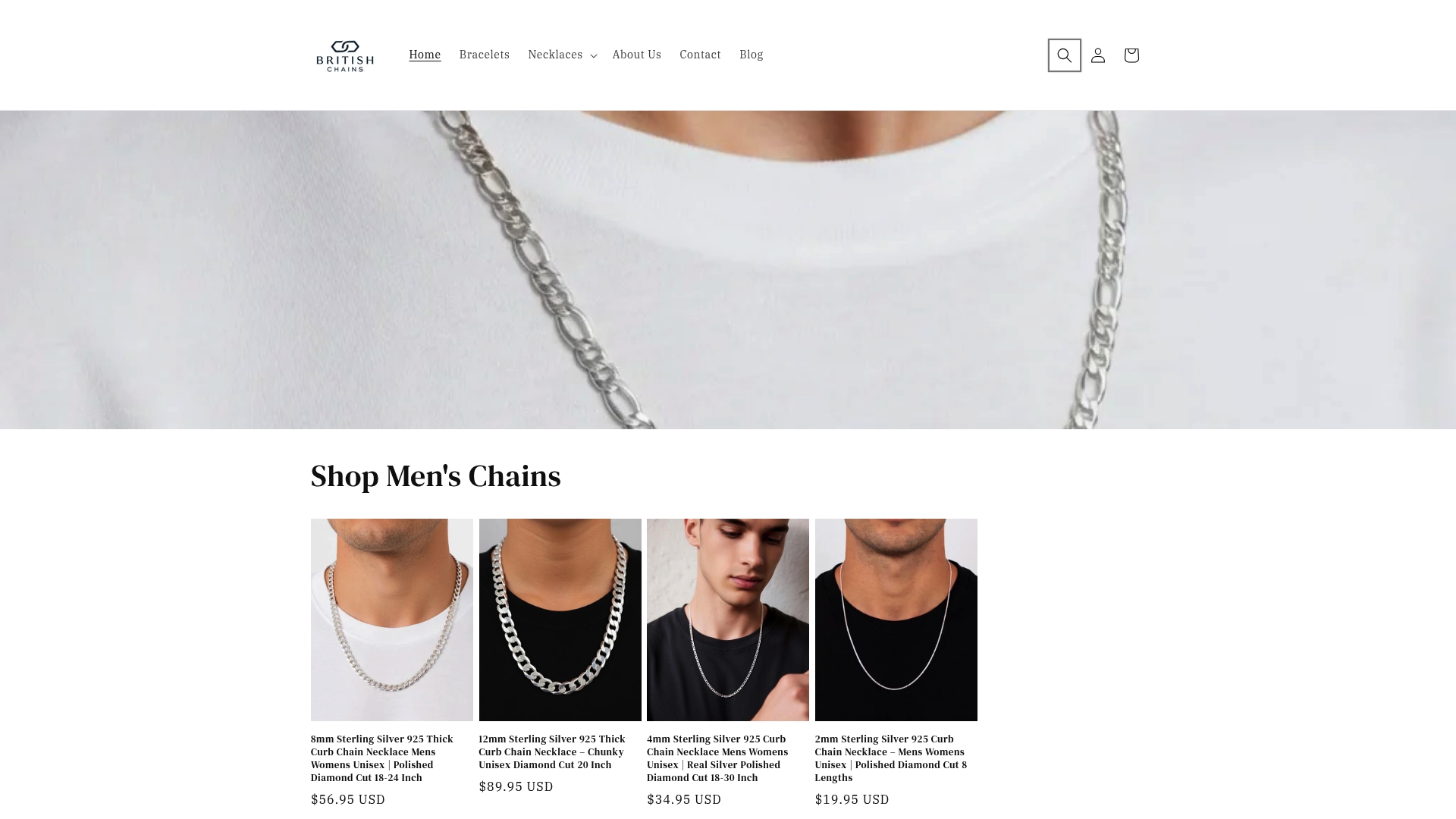
Every piece in the Britishchains collection carries a full UK hallmark, verified by an official Assay Office and meeting the sterling silver standard of 92.5% pure silver. From the 8mm Figaro chain to finer everyday styles, each necklace is made to be worn, kept, and passed on with confidence in what it actually is.
Britishchains sells direct to consumers across the UK, with full hallmarking details available on every product page. If you want silver you can verify, not just trust, browse the full collection at Britishchains.
Key takeaways
Hallmarked silver is the only silver whose purity has been independently tested and legally certified by a UK Assay Office, making it the only form of silver that fully protects you as a buyer.
| Point | Details |
|---|---|
| Legal threshold | Silver items over 7.78 grams must carry a UK hallmark or the seller commits a criminal offence. |
| What a hallmark confirms | Independent verification of silver purity, not a self-applied manufacturer’s stamp. |
| Four Assay Offices | London, Edinburgh, Sheffield, and Birmingham are the only bodies authorised to apply UK hallmarks. |
| Resale and value | Hallmarked silver commands higher resale confidence because purity is a documented fact, not a claim. |
| Exceptions exist | Items below 7.78 grams and certain antiques are exempt, but sellers still cannot misdescribe purity. |


