

Avoid Overpaying for Silver Chains in the UK: 4 Checks to Value
Three things drive most of a silver chain’s price: how much it weighs, whether it’s solid or hollow, and how complicated the link pattern is to make. Purity almost never varies (nearly every UK chain is .925 sterling), so weight in grams and construction quality do the heavy lifting. Before judging any price tag, check the grams and look for the hallmark. Everything else, style, brand, plating, is a smaller premium layered on top.
TL;DR:
- The price of a silver chain is primarily determined by its weight, construction (solid or hollow), and link pattern complexity; style and brand add smaller premiums.
- Hallmark verification ensures the chain’s purity, with .925 stamped pieces carrying genuine assay marks and unmarked or plated chains being priced lower accordingly.
- Doubling wire gauge increases grams by roughly four times, making weight in grams the most reliable factor for comparing chain values across styles.
- Handcrafted or intricately finished chains cost more due to labor, especially for designs like diamond-cut or soldered links, compared to simple machine-made styles.
- Hollow chains are cheaper upfront but more prone to damage, so factoring in potential repair costs is essential when assessing their value and durability.
Table of Contents
- Silver chain price factors: purity, hallmarks and the metal market
- Weight, length and thickness: why grams matter more than looks
- Chain style and complexity: which designs cost more to make
- Construction and durability: solid vs hollow links
- Pricing benchmarks: what entry, mid and premium actually look like
- How to value a chain yourself: checklist and worked example
- Where and how to buy: warranties, returns and negotiation
- Publisher proofs: how Britishchains applies these standards
- Buying for keeps or buying for style
- Chain examples that show the checks in practice
- Sources
- FAQ
Silver chain price factors: purity, hallmarks and the metal market
Sterling silver is 92.5% pure silver alloyed with other metals for strength, and it’s the standard purity for almost every chain sold in the UK. Fine silver (99.9%) is too soft for everyday jewellery; it dents and bends with normal wear. Silver-plated chains have a thin coating over a base metal core and carry almost none of the intrinsic value that sterling does, which is the single biggest reason two chains that look identical can be priced worlds apart.
The melt value, what the raw metal is worth if stripped down and sold as bullion, sets the price floor beneath every chain. The formula is simple: grams × 0.925 × the current spot price per gram. A 20 gram sterling chain contains a high proportion of pure silver, so at any given spot price you can work out the baseline cost before a single hour of labour gets added.
That baseline moves more than most buyers expect. Silver behaves as a higher-beta extension of gold, tracking gold’s direction but swinging harder in both directions. Because most mined silver comes as a by-product of mining other metals like copper and zinc, supply barely responds when prices spike, which is one reason the silver market sees sharp price swings that retailers don’t always pass through overnight.
Pro Tip: When calculating melt value yourself, use an averaged recent price rather than a single day’s spot quote. The LBMA and COMEX references move throughout the trading day, and a snapshot from one moment can skew your baseline.
UK hallmarking is the buyer’s real proof of what’s inside a chain. A hallmark confirms the metal has been independently tested and certifies its purity, it isn’t a manufacturer’s claim, it’s a legal assay mark. Understanding sterling silver purity standards in the UK and knowing how to read purity marks on silver jewellery protects you from paying sterling prices for plated goods.
- .925 stamped or marked pieces should carry a genuine assay hallmark, not just a printed “925” on the packaging.
- Fine silver (.999) is rare in chains because it’s too soft for daily wear.
- Plated chains have no meaningful melt value and should be priced accordingly.
Weight, length and thickness: why grams matter more than looks
Gauge (the wire thickness, measured in millimetres) and length both feed directly into grams, and grams are what you’re actually paying metal value for.
The relationship isn’t straight-line. Doubling the gauge of a chain doesn’t double the grams, it roughly quadruples them, because you’re increasing the cross-sectional area of the wire, not just its width. A jump from 2mm to 4mm on the same style and length can mean three or four times the silver content, not twice.
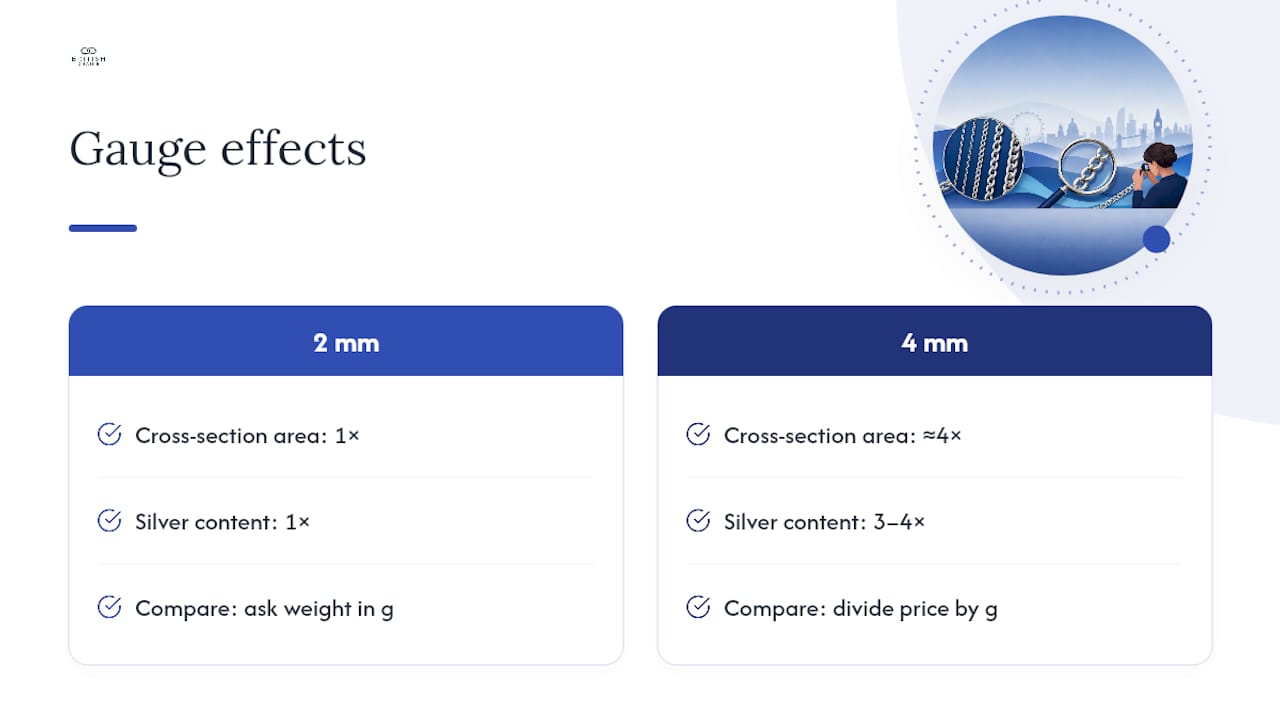
Pro Tip: Never judge a chain by eye alone. Ask the retailer for the exact weight in grams, then divide the price by that figure to get a price-per-gram number. That single figure lets you compare a delicate box chain against a chunky curb on equal terms, regardless of style.
Chain style and complexity: which designs cost more to make
Some link patterns are cheap to machine-produce at scale. Others need far more handling, soldering, and finishing passes, and that labour shows up in the final price even when the metal weight is identical.
Simple box and curb chains sit at the low-labour end: the link pattern is repetitive and well suited to automated production. Figaro and rope chains sit in the middle, the twist or alternating pattern needs more precise machine setup. Fully handcrafted or intricately soldered designs, along with anything with a diamond-cut finish, sit at the top, because diamond-cutting involves precision faceting on every link to create that sparkle. Understanding why handcrafted silver costs more explains a lot of price gaps that look confusing at first glance.
- Box and curb: low labour, machine-friendly, most affordable per gram.
- Figaro and twisted rope: moderate labour, more complex tooling.
- Diamond-cut and handcrafted finishes: highest labour, visible sparkle and detail.
- Rhodium plating adds a bright white finish and modest tarnish resistance, but it wears off over time.
- Gemstones or extra fittings only justify a real premium when they’re genuine and disclosed; cubic zirconia or glass “accents” shouldn’t carry gemstone pricing.
Construction and durability: solid vs hollow links
A chain’s internal construction affects both what you pay now and what you’ll spend later. Solid links are cast or drawn from a single piece of wire and resist crushing. Hollow links are formed from thin sheet silver rolled into a tube, using far less metal for the same visual thickness, and tube constructions sit somewhere between the two depending on wall thickness.
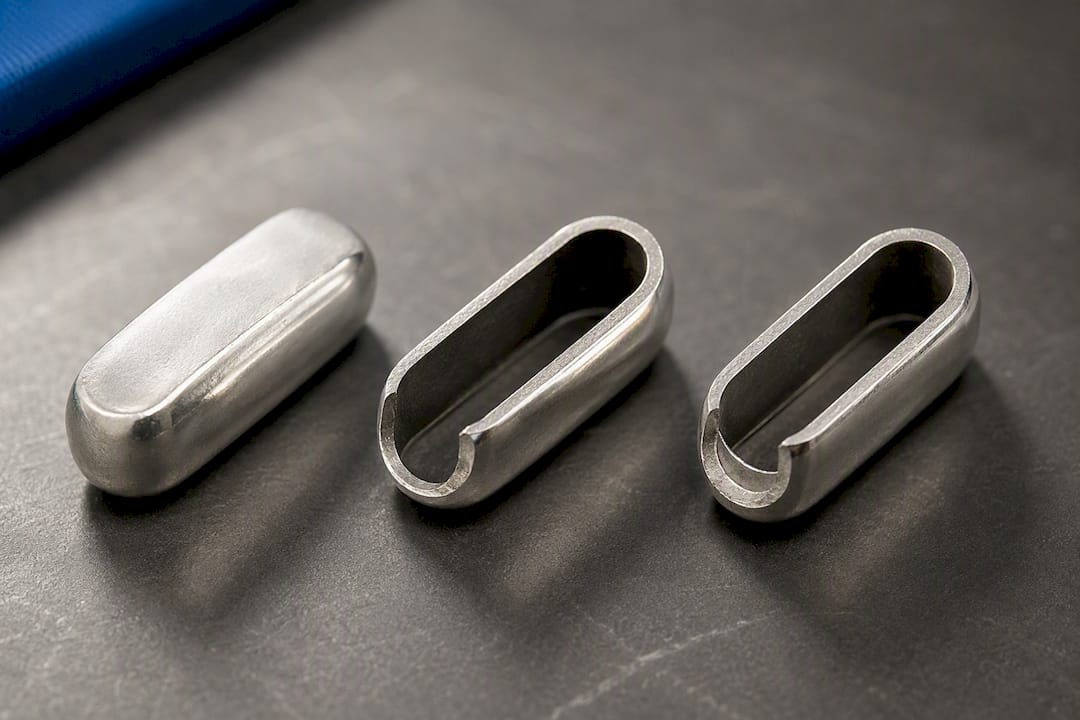
Hollow chains cost less upfront precisely because they use less silver, but they’re considerably more prone to kinking, splitting, and denting under normal wear. A chunky-looking hollow curb chain might weigh a third of its solid equivalent, which explains the price gap instantly once you know to ask.
Clasp quality matters just as much as the links. A soldered lobster clasp with a reinforced jump ring holds up far better than a spring-ring clasp on a heavy chain, where the mechanism can fatigue and snap under repeated tension. Comparing solid silver against hollow chain construction before buying saves most people a repair bill within the first year or two.
- Solid: heaviest, most expensive per style, most resistant to everyday damage.
- Hollow: lightest, cheapest, most likely to need repair or replacement.
- Tube: a middle ground, but wall thickness varies wildly between makers.
Pro Tip: A hollow chain that mimics the look of a solid one isn’t a bargain if you’re wearing it daily. Factor in the realistic cost of a repair or early replacement before comparing sticker prices.
Pricing benchmarks: what entry, mid and premium actually look like
Retail price is rarely just metal value plus a flat margin. A finished 20 gram sterling chain might contain only $40 to $60 of raw silver yet retail for $120 to $250, with the gap covering labour, finishing, packaging and brand.
- Entry band: fine-gauge box or curb chains (2mm, 5 to 8g) typically sit at the lowest end of a retailer’s range, dominated by metal cost with minimal labour premium.
- Mid band: 3mm to 4mm rope or figaro chains (10 to 20g) carry a moderate labour premium for the twist pattern or diamond-cut finish, usually landing meaningfully above pure melt value.
- Premium band: 8mm and above curb or figaro chains (40g plus), often diamond-cut, sit at the top because both material cost and labour complexity scale together.
Two chains of identical weight can still differ sharply in price. That difference is labour, not metal, and it’s worth knowing which one you’re paying for.
How to value a chain yourself: checklist and worked example
Judging a fair price takes four checks and one calculation.
- Confirm the hallmark is a genuine assay mark, not just a printed “925” on a tag.
- Get the exact weight in grams, ideally from the product listing or by asking the retailer directly.
- Identify the construction (solid, hollow or tube) and clasp type.
- Check the warranty and returns policy before you commit.
The worked calculation: grams × 0.925 × spot price per gram gives you the melt baseline. A 15 gram chain, for instance, contains around 13.9 grams of pure silver. Multiply that by the current spot price to get your floor value, then layer on a reasonable labour and brand premium.
| Chain type | Melt baseline share | Typical labour/brand premium | Total retail range |
|---|---|---|---|
| Simple box/curb | High share of price | 20 to 40% above melt | Entry |
| Figaro/rope, diamond-cut | Moderate share | 50 to 120% above melt | Mid |
| Heavy curb, handcrafted finish | Lower share, high absolute grams | 60 to 120% above melt | Premium |
If a seller can’t or won’t state the weight, or the price seems far below the melt baseline for the stated weight, treat that as a red flag. Underweight claims and vague “solid look” descriptions are the two most common ways buyers get misled.
Where and how to buy: warranties, returns and negotiation
Specialist silver retailers and high-street jewellers typically state weight, hallmark and construction clearly, and back purchases with a returns policy. Online marketplaces and secondhand sources can offer real savings, but verification is entirely on you, insist on clear photos of the hallmark, a stated weight, and a defined returns or repair window before paying.
- Ask for the hallmark location and a close-up photo if buying online.
- Confirm return and repair terms before purchase, not after a problem appears.
- If the price feels fixed, ask for a clasp upgrade or free polishing rather than pushing for a blunt discount, sellers often have more room on service than on price.
- Be wary of secondhand listings with no stated weight or hallmark photo.
Publisher proofs: how Britishchains applies these standards
Britishchains publishes detailed guidance alongside its catalogue, including how to spot good silver chain deals and explanations of UK hallmarking standards that back up the checks covered here. Every product page states weight in grams, gauge and hallmark information rather than leaving buyers to guess.
- Product listings show gram weight and hallmark details directly, not buried in fine print.
- Educational posts cover purity marks, construction differences, and regional craft questions like UK vs Italian silver chains.
- Guidance is designed to be checked against the product page in front of you, not taken on faith.
Buying for keeps or buying for style
If a chain is a daily-wear piece or a gift meant to last decades, prioritise solid construction, a soldered clasp and a weight that matches its melt value fairly closely. If it’s an occasional statement piece, a style or brand premium is reasonable, you’re paying for the look, not just the grams.
Chain examples that show the checks in practice
Seeing these factors on real products makes them easier to apply. A 2mm sterling silver box chain sits firmly in the entry band, low gram weight, simple link pattern, minimal labour premium, and it makes a sensible everyday piece where you’re paying mostly for metal and hallmark assurance rather than craftsmanship.
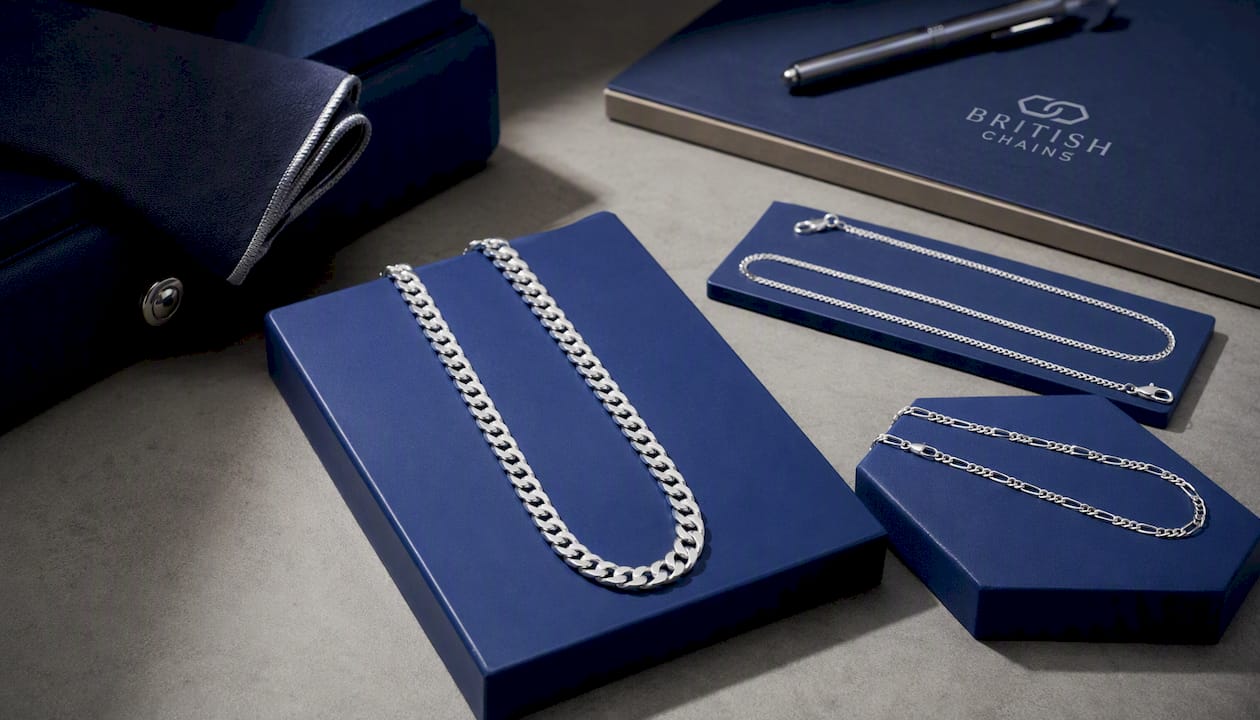
At the other end, an 8mm thick sterling silver curb chain carries substantially more grams and solid construction, the kind of piece where the melt value alone justifies a meaningful chunk of the price, with diamond-cut finishing adding the rest. Both are listed with weight, hallmark details and construction information on the product page, along with returns information, so you can run the checks covered in this piece before you buy rather than after. If you want a chain closer to investment weight, the 3mm twisted rope chain offers a middle ground between everyday wear and heavier statement pieces. Browse the full range and weigh up gauge, construction and finish against what you actually need it for.
Sources
- Gold & Silver: Prices, Volatility, What’s Next | BlackRock
- Factors that determine the silver price | The Silver Institute (Market trend report)
- How much is silver jewellery? A complete price guide | Grace Studio
- Gold
FAQ
What is a reasonable price for a silver chain?
It depends on weight and construction, but as a rule of thumb, expect to pay 20 to 40% above melt value for a simple solid chain and 50 to 120% above melt value for diamond-cut or heavier designer pieces.
How much is a 925 silver chain worth today?
Multiply the weight in grams by 0.925, then by the current spot price per gram, to get the melt value; a 20 gram chain typically contains around 18.5 grams of pure silver.
How can I tell how much a silver chain is worth?
Check the hallmark to confirm purity, get the exact weight in grams, and identify whether it’s solid or hollow, those three facts let you calculate a melt baseline and judge any asking price against it.
How much can I sell my 925 silver chain for?
Resale value tends to sit closer to melt value than retail price, since buyers of secondhand silver rarely pay for the original labour or brand premium, so weight and current spot price are the main drivers.


