

UK vs Italian silver chains: what actually decides quality
UK and Italian sterling silver chains use the same 925 purity standard, so purity alone won’t tell you which chain to buy. The real differences sit in construction, hallmarking, and finish. A hallmarked, solid 925 chain from a British retailer verified through a UK Assay Office gives you legal proof of what’s in your hands; an Italian-style chain often wins on mirror-polish finishing and diamond-cut detail. Neither beats the other outright. It depends on what you want the chain to do.
Here’s the shorthand for deciding fast:
- Construction – solid chains outlast hollow ones and can be repaired; hollow chains are lighter but crush permanently if bent.
- Hallmark and provenance – a genuine UK hallmark is independently verified; a “925 Italy” stamp is usually a style label, not a certified origin mark.
- Finish and craftsmanship – Italian workshops are known for diamond-cut faces and high-tolerance polish; British makers focus on robust everyday styles like curb and Figaro.
For most UK buyers wearing a chain daily, a hallmarked, solid British 925 chain is the safer long-term buy. If your priority is a specific decorative finish and you’re happy to trade some repairability for shine, an Italian-style piece can be the right call.
Key takeaways
Construction, hallmarking, and finish decide chain quality far more than whether the label says Britain or Italy, since both markets share the same 925 purity standard.
| Point | Details |
|---|---|
| Purity is equal | UK and Italian sterling silver both use the 925 (92.5%) standard; it’s not a differentiator on its own. |
| Construction decides lifespan | Solid chains are repairable and outlast hollow ones, which crush permanently once damaged. |
| UK hallmarks are verified | Marks from London, Birmingham, Sheffield, or Edinburgh confirm independent testing; “925 Italy” often signals style, not certified origin. |
| Aftercare favours UK sellers | Domestic warranty claims and repairs are simpler than dealing with imported or overseas-based sellers. |
| Britishchains fits daily wear | Its solid 925 curb, Figaro, and diamond-cut chains combine UK hallmarking with the finish quality buyers associate with Italian style. |
Table of Contents
- UK vs Italian silver chains: does purity actually differ?
- UK profile: hallmarks, typical styles, and the aftercare advantage
- Italian profile: what makes Italian finishing distinctive
- Which lasts longer: solid or hollow construction?
- How to verify authenticity and spot fakes
- What to ask before buying a UK or Italian silver chain
- How do you keep a silver chain looking new?
- Warranty and aftercare: UK versus Italian manufacturers
- Publisher perspective: why we lean towards hallmarked British solid 925
- If you want a hallmarked UK option, here’s where to look
- Frequently asked questions
- Sources
UK vs Italian silver chains: does purity actually differ?
No, it doesn’t, and this is the point most sellers gloss over. Sterling silver is defined by law as sterling silver alloyed with other metals, usually copper, for strength, meeting a 925 standard for purity. This standard applies universally whether the chain was made in Sheffield or Vicenza. A stamp reading “925,” “S925,” or “Sterling” tells you the metal content meets that threshold. It says nothing about where the piece was made, how it was constructed, or whether an independent body has checked the claim.
That last part matters more than most buyers realise. In the UK, items over a certain weight threshold legally require an official hallmark from a recognised Assay Office before sale, and that hallmark is a legal guarantee of metal content, not a marketing flourish. The UK’s hallmarking guidance sets out exactly what verification looks like and which items qualify. Italian sellers can and do use 925 stamps too, but the crucial difference is who checks it.
What “925” guarantees and what it doesn’t:
- It confirms the alloy is at least 92.5% silver by weight.
- It does not confirm construction quality, country of manufacture, or wall thickness.
- It does not, by itself, prove the claim was independently tested. A hallmark from a UK Assay Office does.
Pure silver (999) is too soft for jewellery that gets worn daily, which is exactly why the 92.5% alloy exists. Adding around 7.5% copper hardens the metal enough to survive knocks, clasps, and years of wear without losing its shape.
UK profile: hallmarks, typical styles, and the aftercare advantage
A British-made or British-sold chain carrying a genuine hallmark has been independently tested by one of four Assay Offices: London, Birmingham, Sheffield, or Edinburgh. Each office stamps pieces with its own town mark alongside the fineness mark (925) and a sponsor’s mark identifying the maker or retailer responsible for the piece. That combination is what separates a hallmark from a stamped claim: someone outside the seller has physically tested the metal.
UK retailers tend to favour a specific set of chain styles that suit everyday wear and are easy to repair if a link fails: curb, Figaro, rope, snake, and box chains dominate the market. These aren’t decorative flourishes so much as practical, time-tested forms. A curb chain’s flattened, interlocking links resist twisting; a Figaro’s alternating link pattern balances strength with a bit of visual interest. Britishchains carries these classic forms in solid 925. The range of sterling silver chain styles shows how each one behaves differently under daily wear.

The aftercare side is where UK-sourced chains often pull ahead for practical reasons rather than prestige. If a clasp fails or a link needs re-soldering, a UK retailer or local jeweller can usually assess and repair it without shipping the piece abroad or dealing with a customs delay. Warranty claims are simpler when the seller operates under UK consumer law and a domestic returns address.
Pro Tip: Turn the chain over near the clasp and look for a small cluster of four stamps: the sponsor’s mark, the assay office mark, the fineness mark, and often a date letter. If you only see “925” with nothing else, ask the seller directly whether the piece has been hallmarked, and by which office.
| What to check | UK hallmarked chain | Unmarked or stamp-only chain |
|---|---|---|
| Purity verification | Independently tested by an Assay Office | Self-declared by the seller only |
| Legal accountability | Sponsor’s mark ties the piece to a registered maker | No traceable accountability |
| Typical resale/trust value | Higher, verifiable at any UK jeweller | Lower, depends entirely on seller reputation |
| Repair pathway | Straightforward through UK jewellers | Uncertain, especially for imported hollow pieces |
Italian profile: what makes Italian finishing distinctive
Italian workshops have built a genuine reputation over generations for a particular kind of finish work. Diamond-cut faceting, where tiny angled cuts are machined into each link to catch and scatter light, is a technique refined by Italian manufacturers combining precision machinery with hand finishing. The result is a chain that looks brighter and more polished than a plain-finished equivalent of the same weight, and it’s why Italian mariner, herringbone, and diamond-cut Figaro chains have such a strong following.
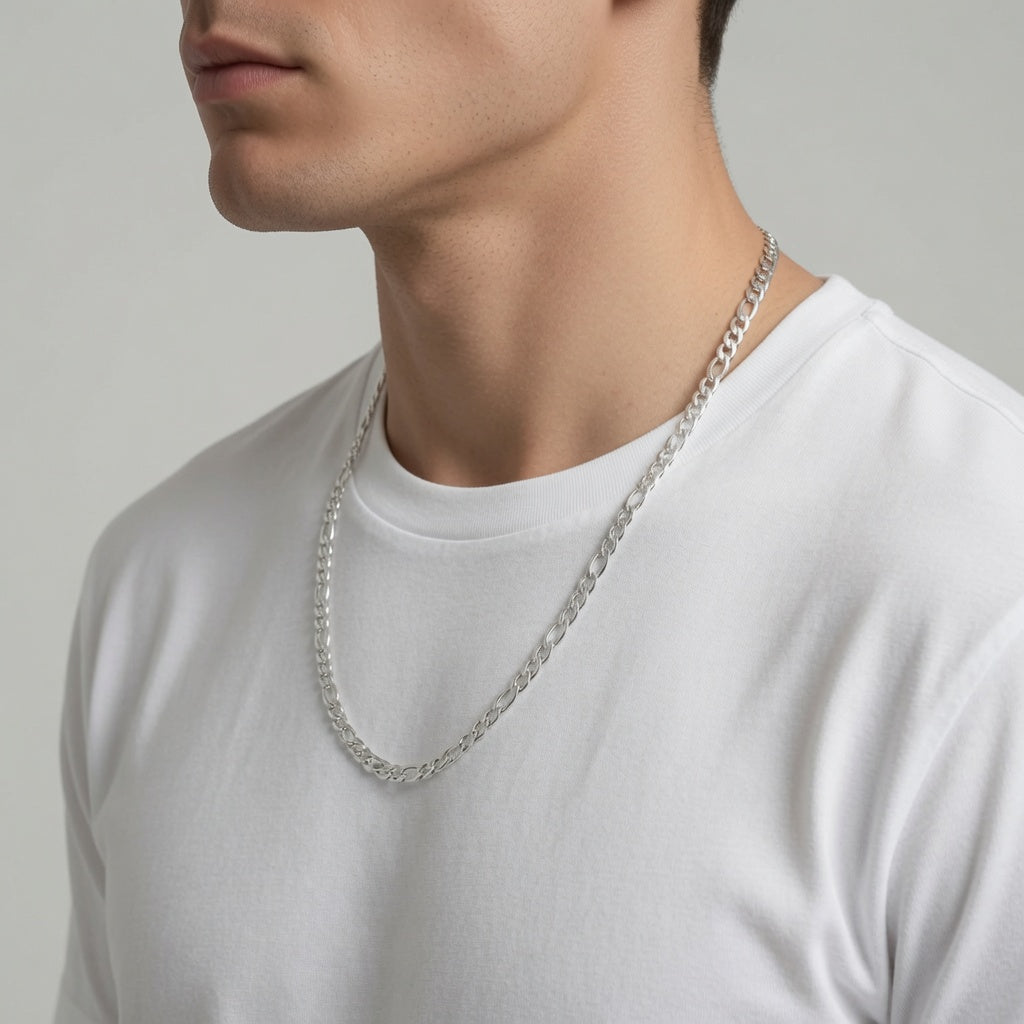
Here’s where buyers need to slow down, though. The label “Italian” or “925 Italy” stamped on a chain frequently signals a style, not a stricter purity standard or even confirmed origin. Comparisons of Italian silver against standard 925 point out that plenty of “Italian-style” pieces are manufactured elsewhere entirely, using the same 92.5% alloy and the same diamond-cut techniques, then sold under an Italian-sounding description because that’s what the market expects to see. It’s the jewellery equivalent of calling a garment an “Italian-cut suit.” Sometimes it genuinely was cut in Italy. Often it just means the styling follows that tradition.
None of this means Italian-made pieces aren’t worth the money. When a chain genuinely comes from an established Italian workshop with hand-finished links and tight tolerance control, that craftsmanship justifies a premium. The issue is that a stamp alone can’t tell you which situation you’re in.
Where the premium is genuinely earned:
- Consistent, tight link tolerance across the entire chain length (no visibly uneven gaps).
- A true mirror finish that holds up under close inspection, not just a quick buff.
- Verifiable maker or workshop provenance, not just a country name on a listing.
Pro Tip: Hold the chain at an angle under a bright light. Genuine diamond-cut faces reflect in tight, uniform flashes along the whole length. If the sparkle is patchy or the link shapes vary noticeably, you’re likely looking at a mass-produced piece wearing an Italian label rather than true Italian craftsmanship. One detail worth knowing: thin, heavily diamond-cut chains show wear on those cut faces faster than plain-finished links of the same gauge, simply because there’s less metal at each faceted point.
Which lasts longer: solid or hollow construction?
This is the single biggest factor in how long a chain survives, and it has almost nothing to do with which country made it. Solid chains are formed from wire with no internal cavity, so a bent or kinked link can be reshaped, resoldered, or repaired by a jeweller. Hollow chains are made from thin, folded metal tubing to save weight and cost. They look identical to solid chains at a glance and can even carry the same 925 stamp, but a hollow link that gets crushed usually stays crushed. There’s no metal underneath to push back into shape.
Comparing solid and hollow sterling silver construction makes the practical case plainly: hollow chains suit occasional, careful wear, while solid chains suit daily use where knocks and snags are inevitable. Weight is your quickest clue here. A hollow chain of a given link size will always weigh noticeably less than a solid chain of the same dimensions, because there’s simply less metal in it.
Soldering quality matters almost as much as the solid/hollow question. Poorly soldered links create weak points that stretch or open under tension, particularly at the clasp junction, which takes the most repeated stress of any point on the chain. A clasp weight-matched to the chain reduces the odds of that junction becoming the failure point.
Practitioners in the trade will tell you, off the record more often than in marketing copy, that construction beats country of origin every time when it comes to predicting how long a chain survives daily wear. A beautifully finished hollow Italian-style chain can fail within a year of regular use. A plainer, solid British curb chain can outlast it by a decade.
Pro Tip: Before buying, gently squeeze a link between your fingers, if you can handle the item in person. Solid links have almost no give. Hollow links feel slightly springy or can dent under moderate pressure. Online, ask for the exact weight in grams for the length you want; a suspiciously light chain for its stated dimensions is almost always hollow.
How to verify authenticity and spot fakes
Before you commit to any chain, whether it’s marketed as British-made or Italian-finished, run through a short verification checklist. This matters more with online purchases, where you can’t handle the piece before paying.
What a trustworthy seller should show you:
- A visible hallmark or, for smaller items exempt from mandatory hallmarking, a clear maker’s mark and country-of-origin statement.
- The exact weight in grams for the specific length and gauge you’re ordering.
- Clear product photography showing the clasp mechanism and link construction up close, not just a styled lifestyle shot.
- Willingness to provide an assay certificate or equivalent documentation if provenance is part of their sales pitch.
Red flags that should make you walk away:
- No hallmark and no explanation for its absence.
- A price that seems too low for the stated weight and gauge, a classic sign of hollow construction sold as solid.
- Vague or evasive answers about returns, repairs, or where the chain was actually assayed.
- Stock photography that never shows the clasp or link profile in detail.
Running through practical authenticity checks before purchase catches most problems before money changes hands. One warning worth taking seriously: don’t rely on DIY acid or magnet tests at home. Acid testing damages the piece, magnet tests only rule out ferrous fakes and tell you nothing about actual purity, and neither replaces a proper hallmark or assay certificate. If you genuinely need to confirm a suspect piece, an independent Assay Office assessment is the reliable route, not a kitchen chemistry experiment.
What to ask before buying a UK or Italian silver chain
Treat the purchase like you would any considered spend. A few direct questions to the seller will expose most of the issues covered so far, well before you’ve handed over any money.
| Question to ask | Why it matters | What a good answer sounds like |
|---|---|---|
| Is this hallmarked, and by which Assay Office? | Confirms independent purity verification | Names London, Birmingham, Sheffield, or Edinburgh specifically |
| Solid or hollow construction? | Determines durability and repairability | A direct, unambiguous answer, backed by the stated weight |
| What’s the exact weight in grams? | Weight versus dimensions reveals hollow construction | A specific figure per length, not a vague range |
| What’s your repair or returns policy? | Signals confidence in the product and buyer protection | Clear, written terms with a UK contact point |
On price, expect a hallmarked, solid 925 curb or Figaro chain from a UK retailer to sit meaningfully above mass-produced, unhallmarked “Italian-style” imports of similar appearance. That gap reflects the metal weight (solid chains use more silver) plus the cost of hallmark testing. It isn’t padding. A chain priced suspiciously close to costume jewellery, despite claiming solid 925 construction, is the clearest red flag on this entire list.
Pro Tip: If you’re choosing between two similar-looking chains and one is notably cheaper, ask both sellers for the weight in grams before comparing prices per pound. Price per gram is a far more honest comparison than sticker price alone.
How do you keep a silver chain looking new?
Sterling silver tarnishes through normal exposure to air and skin oils, not through any fault in manufacturing, so care routines matter regardless of where the chain came from.
- Wipe the chain with a soft, lint-free cloth after each wear to remove skin oils and moisture before storing it.
- Store it in an anti-tarnish pouch or a sealed bag, away from direct light and humidity.
- Clean tarnish buildup with a proper silver cleaning cloth or a mild, jeweller-approved solution rather than household abrasives.
- Reserve professional polishing for occasional deeper restoration, not routine upkeep.
Following proper sterling silver cleaning practice keeps a chain looking sharp for years rather than months.
What to avoid wearing your chain around:
- Swimming pools and hot tubs, where chlorine accelerates tarnishing and can pit the surface.
- Perfume and hairspray applied directly onto the chain rather than beforehand.
- Prolonged sweat exposure during exercise without a rinse and dry afterwards.
Pro Tip: Diamond-cut Italian-style finishes lose their sparkle if over-polished, because each polish pass removes a microscopic layer of metal, and those faceted cuts are shallow to begin with. Stick to soft-cloth wipes for these finishes and save chemical polish for plain-link chains where the metal loss matters less.
Warranty and aftercare: UK versus Italian manufacturers
This is where the practical gap between the two markets shows up most clearly, and it rarely gets the attention purity does. UK retailers selling hallmarked chains typically operate under UK consumer protection law, which gives buyers clear statutory rights on faulty goods, alongside whatever additional warranty the retailer offers on top. Returns go to a domestic address, repairs can often be assessed by post or in person without customs paperwork, and complaints have a clear regulatory backstop if a seller doesn’t cooperate.
Chains imported from or manufactured in Italy, particularly when bought through third-party marketplaces rather than a dedicated Italian jeweller with UK distribution, often carry warranty terms that are harder to action from the UK. Shipping a piece back for repair can mean international postage costs and longer turnaround, and the consumer protections that apply depend on exactly who you bought from and where they’re legally based, not simply where the chain was made.
None of this means a genuine Italian workshop piece comes with worse craftsmanship. It means the service wrapped around the purchase, repairs, replacement clasps, warranty claims, tends to be faster and simpler when the seller and the buyer are both operating under the same jurisdiction. For a chain you intend to wear daily for years, that aftercare pathway is worth weighing alongside the finish itself.
Publisher perspective: why we lean towards hallmarked British solid 925
We tend to recommend a hallmarked, solid British 925 chain to most UK customers, and it’s not because Italian craftsmanship is inferior. It’s because most people buying a chain want to put it on and forget about it, and that use case rewards verified purity, easy repairs, and a warranty you can actually action without international shipping. The gap between “beautiful finish” and “chain that survives a decade of daily wear” is almost entirely a construction and provenance question, not a country-of-origin one.
Working within the UK silver trade, the pattern that comes up again and again is repair requests. A hollow chain that’s been crushed at the clasp junction, bought cheaply and labelled “925 Italy” with no further documentation, usually can’t be saved. A solid hallmarked chain with the same damage goes to a jeweller, gets resoldered, and comes back looking new. That difference in outcome, not the country stamped on the box, is what should drive the decision for most buyers.
There’s a genuine exception worth stating plainly: if what you actually want is a specific decorative finish, a diamond-cut mariner link with that particular Italian sparkle, and you understand you’re trading some repairability for it, that’s a legitimate, style-led choice and not a mistake.
If you want a hallmarked UK option, here’s where to look
Britishchains sells exactly the chain this article argues for: solid, hallmarked 925 sterling silver, made to be worn daily and repaired when it needs it, not replaced. Every piece carries genuine UK hallmarking, so you’re not relying on a stamp alone to know what you’re wearing.
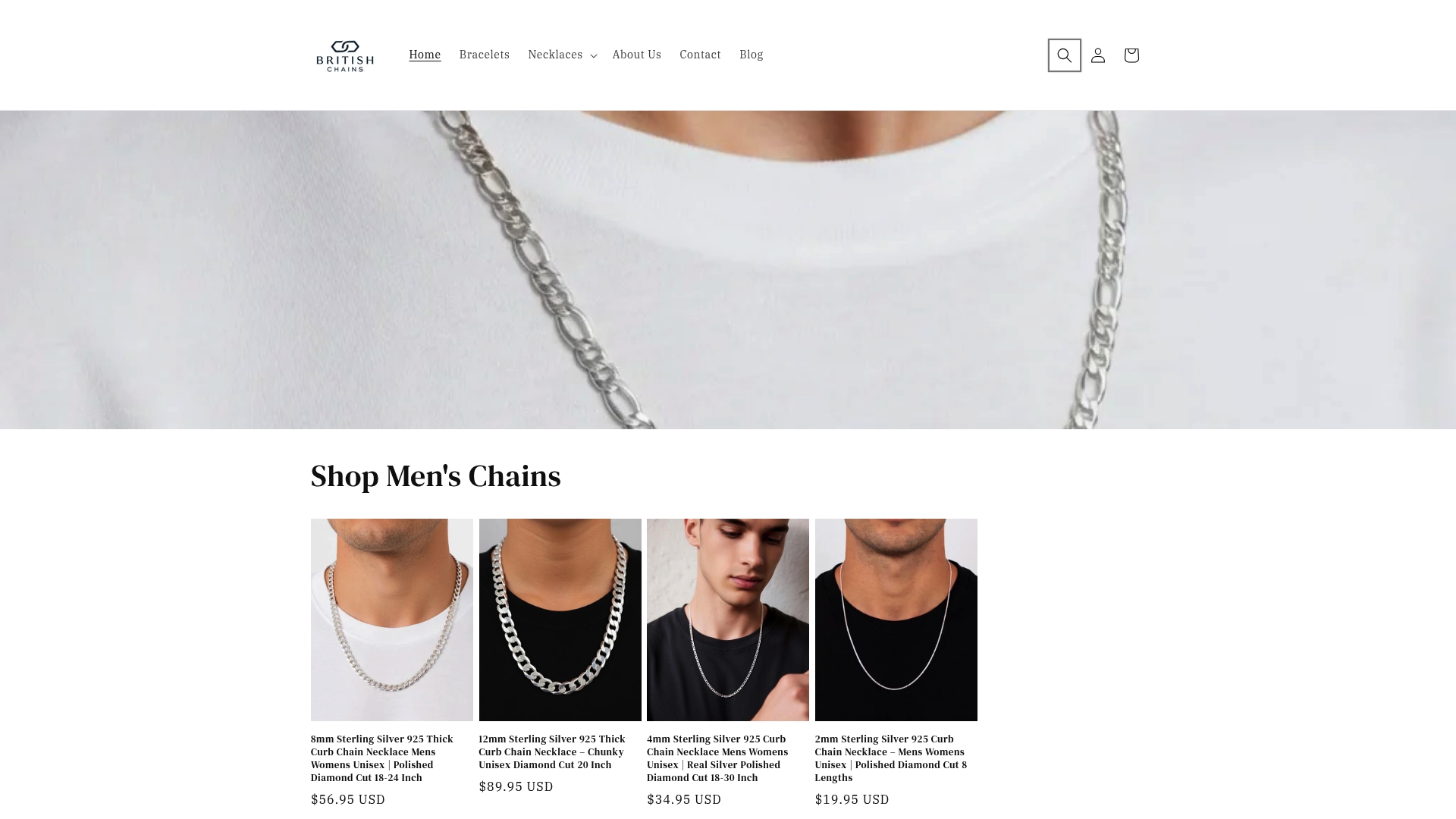
If durability and everyday wear are your priority, the 8mm thick curb chain in solid 925 ticks every box from the buying checklist above: solid construction, diamond-cut polish, and full hallmarking. Want something bolder still? The 12mm chunky curb chain offers the same solid, repairable build in a heavier gauge. If you prefer the finer, Italian-inspired look without giving up UK hallmarking, the 2mm Figaro chain delivers that diamond-cut shine on a verified British piece.
Browse the collection, check the hallmark details listed on each product page, and pick the gauge that matches how you’ll actually wear it.
Frequently asked questions
Is Italian silver better quality than UK silver? Not in terms of purity. Both use the 925 sterling standard. Italian workshops have a strong reputation for diamond-cut and mirror-polish finishing, but a UK hallmarked chain offers stronger, independently verified provenance and typically easier repairs.
What does a “925 Italy” stamp actually mean? It’s not the same as a legally verified UK hallmark, and it doesn’t independently confirm where the piece was actually made.
Which is more durable, a UK or Italian silver chain? Durability comes down to solid versus hollow construction, not country of origin. A solid chain from either market will outlast a hollow one, and solid chains can be professionally repaired if damaged.
How can I tell if a silver chain is genuinely hallmarked? Look for a small cluster of stamps near the clasp: a sponsor’s mark, an assay office town mark, and the 925 fineness mark. If you can’t see these, ask the seller directly which Assay Office tested the piece.
Are Italian silver chains worth the extra cost? When the premium reflects genuine hand-finishing and verified workshop provenance, yes. When it simply reflects a marketing label on a mass-produced piece, no. Ask for specifics rather than trusting the description alone.
Sources
For independent confirmation beyond any seller’s word, these are the bodies and resources worth knowing:
- Gov


