

Budget silver jewellery quality checklist: UK buyer's guide
Buying sterling silver on a budget does not mean settling for something that turns your wrist green by Thursday. The difference between a piece that lasts years and one that flakes within weeks usually comes down to a handful of checks any buyer can make before spending a penny. Here is the core budget silver jewelry quality checklist to run through every time:
- Hallmark present? Look for the ‘925’ fineness mark plus the Assay Office mark and sponsor’s mark on any piece exceeding the UK hallmarking weight threshold.
- Magnet test: Real silver is non-magnetic. A strong pull means base metal underneath.
- Weight and sound: Genuine sterling silver feels substantial. Tap it lightly; solid silver rings with a clear, sustained tone.
- Tarnish pattern: Authentic silver tarnishes to a grey-black patina over time. Bright orange or copper tones at edges suggest plating.
- Craftsmanship: Smooth edges, sharp detailing, and sturdy clasps indicate quality construction.
- Seller credentials: Check reviews, return policies, and whether the listing explicitly states ‘925 sterling silver’ with hallmark confirmation.
- Price sense: If the price is dramatically below market rate for sterling silver, treat it as a warning sign.
Table of Contents
- ## 1. What UK hallmarking laws actually tell you about silver authenticity
- ## 2. Practical at-home tests to spot genuine sterling silver
- ## 3. How to read craftsmanship quality in a silver piece
- ## 4. Sterling silver 925 versus fine silver 999: which holds up better?
- ## 5. How to research sellers and prices to avoid silver jewellery scams
- ## 6. What Britishchains’s approach tells you about buying silver safely in the UK
- ## 7. How to assess gemstone quality in silver jewellery
- ## 8. How to negotiate price without accepting lower quality
- Key takeaways
- Britishchains: hallmarked sterling silver built for everyday wear
## 1. What UK hallmarking laws actually tell you about silver authenticity
UK law mandates that any silver item weighing more than 7.78 grams must carry at least three compulsory hallmarks before it can legally be sold as silver: the sponsor’s mark (identifying the maker or importer), the fineness mark (the numerical purity standard), and the Assay Office mark (confirming which independent body tested it).
This matters because you cannot tell silver purity by sight or touch. The alloy looks the same whether it is 92.5% silver or 40%. The hallmark is the only independent guarantee, which is why UK Trading Standards treats it as the definitive proof of purity rather than any seller’s description.
The four UK Assay Offices and their marks:
| Assay Office | Location | Mark |
|---|---|---|
| London | London | Leopard’s head |
| Birmingham | Birmingham | Anchor |
| Edinburgh | Edinburgh | Castle |
| Sheffield | Sheffield | York Rose |
For sterling silver specifically, the fineness mark reads ‘925’. The Hallmarking Act 1973 also recognises ‘958’ (Britannia silver) and ‘999’ (fine silver) as legal standards. Selling an unhallmarked silver item over the weight threshold is a criminal offence, so a legitimate UK retailer will always be able to confirm hallmarking.
Pro Tip: Use a jeweller’s loupe or even a smartphone macro lens to read hallmarks clearly. Stamps on budget pieces can be small and worn; if you cannot read them at all, that itself is a red flag.
One important caveat: the ‘925’ stamp alone can be faked. A complete, authentic hallmark set including the Assay Office mark is far harder to replicate convincingly than a single number stamp.
## 2. Practical at-home tests to spot genuine sterling silver
No single home test is conclusive, but running several together builds a reliable picture. Think of them as a shortlist of clues rather than a verdict.
- Magnet test: Hold a strong neodymium magnet near the piece. Genuine silver is diamagnetic, meaning it shows no attraction. A firm pull indicates iron or steel underneath. A slight drag without attraction can occur with some base metals too, so combine this with other checks.
- Ice test: Silver has exceptionally high thermal conductivity. Place an ice cube on the piece; it should melt noticeably faster than on a glass surface. This is a secondary indicator, not proof.
- Ping test: Drop the piece gently onto a hard surface or tap it with a fingernail. Solid sterling silver produces a clear, bell-like ring that sustains for a moment. A dull thud suggests hollow construction or base metal.
- Tarnish inspection: Check clasps, inner links, and any worn edges. Copper or brassy tones at these points indicate silver plating wearing through, not solid sterling.
- Cloth rub: Rub the piece firmly with a white polishing cloth. Genuine silver leaves a faint black residue as surface oxidation transfers. No residue at all can suggest heavy plating or a non-silver metal.
- Weight check: Sterling silver is dense. A chain that feels surprisingly light for its size is worth scrutinising further.
At-home tests like these give useful clues but cannot replace hallmark verification or professional XRF analysis for certainty. If you are spending a meaningful sum, an assay office or a reputable jeweller can confirm purity definitively.
## 3. How to read craftsmanship quality in a silver piece
Good craftsmanship is not just about aesthetics. On a chain or necklace, it directly affects how long the piece holds together under daily wear.
- Link consistency: Each link should be uniform in size and shape. Irregular or misshapen links indicate rushed production and create weak points where the chain is likely to break.
- Edge finishing: Run your finger along the edges of links and clasps. Smooth, rounded edges indicate proper finishing. Sharp or rough edges suggest cost-cutting at the polishing stage.
- Clasp construction: The clasp takes more mechanical stress than any other part of a necklace. Test the spring action; it should engage firmly and release cleanly without wobbling.
- Diamond-cut detailing: On chains like rope or curb styles, diamond-cut facets should be sharp and consistent across the full length. Blurring or inconsistency in the cut pattern suggests lower-grade tooling.
- Solder points: Where links are closed or components joined, look for clean, flush solder. Visible blobs or gaps are signs of poor assembly that will fail under tension.
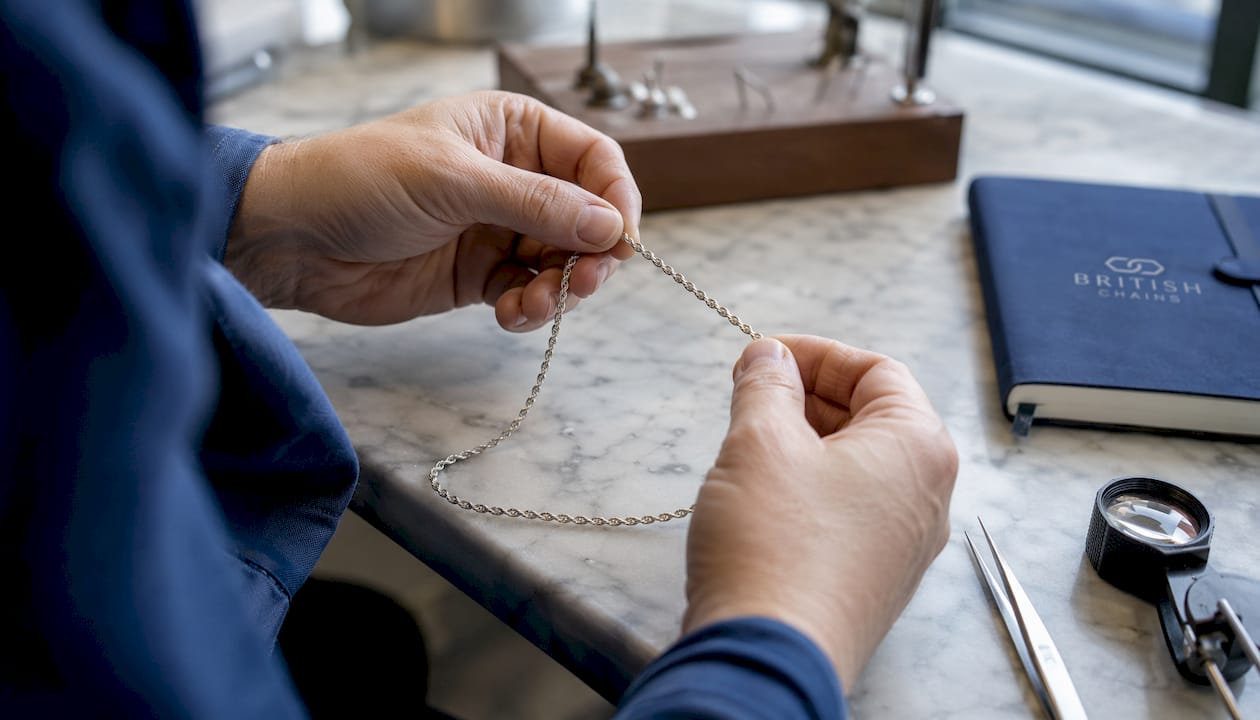
Pro Tip: On rope chains specifically, twist the chain gently. The twist pattern should remain consistent along the entire length. Any section that looks looser or tighter than the rest has been assembled unevenly.
Careful inspection for brassy or copper tones at edges and clasps is one of the most reliable ways to detect plating rather than solid sterling, even on pieces that carry a ‘925’ stamp.
## 4. Sterling silver 925 versus fine silver 999: which holds up better?
The differences between silver jewellery grades come down to one fundamental trade-off: purity versus durability.
- Sterling silver (925): 92.5% pure silver alloyed with 7.5% copper. The copper gives it the hardness needed for chains, clasps, and rings that take daily mechanical stress. Sterling silver is approximately ten times harder than fine silver, which is why it dominates commercial jewellery.
- Fine silver (999): 99.9% pure silver with almost no alloying metals. Brighter, whiter lustre and significantly more tarnish-resistant because there is almost no copper to react with sulphur in the air. However, it is soft enough to bend, dent, and lose shape under regular wear.
- Tarnish behaviour: Sterling silver tarnishes more readily because of its copper content. Fine silver stays bright longer but is not immune. Neither tarnishes as quickly as silver-plated jewellery.
- Practical use: For chains, bracelets, and clasps, sterling silver is the correct choice. Fine silver suits low-stress decorative pieces, enamel work, and artisan rings where softness aids shaping.
- Britannia silver (958): A third standard recognised under UK law. Higher silver content than sterling but behaves closer to fine silver at thin edges and stressed fittings. Less common in everyday jewellery.
Higher purity is not automatically better for jewellery quality. A 925 hallmark on a well-constructed chain tells you more about long-term wearability than a 999 mark on a piece too soft for its purpose.
## 5. How to research sellers and prices to avoid silver jewellery scams
Price is the first filter. Genuine sterling silver has a commodity cost floor; a chain selling for a fraction of what comparable pieces cost elsewhere is almost certainly silver-plated or base metal entirely.
- Check for explicit hallmark confirmation: Legitimate listings state ‘925 sterling silver’ and confirm UK hallmarking. Vague descriptions like ‘silver-tone’ or ‘silver-coloured’ are not silver at all.
- Read reviews critically: Look for mentions of tarnishing within weeks, discolouration, or allergic reactions. These are consistent signs of plated or base-metal pieces being sold as silver.
- Understand EPNS: Electroplated Nickel Silver contains no solid silver content whatsoever. The thin silver layer wears away quickly, and the piece has negligible resale value. EPNS items cannot legally be described as silver in the UK.
- Verify return policies: A seller confident in their product offers straightforward returns. Restrictive or absent return policies on silver jewellery are a consistent marker of low-quality stock.
- Cross-reference pricing: Check the current spot price of silver and consider the weight of the piece. A 10g sterling silver chain has a material cost you can calculate; anything priced far below that warrants scrutiny.
- Avoid unverified marketplaces: When buying authentic sterling silver online, prefer retailers who publish hallmark details, product weights, and clear photographs of the actual marks.
## 6. What Britishchains’s approach tells you about buying silver safely in the UK
Britishchains operates from a straightforward position: every piece it sells is hallmarked sterling silver 925, crafted to meet UK legal standards, and described with the specificity a buyer needs to make an informed decision. That means product listings include chain width, length options, weight, and explicit hallmark confirmation rather than vague ‘silver-coloured’ language.
From a practical standpoint, this is what quality British silver jewellery should look like at the point of sale. The hallmark is not a marketing claim; it is a legal certification from an independent Assay Office. Britishchains’s focus on diamond-cut rope and curb chains reflects the craftsmanship standard that makes the hallmark meaningful: consistent link construction, sharp faceting, and clasps built to last rather than to photograph well.
For UK buyers, the practical shopping tips are these: always request or confirm the Assay Office mark alongside the ‘925’ stamp, check that the seller’s return policy is unconditional for hallmarking disputes, and treat any listing that cannot confirm the full three-mark hallmark set as unverified.
## 7. How to assess gemstone quality in silver jewellery
When a silver piece includes stones, the gemstone setting adds another layer to evaluate. A well-set stone in a sterling silver mount should feel secure with no movement when you press it gently. Any rocking or clicking suggests the bezel or prong setting was not closed properly, and the stone will eventually fall out.
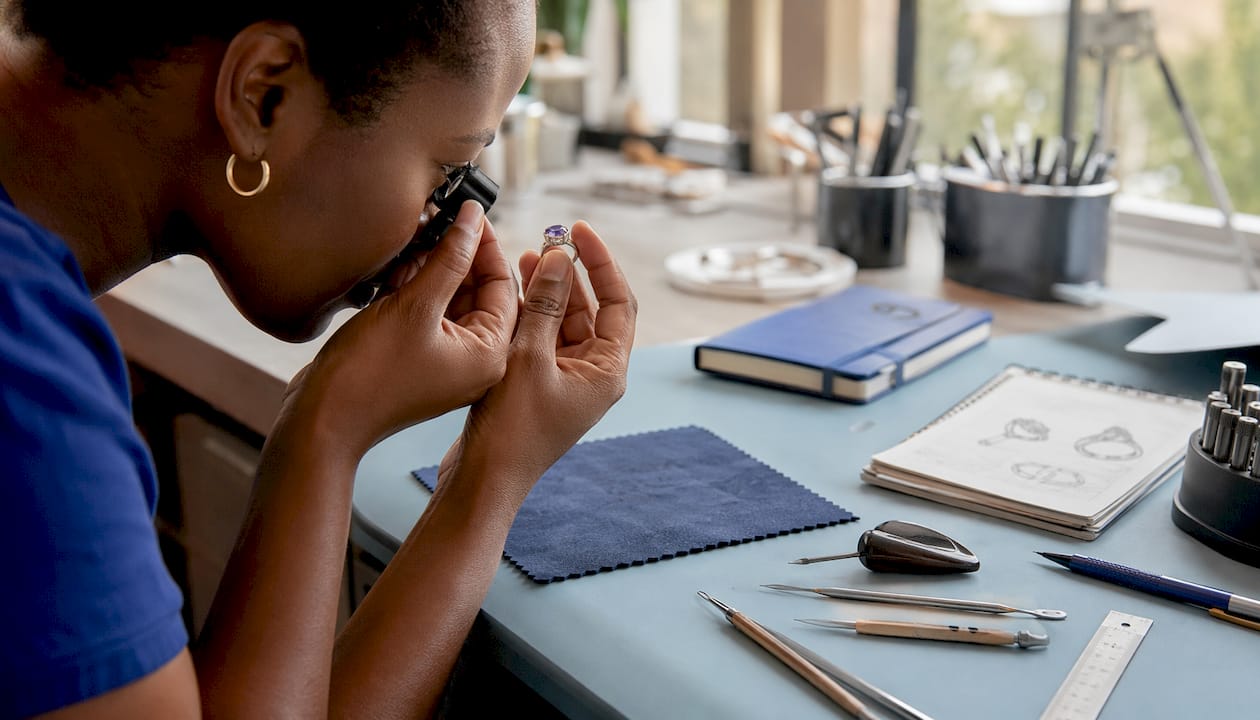
Check the stone’s surface for scratches, chips, or cloudiness. Genuine semi-precious stones like amethyst, blue topaz, or garnet have a depth and clarity that glass imitations lack under direct light. Glass tends to show surface scratches more readily and often has small bubbles visible under magnification.
For pieces marketed as containing cubic zirconia, that is an honest description of a synthetic stone and not inherently a problem. The issue arises when listings imply genuine gemstones without stating the material. Always check the product description for explicit stone identification. If it reads ‘crystal’ or ‘stone’ without naming the material, ask before buying.
Silver-tone settings that show goth or alternative aesthetic styling often pair darker stones like onyx or marcasite with sterling silver mounts. The same setting quality rules apply regardless of style.
## 8. How to negotiate price without accepting lower quality
Negotiating on silver jewellery does not mean pushing a seller to cut corners. The goal is to get fair value at the right price, not to extract a discount that only makes sense if the piece is not what it claims to be.
Ask about bundle pricing first. Many sterling silver retailers will offer a modest reduction when you buy two or more pieces, particularly for chains in different lengths or widths. This is a straightforward way to reduce the per-piece cost without touching the quality of any individual item.
Timing matters more than most buyers realise. Post-Christmas and post-Valentine’s Day periods typically see genuine reductions on sterling silver stock as retailers clear inventory. These are not clearance sales of inferior pieces; they are standard retail cycles. Buying a budget silver jewellery gift outside peak gifting seasons can save a meaningful amount on the same hallmarked piece.
Never negotiate by questioning the hallmark as a bargaining tactic. If you genuinely doubt the hallmark, that is a reason to walk away, not a lever for a discount. A seller who reduces the price in response to hallmark doubts is either confirming your suspicion or selling under pressure they should not be under.
Key takeaways
Hallmarked sterling silver 925 is the only legally verified standard for silver jewellery in the UK, and checking for the complete three-mark hallmark set is the single most reliable step any budget buyer can take.
| Point | Details |
|---|---|
| Hallmark is the baseline | UK law requires three marks on silver over 7.78g; the Assay Office mark confirms independent verification. |
| At-home tests are secondary | Magnet, ping, and tarnish checks build a picture but cannot replace a verified hallmark or XRF analysis. |
| 925 outperforms 999 for daily wear | Sterling silver is approximately ten times harder than fine silver, making it the practical choice for chains and clasps. |
| Plating is not silver | EPNS and silver-plated items carry no solid silver content and cannot legally be described as silver in the UK. |
| Britishchains | Every piece is hallmarked 925 sterling silver with explicit product details, making it a straightforward choice for UK buyers applying this checklist. |
Britishchains: hallmarked sterling silver built for everyday wear
If you have worked through this checklist and want a starting point that already ticks every box, Britishchains sells hallmarked 925 sterling silver chains with the product detail that budget buyers actually need: stated weight, confirmed Assay Office hallmarking, and clear length options.
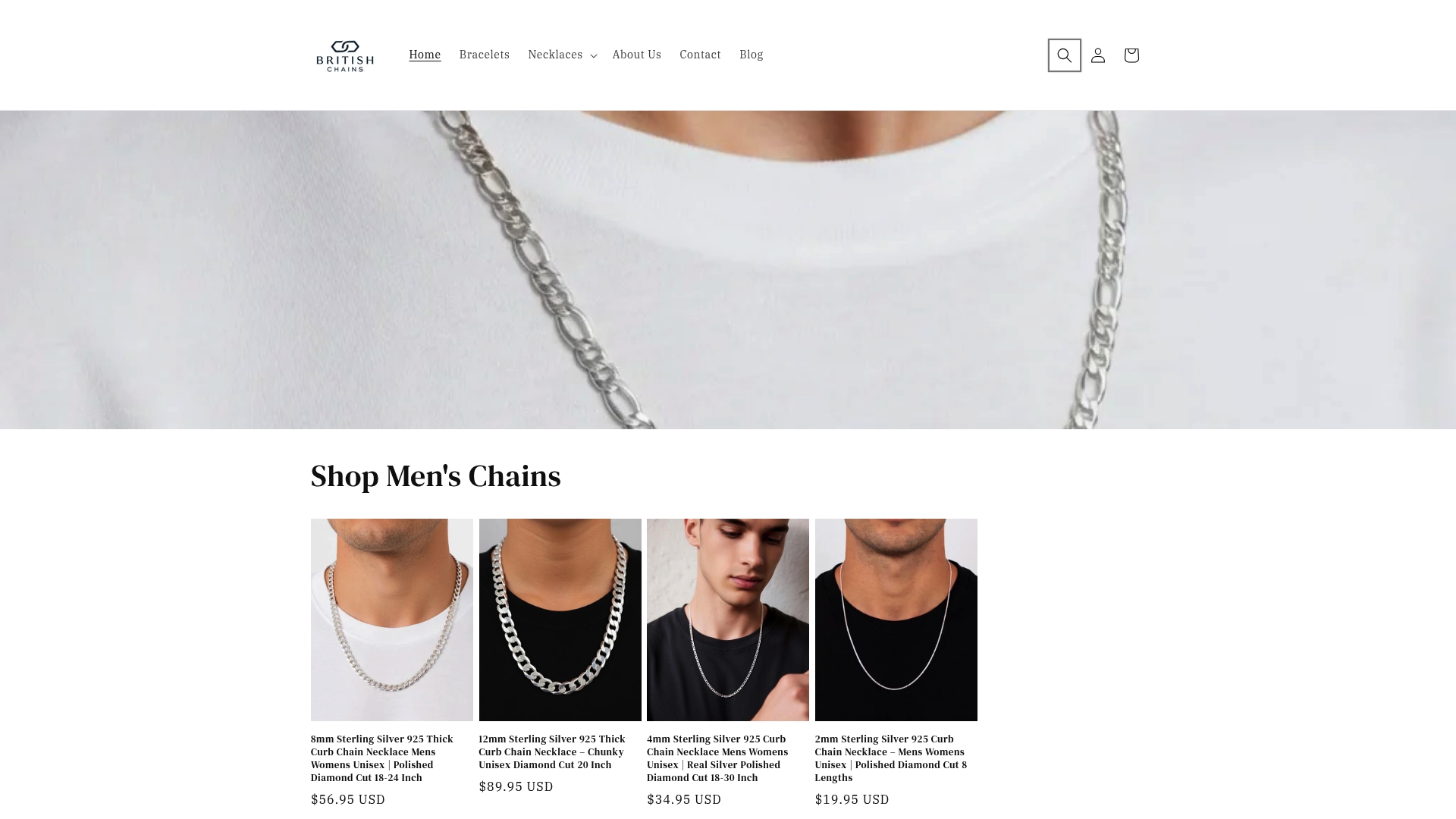
The 3mm diamond-cut twisted rope chain is a clean entry point: lightweight enough for everyday wear, with sharp faceting that holds its finish. Step up to the 4mm rope chain for more presence without moving into heavy territory. For buyers who want something with genuine weight and visual impact, the 8mm thick curb chain delivers polished diamond-cut sterling silver in a substantial format available from 18 to 24 inches. All three are unisex, all three are hallmarked, and all three come with the product transparency this checklist demands. Browse the full range at britishchains.com and buy with the confidence that the hallmark is already confirmed.


