

How jewellery pricing transparency works for UK buyers
Pricing transparency in jewellery means one thing: an itemised, auditable breakdown of what you are paying for — metal, stones, making charges, overhead and margin — backed by verifiable sourcing and certification. If a seller cannot show you those components separately, you are buying on faith. The practical first step is to ask for an itemised breakdown and, for any piece containing significant gemstones, a grading certificate from a recognised laboratory such as the Gemological Institute of America (GIA).
The trust signals that matter most before you buy:
- Itemised price breakdown showing metal weight, purity and the spot rate used
- Hallmark number and assay office mark (Birmingham Assay Office, Edinburgh, London or Sheffield)
- Independent gemstone grading report with a lab name and report number (GIA or equivalent)
- Origin or chain-of-custody statement, ideally backed by Responsible Jewellery Council (RJC) membership or Kimberley Process certification
- Clear returns, repair and buyback policy in writing
TL;DR: Ask for a written price breakdown and certificate numbers before you pay. If the seller cannot provide them, the price is not transparent — it is a guess dressed as a quote.
Table of Contents
- How does jewellery pricing actually work? The components explained
- Why supply-chain traceability affects both price and trust
- What does a transparent jewellery business actually look like?
- Why some brands do not fully disclose — and what is reasonable
- How to read a price breakdown: a UK buyer checklist
- Sterling silver in the UK: hallmarks, 925 purity and what Britishchains shows you
- Key takeaways
- Why transparency benefits sellers as much as buyers
- Britishchains: hallmarked sterling silver with the details shown
- Authoritative sources and further reading
How does jewellery pricing actually work? The components explained
Every jewellery price is built from the same basic formula: materials plus labour plus overhead plus margin. The proportions shift dramatically depending on the piece, but the components are always there, whether or not the seller shows them to you.
Metal value is calculated as weight (in grams) multiplied by purity multiplied by the live spot price. A sterling silver chain weighing 15 grams at 92.5% purity is priced against the silver spot rate on the day of manufacture or sale. That rate moves daily, which is why a transparent seller will either state the rate used or offer a live-price guarantee. The jewellery pricing formula every maker works from starts here: materials by gram, then everything else stacks on top.
Gemstones are priced by the 4Cs (cut, colour, clarity, carat weight) for diamonds, or by type, origin and treatment status for coloured stones. A 0.5ct VS1 round brilliant diamond and a 0.5ct heavily included stone of the same carat weight can differ by thousands of pounds. Without a grading report, you cannot verify which you have.
Labour and making charges cover the hours of skilled work to fabricate, set and finish the piece. For a plain sterling silver curb chain, labour is a modest share of the total. For a pavé diamond ring with hand-milgrained edges, it can exceed the metal cost. Handcrafted silver costs more for exactly this reason: small-batch production and skilled finishing cannot be priced like machine-stamped output.
Overhead, design and retail margin complete the picture. Overhead includes insurance, photography, website costs, packaging and rent. Design and development costs are real for original pieces. Retail margin is the business’s operating profit. According to pricing guidance from ANTOANETTA, typical component shares look roughly like this:
| Component | Typical share of retail price |
|---|---|
| Materials (metal + stones) | 30–50% |
| Labour / making charges | 20–40% |
| Overhead | 10–20% |
| Retail margin | 10–30% |
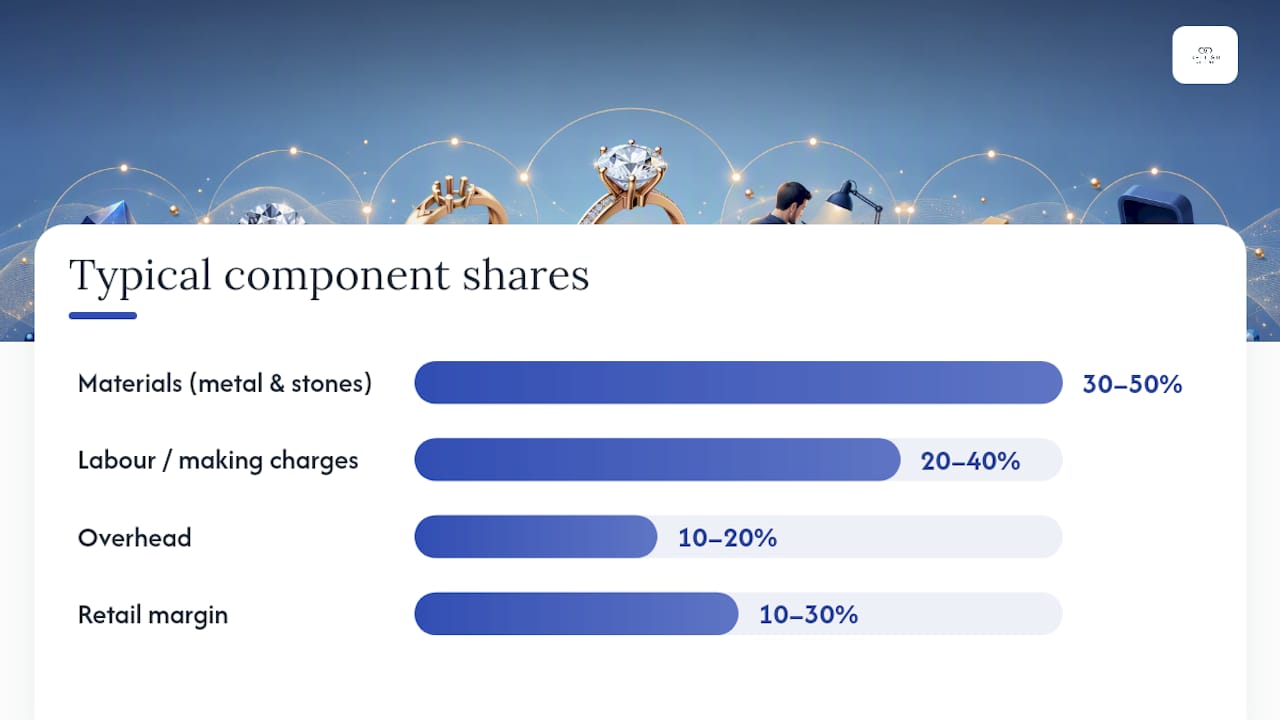
These ranges shift by product type. A plain gold wedding band sits at the high end for materials and the low end for labour. A pavé diamond ring flips that: stones dominate, labour is significant, and materials as a percentage of the total can look deceptively low. A sterling silver chain sits somewhere in the middle, with metal and labour sharing the largest portions.
Pro Tip: When you receive an invoice, check that it states the metal weight in grams, the purity (925 for sterling silver, 750 for 18ct gold), and the stone details by carat weight and grade. If any of those fields are blank, ask for them in writing before you pay.
Why supply-chain traceability affects both price and trust
Traceability means being able to follow a material from its point of extraction through every stage of processing, fabrication and retail to the finished piece in your hand. Chain of custody is the documented record of that journey. Both cost money to maintain — audits, paperwork, certified suppliers — and that cost shows up in the price.
The OECD guidance on due diligence for responsible business conduct sets out what credible supply-chain due diligence looks like for companies operating across borders. For jewellery buyers, the practical implication is straightforward: a brand that has done the work will have documentation. One that has not will offer vague assurances instead.
Key standards and bodies to recognise:
- World Gold Council conflict-free gold standard: A framework that allows gold producers and refiners to demonstrate that their gold does not finance armed conflict. Retailers who source from compliant refiners can reference the conflict-free gold standard in their provenance statements.
- Extractive Industries Transparency Initiative (EITI): A global standard for how countries report revenues from oil, gas and mining. EITI is relevant to gold provenance because it governs how producing countries account for extraction — a useful background check when a brand claims a specific country of origin.
A provenance statement you might see in practice: “Our gold is sourced from LBMA-approved refiners who comply with the World Gold Council’s Responsible Gold Guidance.” That is a meaningful claim. “We use ethically sourced gold” with no further detail is not.
Recycled metal is increasingly common and carries its own premium. Recycled silver or gold avoids new mining entirely, but the recycled-metal claim should be backed by a supplier declaration or certification, not just a marketing line. The Global Reporting Initiative (GRI) provides disclosure standards that companies use to report these practices formally — a brand that references GRI in its sustainability reporting is at least working within a recognised framework.
As Human Rights Watch has documented, opaque supply chains in jewellery can conceal serious abuses. Provenance is not a luxury concern for high-end buyers only. Fashion Revolution has made the same argument for the broader accessories sector: consumer demand for traceability is what moves brands to invest in it.
Pro Tip: When provenance matters to you, ask specifically: “Can you provide a chain-of-custody declaration or recycled-metal certification for this piece?” A credible seller will have a document. A vague answer is itself informative.
What does a transparent jewellery business actually look like?
Positive signs are specific and verifiable. Vague ones are not.
Signs of a genuinely transparent seller:
- Invoices that itemise metal weight, purity, stone details and the rate basis used
- Visible hallmark numbers and the assay office mark on the product (or in product photography)
- Stone certificates with the issuing lab’s name and a report number you can verify online
- Published sourcing statements referencing named standards (RJC, Kimberley Process, World Gold Council)
- Clear, written returns, repair and buyback policies with specific timeframes
Red flags that warrant further questions:
- A “design charge” listed as a single line with no breakdown
- Inconsistent or absent hallmarking on pieces that should carry one under UK law
- No grading certificate for a diamond or coloured stone above a modest value
- Live metal price not disclosed or a price that does not move with spot rates
- Origin claims that cannot be traced to a named standard or certification body
The difference between a clear invoice and a bundled price is stark. A clear invoice reads: Sterling silver 925, 12.4g @ £0.52/g = £6.45; making charge £18.00; design £5.00; VAT £5.89; total £35.34. A bundled price reads: Silver necklace — £35. Both might be fair. Only one lets you check.
If you have concerns, ask for written confirmation of any verbal claim and request the certificate number to verify directly with the issuing laboratory. GIA report numbers can be checked at GIA’s online report check. RJC membership can be confirmed through the RJC member directory.
Why some brands do not fully disclose — and what is reasonable
Partial disclosure is not always dishonest. There are legitimate commercial and technical reasons why a brand might not publish every cost line.
Commercial reasons for limited disclosure:
- Supplier confidentiality agreements that prevent naming specific mines or refiners
- Competitive margins that a brand reasonably treats as proprietary
- Multi-tier supply chains where the brand itself does not have item-level data from every upstream supplier
- Contractual NDAs with manufacturing partners
Technical reasons:
- Mixed or alloyed metals where item-level traceability is genuinely difficult
- Aggregated stone lots purchased at auction, where individual stone provenance is not recorded
- Small artisan workshops that cannot afford the cost of RJC certification audits
Common Objective’s analysis of supply-chain transparency in jewellery identifies these barriers clearly: even well-intentioned brands face real structural limits, particularly at the artisan end of the market.
What is acceptable: a seller who shows metal weight and hallmark but does not disclose supplier invoices is being commercially reasonable. What is not acceptable: no hallmark at all on a piece that should carry one, or no grading report for a high-value diamond.
Pro Tip: Ask targeted questions rather than open-ended ones. “What is the metal weight and purity of this piece?” and “Which assay office hallmarked it?” are harder to deflect than “Can you tell me about your sourcing?” Specific questions separate reasonable commercial limits from deliberate obscurity.
How to read a price breakdown: a UK buyer checklist
Before you commit to a purchase, work through these steps in order.
- Confirm metal weight and purity. Ask for the weight in grams and the purity mark (925 for sterling silver, 750 for 18ct gold, 375 for 9ct gold). Cross-reference with the hallmark on the piece.
- Verify the hallmark and assay office. UK hallmarks include a maker’s mark, a standard mark (the purity), an assay office mark and a date letter. The Birmingham Assay Office uses an anchor symbol; London uses a leopard’s head. You can verify hallmark details through the UK Assay Offices’ online resources.
- Request stone report numbers. For any significant gemstone, ask for the grading report number and the issuing laboratory. GIA report numbers are verifiable at GIA’s report check portal. Equivalent labs include IGI and HRD Antwerp.
- Ask for RJC membership or third-party audit evidence. An RJC member number can be confirmed in the RJC public directory. If the seller claims ethical sourcing without any third-party backing, treat it as unverified.
- Confirm return, repair and buyback terms in writing. Under the Consumer Rights Act 2015, you have statutory rights, but a seller’s own policy may go further — or not. Know what you are agreeing to before you pay.
Questions to ask a seller — and what good answers look like:
- “What is the metal weight and purity of this piece?” Good answer: a specific figure in grams and a purity mark. Evasive answer: “It’s high quality silver.”
- “Which assay office hallmarked it?” Good answer: names the office and describes the mark. Evasive answer: “It’s hallmarked, don’t worry.”
- “Can I have the GIA or grading report number for the stone?” Good answer: provides a number you can verify. Evasive answer: “It’s a certified diamond.”
- “Are you an RJC member or do you have a third-party sourcing audit?” Good answer: provides a membership number or audit summary. Evasive answer: “We only work with ethical suppliers.”
- “What is your returns policy if the piece is not as described?” Good answer: specific timeframe and process. Evasive answer: “We deal with issues case by case.”
| Document to request | Where to verify independently |
|---|---|
| Hallmark details | UK Assay Offices (Birmingham, London, Edinburgh, Sheffield) |
| GIA grading report | GIA Report Check (gia.edu) |
| RJC membership | RJC member directory (responsiblejewellery.com) |
| Kimberley Process certificate | Ask for the KP certificate number from the supplier |
| Recycled-metal declaration | Request supplier certification document |
Sterling silver in the UK: hallmarks, 925 purity and what Britishchains shows you
British hallmarking law requires that any silver article above a certain weight sold as silver must be hallmarked by one of the four UK Assay Offices: Birmingham, London, Edinburgh or Sheffield. The 925 standard mark confirms that the metal is 92.5% pure silver — the definition of sterling silver. A full British hallmark punch includes four elements: the maker’s mark (the manufacturer’s registered symbol), the standard mark (925 in a shield for sterling), the assay office mark, and the date letter indicating the year of hallmarking.
Reading a hallmark correctly matters for buying authentic sterling silver online. The 925 mark alone, without an assay office mark, is not a full British hallmark — it may be a foreign import mark or a self-declaration. A genuine Birmingham Assay Office mark carries the anchor symbol alongside the 925 shield.
What a well-structured product page should show you:
- Metal weight in grams
- Purity stated as 925 sterling silver
- Hallmark description or photograph
- Chain style, dimensions and finish
- Care guidance and warranty or repair terms
Britishchains publishes this information on its product pages for hallmarked sterling silver chains, including weight, purity and care guidance — the kind of disclosure that lets you compare pieces on substance rather than marketing language. The brand’s blog covers long-term jewellery value and 925 silver authenticity checks, giving buyers the background to read those disclosures confidently.
Pro Tip: Photograph the hallmark on any piece you buy and save the image alongside your receipt and any certificate numbers. If you ever sell or repair the piece, that record removes any doubt about what you own.
- Confirm the 925 mark and assay office symbol are both present
- Check that the maker’s mark is registered (the assay office can confirm this)
- Save a photograph of the hallmark with your purchase records
- For online purchases, ask for a close-up hallmark image before you pay
Key takeaways
Jewellery pricing transparency requires an itemised breakdown, a verifiable hallmark, and documented sourcing — without all three, you cannot confirm what you are paying for or why.
| Point | Details |
|---|---|
| Ask for an itemised breakdown | Request metal weight, purity, stone details and making charges as separate line items. |
| Verify the hallmark | Confirm both the 925 standard mark and the assay office symbol; a 925 mark alone is not a full British hallmark. |
| Check stone certificates | For significant gemstones, request the GIA or equivalent report number and verify it independently online. |
| Prefer documented provenance | RJC membership, Kimberley Process certificates or recycled-metal declarations are verifiable; vague ethical claims are not. |
| Britishchains product pages | Britishchains publishes metal weight, 925 purity, hallmark details and care guidance on each sterling silver product page. |
Why transparency benefits sellers as much as buyers
The conventional view is that pricing transparency is something buyers demand and sellers reluctantly provide. That framing misses something. A seller who discloses the full breakdown — metal weight, making charges, margin — removes the most common source of post-sale disputes: the buyer who feels they overpaid once they learn more. Transparent pricing converts that potential grievance into a pre-sale conversation, which is far easier to manage.
For small ateliers and independent makers, transparency does something else: it justifies a premium. A maker who can show that their silver is hallmarked by the Birmingham Assay Office, their stones are GIA-graded, and their sourcing is RJC-audited has a concrete argument for charging more than a mass-market alternative. The price is not just a number — it is a claim, and the documentation is the proof. Buyers who understand that are also buyers who come back, refer others, and are less likely to return a piece on a whim.
The brands that resist transparency often do so because their margins would not survive the scrutiny. That is a different problem from the legitimate commercial limits discussed earlier, and buyers who ask specific questions will usually be able to tell the difference.
Britishchains: hallmarked sterling silver with the details shown
Britishchains sells direct to consumers, which removes the wholesale layer that typically obscures pricing in traditional retail. Every piece is hallmarked sterling silver, and product pages state the metal weight, 925 purity and chain specifications — the kind of concrete detail that lets you assess value for money in jewellery rather than guessing at it.
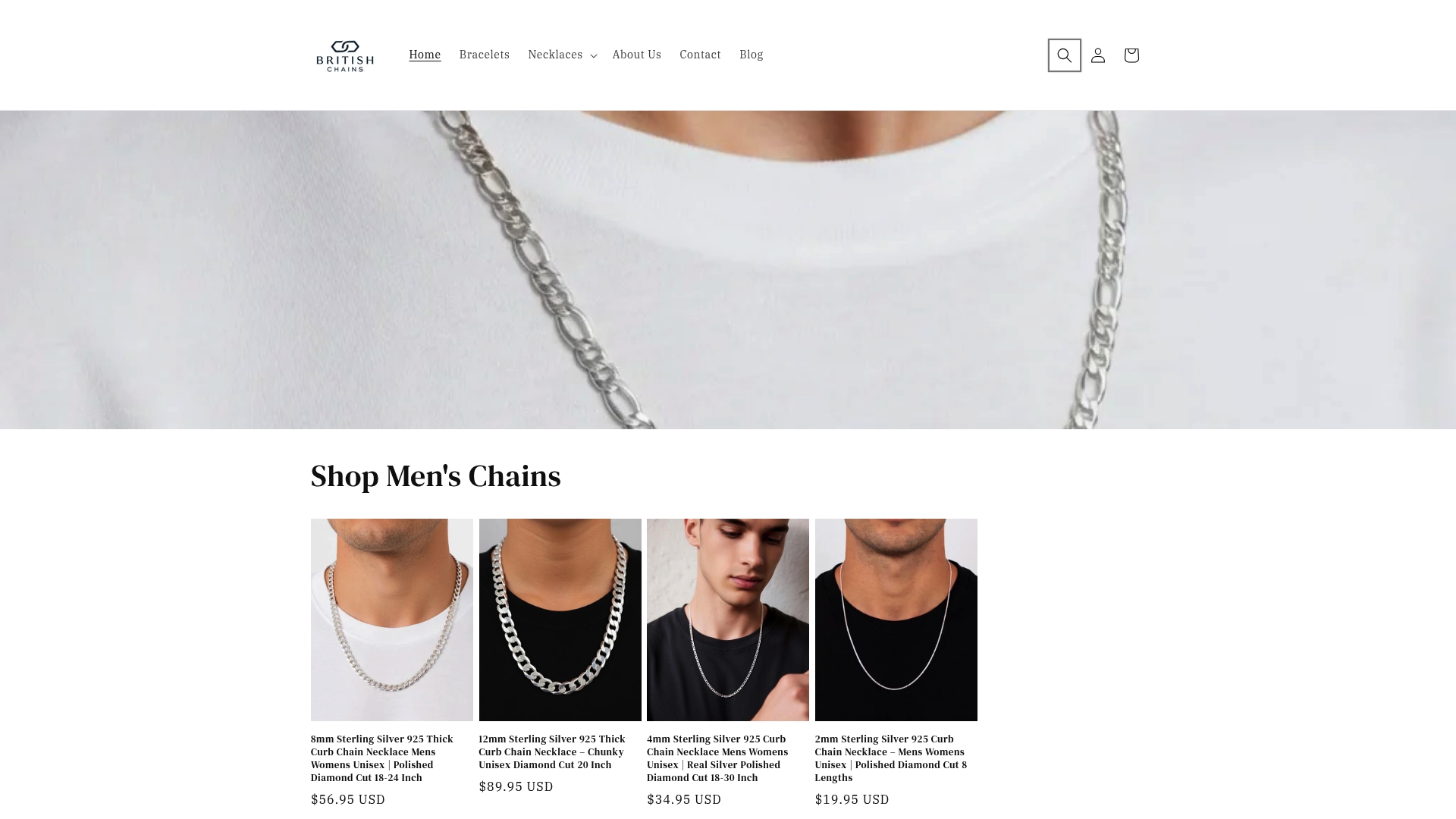
The 2mm sterling silver curb chain is a practical example: the product page shows the weight, the 925 hallmark, the finish and the dimensions. That is the disclosure standard the article describes — applied to a real product you can buy today. Returns and care guidance are published alongside the product, not buried in a footer. Browse the full collection and check the specifications for yourself.
Authoritative sources and further reading
The sources below let you verify claims independently and dig deeper into the standards discussed throughout this article.
- OECD guidance on due diligence for responsible business conduct
- Hidden cost of jewelry — Human Rights Watch
- Extractive Industries Transparency Initiative (EITI)
- Global Reporting Initiative (GRI)
- World Gold Council — conflict‑free gold standard
- Fashion Revolution
- Better jewellery: supply chain transparency — Common Objective
- How is jewelry pricing calculated? Gold, labour & markup — ANTOANETTA
- The jewelry pricing formula every maker needs to know — Craftybase


