

Hallmarked vs stamped silver: how to tell the difference
A hallmark is an independent legal guarantee applied only by one of the UK’s four Assay Offices after testing; a stamped ‘925’ or maker’s mark is nothing more than the manufacturer’s own claim, unverified by anyone. Under the Hallmarking Act 1973, any silver item sold in the UK weighing more than 7.78 grams must carry a genuine hallmark to be legally described as silver.
At a glance, look for:
- Three marks sitting close together, usually in a neat row or cluster
- A recognisable Assay Office symbol (a leopard, anchor, rose or castle)
- A clear fineness number, most commonly 925
Pro Tip: Turn the piece under a strong light and use a jeweller’s loupe or your phone camera zoomed right in. Genuine hallmarks are struck cleanly and sit flush with the metal; a single blurry “925” stamped alone, with nothing else nearby, is a red flag.
Key Takeaways
A genuine UK hallmark is an independently tested, legally compulsory mark from an Assay Office, while a stamped ‘925’ is only the maker’s own unverified claim.
| Point | Details |
|---|---|
| Weight threshold | Silver over 7.78 grams must carry a full hallmark to be sold as silver in the UK. |
| Three compulsory marks | Look for the sponsor’s mark, the fineness mark, and one of four Assay Office symbols. |
| Stamps aren’t proof | A ‘925’ or ‘Sterling’ stamp alone is unverified and not a substitute for a hallmark. |
| Exceptions exist | Lightweight items under 7.78 grams can lawfully lack a hallmark without being fake. |
| Buy from verified sellers | Britishchains hallmarks qualifying sterling silver chains and provides clear provenance and returns. |
Table of Contents
- Hallmarked vs stamped silver: what a hallmark actually is
- What are the compulsory parts of a UK hallmark?
- How do you read British hallmarks step by step?
- How does a stamped mark like ‘925’ differ from a hallmark?
- Common non-hallmark stamps and plate marks you’ll see
- Why does an official hallmark matter for value and insurance?
- How can you verify a hallmark is genuine?
- When can silver legally have no hallmark?
- What should you do if you suspect fake or misdescribed silver?
- Quick checklist for buying silver in person or online
- Where to buy hallmarked silver chains with confidence
- Sources
Hallmarked vs stamped silver: what a hallmark actually is
A hallmark is a set of marks struck into precious metal by an independent Assay Office once the metal has been tested and confirmed to meet a legal standard of fineness. That independence is the entire point. Anyone can stamp “925” onto a bracelet, but only an Assay Office can hallmark it, and the Hallmarking Act 1973 makes doing otherwise, for items over the threshold, an offence.
The system traces back more than 700 years to Goldsmiths’ Hall in London, where London’s silversmiths first submitted work for testing. It survives because the problem it solves hasn’t gone away: alloyed metals can’t be reliably judged by sight or touch, so an independent check remains the only trustworthy way to confirm what’s actually in the object.
A genuine hallmark guarantees:
- The precious metal content has been physically tested, not just declared
- Which Assay Office carried out that test
- Traceability back to the sponsor who submitted the item
What are the compulsory parts of a UK hallmark?
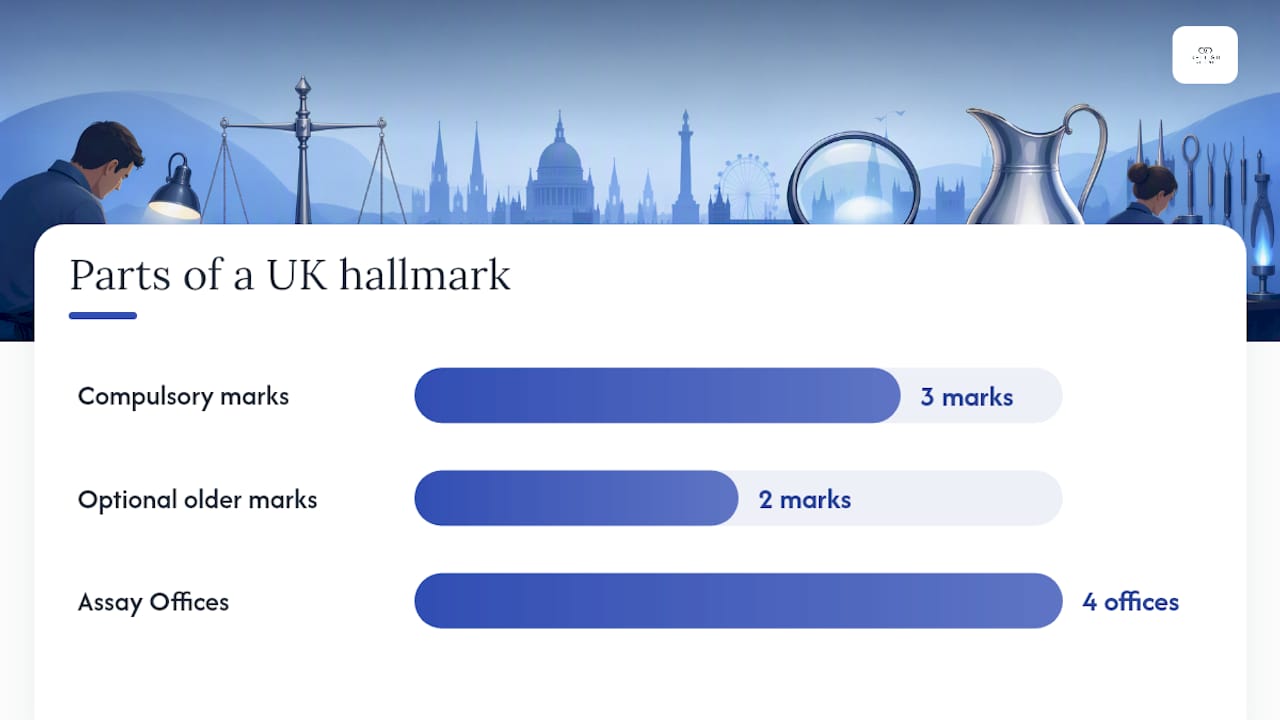
Every legally hallmarked item made or sold in the UK today carries three compulsory marks. Miss one, and it isn’t a full hallmark.
- Sponsor’s mark – identifies the maker or company who submitted the piece for testing
- Metal and fineness mark – confirms the purity, shown as a number such as 925 for sterling silver
- Assay Office mark – shows which of the four UK Assay Offices tested it: London (leopard’s head), Birmingham (anchor), Sheffield (rose) or Edinburgh (castle)
Older pieces often carry two further marks, a date letter and a duty mark, and you’ll still see date letters on plenty of modern jewellery even though neither is compulsory now. Treat them as a bonus, not a requirement.
Pro Tip: If you only remember one rule, remember this: three marks minimum. Two marks, or one lone stamp, is not a complete UK hallmark, whatever the seller calls it.
How do you read British hallmarks step by step?
Work through the marks in a fixed order rather than trying to take them all in at once. Our guide to sterling silver hallmarks breaks the shapes down further, but the sequence is straightforward:
- Find the fineness mark first, usually a number like 925 inside a rectangle or oval
- Locate the Assay Office symbol next to it, and match the shape against London, Birmingham, Sheffield or Edinburgh
- Identify the sponsor’s mark, normally two or three initials in a bespoke shield
- If present, check the date letter, a single letter in a distinctive font that changes yearly, and see whether it matches the era the seller claims
Genuine hallmarks are crisp and consistent in depth, because a machine struck them at the Assay Office. Do not test silver at home with acid or a file. It can permanently damage a good piece, and it still won’t tell you what a proper assay would.
Pro Tip: Photograph the marks in natural daylight rather than under artificial light, which distorts contrast and makes shallow stamps look deeper than they are.
How does a stamped mark like ‘925’ differ from a hallmark?
A stamp is a claim. A hallmark is proof. That’s the entire difference between hallmarked vs stamped silver, and it’s a legal one, not a matter of opinion. A ‘925’ or ‘Sterling’ stamp is applied by the manufacturer itself, with no independent body checking that the metal actually meets that standard. An Assay Office mark means the metal has actually been tested.
Two scenarios show why this matters in practice:
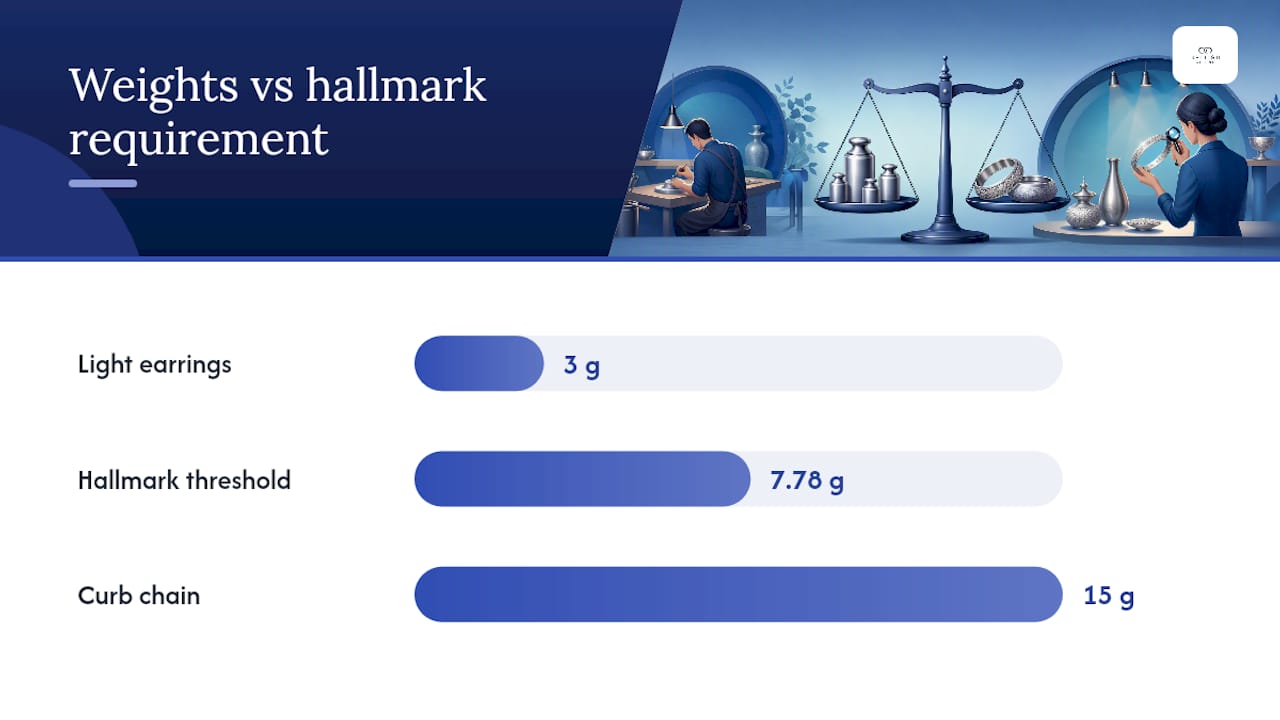
- A lightweight pair of earrings weighing 3 grams can lawfully be sold with only a ‘925’ stamp and no hallmark at all, because it falls under the 7.78 gram threshold
- A heavier curb chain weighing 15 grams must carry a full hallmark if it’s being sold as silver, and its absence is a legal problem, not a technicality
When you’re buying something that only carries a stamp, treat the seller’s paperwork and reputation as your real evidence, since the stamp alone confirms nothing about purity.
Common non-hallmark stamps and plate marks you’ll see
Plenty of markings on silver-coloured jewellery aren’t hallmarks and were never meant to be. Recognising plated metal correctly, as explained in how to wear statement jewelry, stops you overpaying for plated metal.
- EPNS (Electroplated Nickel Silver) – a thin layer of silver over a base metal, not solid silver at all
- “Silver plate” or “coin silver” – descriptive terms, not hallmarks, often used entirely legitimately on plated tableware
- Maker logos – identify the brand but confirm nothing about metal content on their own
- Plain ‘925’ stamps with nothing else – common on genuine lightweight sterling pieces, but equally common on misrepresented plated items
There’s no recognised regulatory system governing plate marks the way there is for hallmarks, which is exactly why they’re so easy to misuse.
Pro Tip: Look for wear at the edges and high-contact points. If a yellowish or coppery tone shows through, you’re looking at plating over base metal, whatever the stamp claims.
Why does an official hallmark matter for value and insurance?
Insurers, valuers and serious collectors treat a hallmark as the baseline fact-check on a piece, because it settles the metal question before anyone discusses design or provenance.
- An Assay Office mark gives an independent purity guarantee no manufacturer stamp can match
- It lets you trace an item back to a sponsor, useful for provenance and estate research
- It removes ambiguity at resale or on an insurance claim, where a genuine hallmark supports the valuation
Hallmarking is Britain’s oldest consumer protection for precious metals. It’s worth stressing that a hallmark confirms the metal, not the artistry. Two identically hallmarked pieces can carry very different market values depending on the maker’s reputation.
How can you verify a hallmark is genuine?
Verification gets easier once you follow a set order rather than guessing from memory.
- Inspect the marks closely under good light, ideally with magnification
- Photograph each mark clearly, including a scale reference like a ruler or coin
- Cross-check the Assay Office symbol and date letter against published hallmark tables
- Contact the relevant Assay Office directly if you need formal confirmation
- Commission a professional assay for high-value or disputed pieces
All four UK Assay Offices, London, Birmingham, Sheffield and Edinburgh, offer identification services, and our piece on the Sheffield Assay Office walks through what one of them actually does day to day.
A few things to keep in mind:
- Acid tests and magnet checks give rough indications at best, and acid can mark or damage the piece
- Professional sampling is the only reliable method for high-value antiques or disputed authenticity
- Keep every photo and any correspondence with an Assay Office as a paper trail
Pro Tip: Before sending anything for professional testing, get a written quote and ask whether the process is destructive. Most modern assay methods for hallmarking purposes are not, but always confirm first.
When can silver legally have no hallmark?
Not every unmarked silver item is fake or misdescribed. UK law carves out several genuine exceptions worth knowing before you assume the worst.
- Items weighing under 7.78 grams, the most common exemption by far
- Silver bullion bars and coins, which follow separate rules
- Certain repaired, altered or extremely delicate pieces where testing risks damage
- Older imported items carrying foreign or historic marks that predate current UK requirements
Antiques and foreign-marked silver often need specialist interpretation, since historic hallmarking systems varied by country and era.
Pro Tip: Always ask the seller for paperwork or an assay certificate on anything sold as exempt. A legitimate seller will have no trouble producing it.
What should you do if you suspect fake or misdescribed silver?
Acting quickly and keeping records protects your legal position from the outset.
- Stop the transaction or return the item to the seller straight away if you still can
- Get an independent assay or professional opinion before doing anything else
- Contact Trading Standards or Citizens Advice if the seller won’t resolve it
- Keep every receipt, listing screenshot and photograph as evidence
Sellers who misdescribe silver may fall foul of both the Hallmarking Act and the Consumer Rights Act, which covers goods being as described. Buyers have real protection here, provided the evidence trail is solid.
Pro Tip: Photograph the marks before you package anything for return, and keep the item in its original state until the dispute is resolved. A broken chain of custody weakens any later complaint.
Quick checklist for buying silver in person or online
Keep this shortlist to hand, whether you’re in a shop with a loupe or scrolling a listing on your phone.
- Confirm all three compulsory marks are present where the item’s weight requires them
- Identify the Assay Office symbol and check it matches the seller’s description
- Ask for paperwork on anything sold as exempt from hallmarking
- Check for plating clues: worn edges, tonal inconsistency, a stamped-only ‘925’ with nothing else
- Photograph every mark before you commit to a purchase
Print version, five lines, keep it on your phone:
- Three marks or paperwork explaining why not
- Assay Office symbol matches claim
- Fineness number is clear and correct
- No wear revealing base metal underneath
- Photos taken before you buy or before you return
Our budget silver jewellery quality checklist expands on several of these points if you’re buying on a tighter budget where corners get cut more often.
How reputable UK sellers ensure hallmark compliance
Reputable retailers submit qualifying pieces to a UK Assay Office as standard practice and keep that paperwork on file, not as an afterthought. Buyers should expect a returns policy, an honest weight-based explanation when a piece is exempt, and transparent product descriptions that don’t blur stamped and hallmarked into the same claim.
Genuine hallmarking evidence and a straightforward returns policy tell you more about a seller’s honesty than any amount of marketing copy ever will.
Pro Tip: Ask for assay or export paperwork on anything high-value or unusual before you buy. A seller with nothing to hide will produce it without hesitation.
A publisher’s view on buying hallmarked silver
Britishchains favours verified hallmarking and transparent provenance over unverifiable stamps, full stop. Every hallmarked sterling silver chain sold reflects that standard, because buyers deserve proof, not just a manufacturer’s word.
Where to buy hallmarked silver chains with confidence
Plenty of sellers will show you a ‘925’ stamp and leave it there. Britishchains doesn’t. Every qualifying chain in the collection carries a genuine UK hallmark from an authorised Assay Office, with the fineness, sponsor and Assay Office marks you’ve just learned to spot, backed by a clear returns policy if anything doesn’t check out.
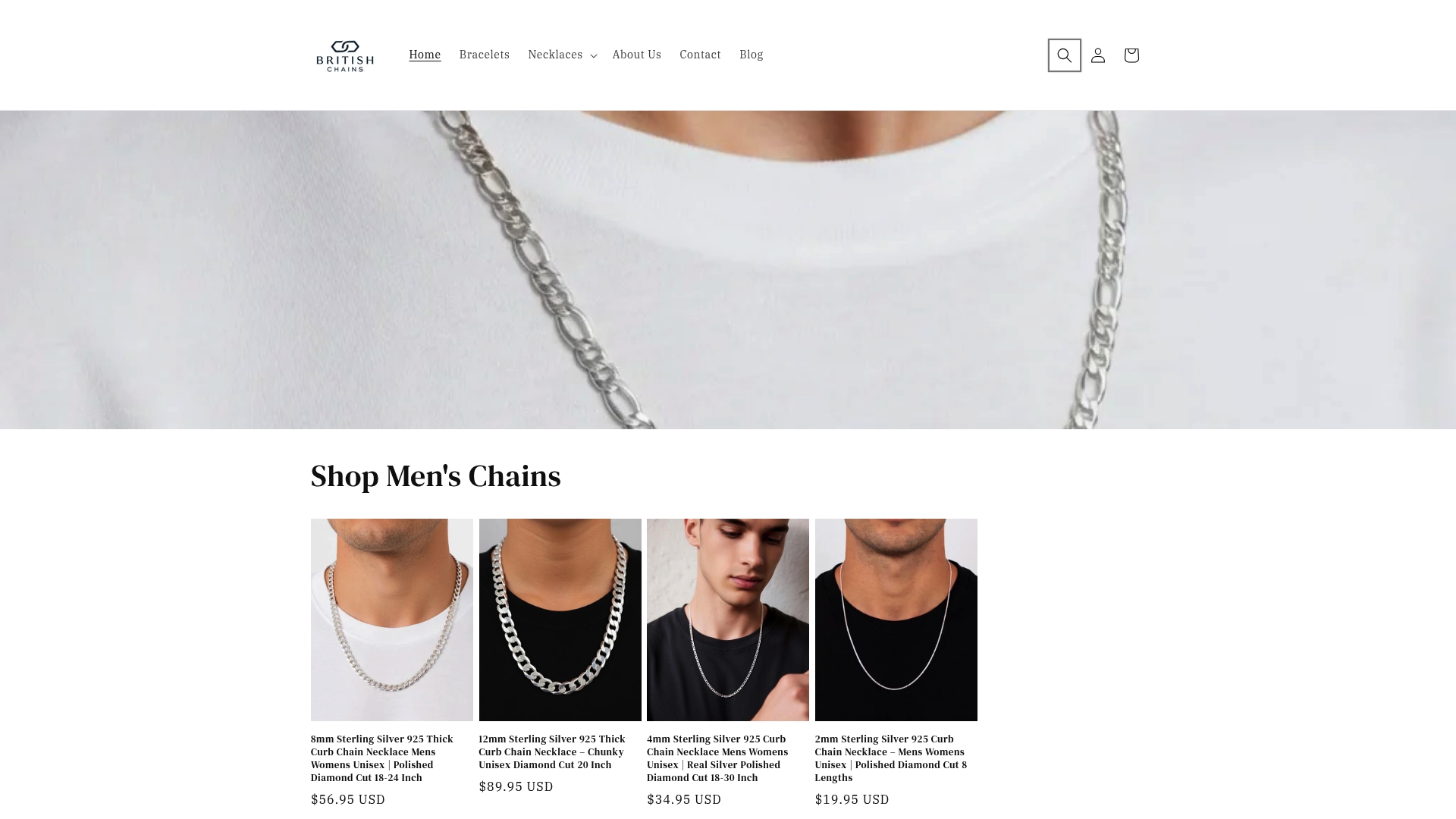
Whether you’re after a curb chain, a Figaro or something finer for everyday wear, you can check hallmark details on any product page before you buy. Browse the hallmarked sterling silver chains and look for the marks yourself; that’s precisely the point.
Sources
- Hallmarking: practical guidance - summary
- Hallmarking — The Goldsmiths’ Company
- What is a Hallmark? - Edinburgh Assay Office


