

Sheffield Assay Office: history, marks and services
The Sheffield Assay Office is one of four official assay offices in the United Kingdom, responsible for independently testing and hallmarking precious metals — gold, silver, platinum, and palladium — so that buyers can trust what they are purchasing. Established by Act of Parliament in 1772 and conducting its first assays in 1773, the office has operated for over 250 years as a consumer-protection institution. It holds UKAS accreditation for its laboratory services, placing it among the most rigorously verified testing bodies in the country.
Table of Contents
- What is the Sheffield Assay Office and where did it come from?
- What services does the Sheffield Assay Office provide today?
- How does UK hallmarking work, and what does the law require?
- What does the Sheffield assay mark look like?
- How do you get an item hallmarked at Sheffield?
- How does the office test metals, and why does accreditation matter?
- Why does the Sheffield Assay Office matter to buyers and makers?
- Sheffield Assay Office today: innovation and new sectors
- Key takeaways
- Why hallmarking is the foundation of honest jewellery retail
- Hallmarked British sterling silver, ready to wear
- Useful sources and further reading
What is the Sheffield Assay Office and where did it come from?
The story begins with frustration. Sheffield silversmiths in the early 1770s were legally required to send their wares to London for hallmarking — an expensive, slow, and frankly impractical arrangement for a city whose metalworking trade was growing fast. They joined forces with petitioners from Birmingham and lobbied Parliament for their own assay offices. London’s Goldsmiths’ Company fought the proposal hard, but Parliament passed the Plate Assay (Sheffield and Birmingham) Act 1772 regardless, and Sheffield opened for business in 1773.
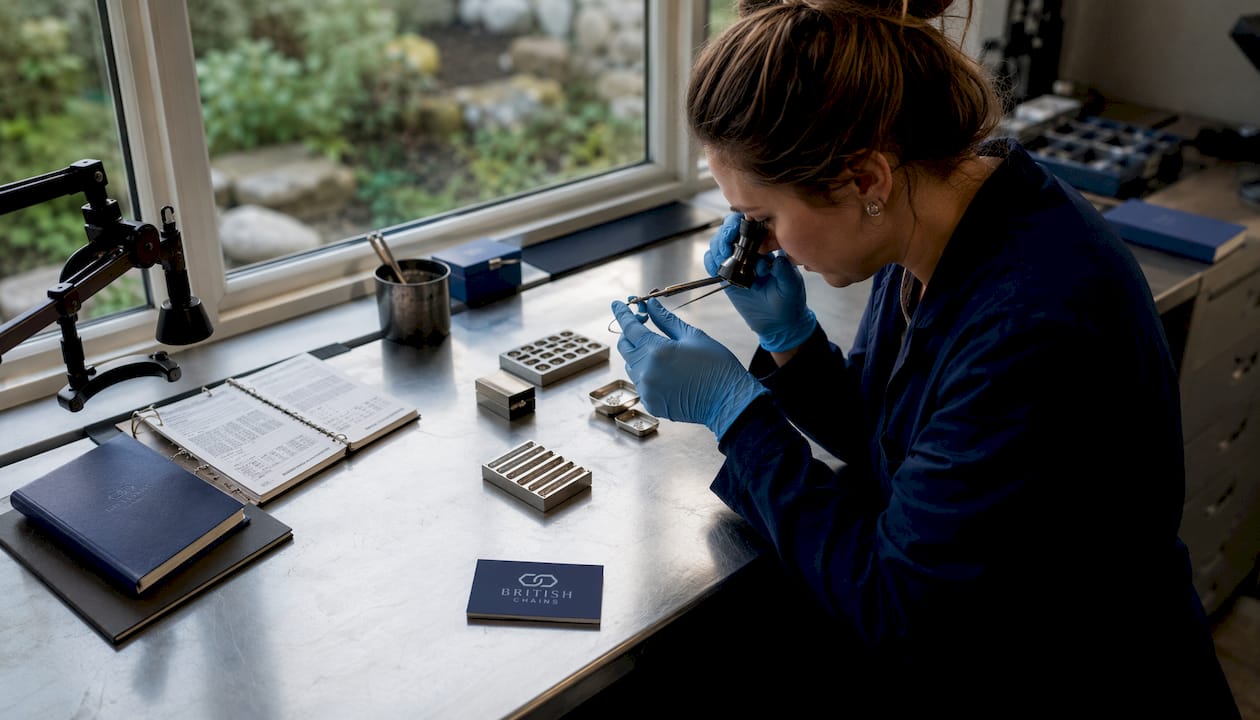
Parliament was careful about how it structured the new office. Rather than handing control to the silversmiths who had lobbied for it, the Act appointed 30 local men as “Guardians of the Standard of Wrought Plate within the Town of Sheffield,” deliberately limiting silversmith representation so the office would serve consumers, not manufacturers. The Assay Master took an oath before the Master of the Royal Mint and posted a financial bond — a level of accountability that made the office genuinely independent from the trade it regulated.
Key milestones in the office’s development:
- 1773 — First assays conducted; original town marks included a crown and a rose.
- 1784 — A second Act extended Sheffield’s registration radius from 20 miles to 100 miles, bringing Birmingham within its reach and allowing the office to charge small articles by count rather than weight, which better suited mass-produced goods.
- 1903 — The Sheffield Corporation Act permitted the office to assay and mark gold in addition to silver, significantly expanding its scope.
- 1973 — The Hallmarking Act 1973 consolidated earlier legislation, introduced standardised date letters across all UK offices, and set the modern legal framework still in force today.
- Post-1973 — The town mark was standardised to the White Rose of York, replacing earlier variants and giving Sheffield its distinctive modern symbol.
The shift from charging by weight to charging by count in 1784 is a small detail that reveals something important: the office has always adapted its operations to the realities of Sheffield’s manufacturing economy, not the other way around.
What services does the Sheffield Assay Office provide today?
Hallmarking remains the core service, but the office has grown well beyond it. Today it operates a modern laboratory offering a range of analytical services that serve clients from jewellery retail to healthcare and environmental consultancy.
| Service | Description | Typical users |
|---|---|---|
| Hallmarking | Testing and applying the official UK hallmark to precious-metal items | Jewellers, silversmiths, retailers, private makers |
| XRF metal analysis | Rapid, non-destructive screening of metal composition | Pawnbrokers, second-hand dealers, manufacturers |
| Melt and assay | Definitive compositional analysis by melting and chemical testing | Refiners, recyclers, legal disputes |
| Mercury screening | Detection of mercury contamination in metals and materials | Healthcare, environmental, and industrial clients |
| Diamond Verification Services (DVS) | Identification of natural vs. lab-grown diamonds | Jewellery retailers, insurers, auction houses |
| Mineral analysis | Compositional testing of minerals and geological samples | Research institutions, mining sector |
| Environmental and contamination testing | Analysis of materials for pollutants and hazardous substances | Environmental consultancies, public bodies |
| Plating thickness and nickel testing | Measurement of surface coatings and nickel release | Manufacturers, retailers, compliance teams |
Maker registration is the entry point for anyone wanting to use the hallmarking service. A jeweller or maker must register as a sponsor and have their unique sponsor’s mark recorded before submitting items. Daily collection services mean that local trade clients can drop off and collect work without lengthy postal delays, while postal submission is available for those further afield.
How does UK hallmarking work, and what does the law require?
The Hallmarking Act 1973 is the governing legislation. Under it, selling an item described as gold, silver, platinum, or palladium without the appropriate hallmark is a criminal offence — with certain weight-based exemptions. The Act applies across the UK and covers all four assay offices equally.
Key points every maker and buyer should know:
- Weight thresholds matter. Items below specified weight thresholds are exempt from the legal hallmarking requirement, though many makers choose to hallmark voluntarily regardless. The exact thresholds vary by metal; the official guidance on the Sheffield Assay Office website carries the current figures.
- A hallmark is not a valuation. This is the most common misconception. The hallmark confirms metal purity, nothing more. It says nothing about craftsmanship quality, condition, or market value.
- Four elements make up a standard UK hallmark. The sponsor’s (maker’s) mark identifies who submitted the item. The fineness mark states the metal purity as a number (e.g. 925 for sterling silver, 750 for 18-carat gold). The assay office mark identifies which of the four offices tested it. The date letter records the year of hallmarking.
- Palladium was added to the Act in 2010, reflecting its growing use in jewellery and the need for the same consumer protections that apply to the other three metals.
- Imported goods are not exempt. Any item described as a precious metal and sold in the UK must meet the same hallmarking requirements, regardless of where it was made.
The consumer protection the Act creates is straightforward: when you see a hallmark, an independent body has tested that item and confirmed the metal is what the seller claims. For hallmarked silver in particular, this matters enormously in a market where plated or lower-purity items are sometimes misrepresented.
What does the Sheffield assay mark look like?
Sheffield’s current town mark is the White Rose of York, a symbol with deep regional significance. Before the Hallmarking Act 1973 standardised the system, Sheffield used a crown as its primary town mark, sometimes alongside a rose. The post-1973 standardisation replaced these with the White Rose of York as the sole Sheffield identifier.
A fully hallmarked Sheffield item carries these elements side by side:
- Sponsor’s mark — usually two or three initials in a shaped cartouche, unique to the registered maker or importer.
- Fineness mark — a number denoting purity: 925 (sterling silver), 999 (fine silver), 375/585/750/916/990/999 for gold grades, 950 for platinum, 500/950 for palladium.
- Assay office mark — the White Rose of York for Sheffield; a leopard’s head for London; an anchor for Birmingham; a castle for Edinburgh.
- Date letter — a letter in a shaped shield, changed annually, recording the year of hallmarking.
Pro Tip: If you need to photograph a hallmark for an enquiry or insurance record, use a macro lens or your phone’s portrait mode in strong raking light (light from the side). Flat-on flash washes out the shallow relief of struck marks and makes them almost impossible to read. A dark background and angled light reveal the detail clearly.
For a full breakdown of how to read sterling silver hallmarks, the components and their meanings are worth understanding before you buy or sell.
How do you get an item hallmarked at Sheffield?
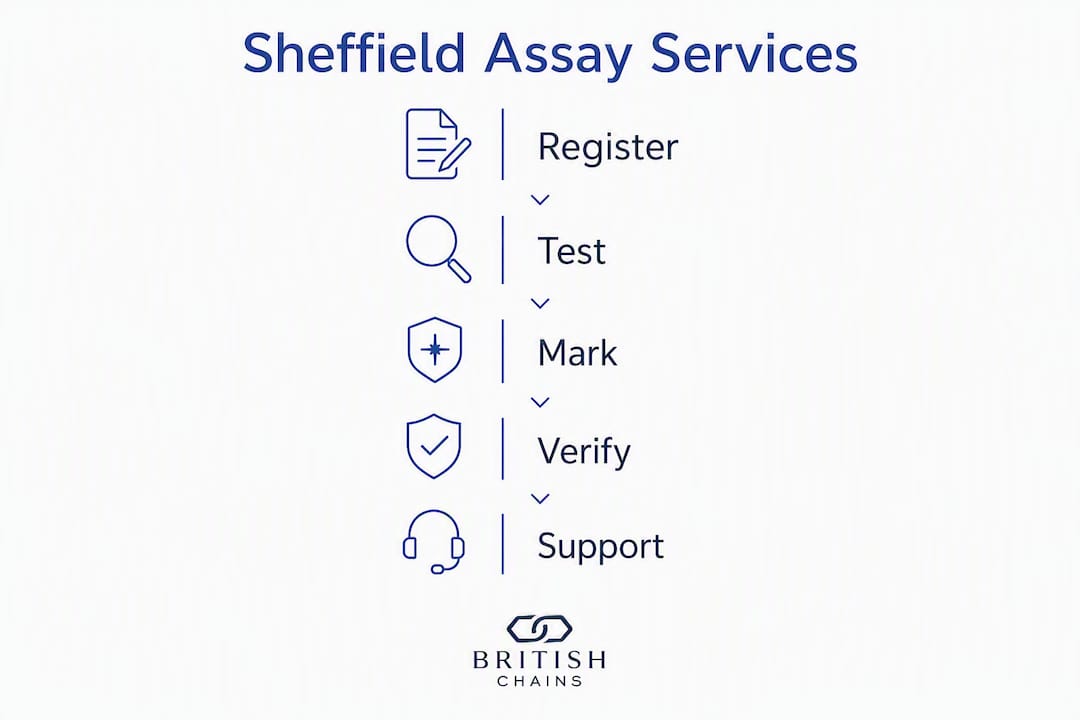
The process is more straightforward than many makers expect. Here is how it works in practice:
- Register as a sponsor. Before submitting any items, you must register your maker’s mark with the office. This involves completing the official registration form, paying the registration fee, and having your unique mark recorded. The Sheffield Assay Office website carries the current forms and guidance.
- Prepare your items. Items should be clean, free of stones where possible (some stones cannot withstand the testing process), and clearly labelled with your sponsor reference. Fragile or complex pieces may need specific packaging instructions from the office.
- Submit for assay. Local clients can use the daily collection service; postal clients send items securely with the relevant paperwork. The office will confirm receipt and log items against your account.
- Testing and marking. The office tests the metal using the appropriate method (XRF for initial screening, melt and assay where definitive results are needed) and, if the item passes, applies the hallmark by striking or laser.
- Collection or return. Standard turnaround times vary; the office publishes current timelines on its website. Urgent or private assay options are available for time-sensitive work, typically at a higher charge.
- Check the current charges. Fees depend on the metal, the number of items, and the service level chosen. The office’s website is the definitive source for up-to-date pricing.
The office also offers customer-service support by phone and email for queries about specific items, unusual alloys, or submission requirements for complex pieces.
How does the office test metals, and why does accreditation matter?
XRF (X-Ray Fluorescence) is the workhorse of initial metal screening. The technique fires X-rays at a sample and reads the energy of the fluorescent X-rays that bounce back, identifying which elements are present and in what proportions. It is fast, non-destructive, and accurate enough for most routine hallmarking work. A piece of jewellery can be screened in seconds without any damage.
The limitation of XRF is worth knowing. For plated items, the reading reflects the surface coating rather than the underlying metal, which can produce a misleadingly high purity figure. Similarly, certain alloy combinations create matrix effects that complicate the reading. In these cases, melt and assay — physically melting a sample and chemically analysing the resulting material — provides the definitive answer. It is the reference technique when results are contested or when the stakes are high (recycled materials, high-value items, legal disputes).
Diamond verification uses a different technology entirely. The office’s DVS service, which has expanded to include detection of lab-grown diamonds through partnerships on SynthDetect technology, addresses one of the most pressing challenges in the jewellery trade today: distinguishing natural from synthetic stones reliably and at scale.
The Sheffield Assay Office has held UKAS accreditation for a prolonged period. UKAS (United Kingdom Accreditation Service) is the national body that assesses whether laboratories meet internationally recognised standards for competence and impartiality. For B2B clients who need traceable, legally defensible test results, that accreditation is not a formality — it is the difference between a result that holds up and one that does not.
Pro Tip: XRF is generally sufficient for retail stock checks and routine second-hand purchases. If you are buying recycled or scrap metal, or any item where the surface finish is unusual, request melt and assay results instead. The extra cost is negligible against the risk of paying for gold-plated silver.
Why does the Sheffield Assay Office matter to buyers and makers?
The hallmark is one of the oldest forms of consumer protection in British commerce, and the Sheffield Assay Office has been delivering it for over 250 years. Its practical value breaks down clearly:
- For buyers: a hallmark is independent confirmation of metal purity. You are not relying on the seller’s word.
- For makers and retailers: hallmarking provides legal compliance, supports resale value, and signals quality to buyers who know what to look for.
- For the second-hand and pawn market: XRF and melt-and-assay services allow dealers to verify items quickly before purchase, reducing fraud risk.
- For the wider market: consistent, independent testing maintains confidence in British precious-metal goods internationally.
The misconception that a hallmark guarantees condition or value is worth addressing directly. It does not. A hallmarked piece of silver can be damaged, poorly made, or worth very little on the secondary market. The mark speaks only to metal purity — which is exactly what it is supposed to do, and exactly what the law requires.
Sheffield Assay Office today: innovation and new sectors
Over 250 years, the office has moved well beyond its original silversmithing remit. Its analytical division now serves sectors that would have been unrecognisable to the Guardians of the Standard in 1773:
- Jewellery retail and manufacturing remain the core, with hallmarking volume reflecting the health of the UK trade.
- Healthcare and research clients use mercury screening and mineral analysis for applications ranging from medical device testing to academic research.
- Environmental consultancy clients commission contamination and pollutant testing, where the office’s UKAS accreditation makes results admissible in regulatory contexts.
- Diamond trade clients use DVS to distinguish natural from lab-grown stones, a service that has grown sharply as synthetic diamonds have become commercially significant.
The office’s analytical services page and its DVS section carry the most current detail on each of these offerings, including how to commission testing and what turnaround times to expect.
Key takeaways
The Sheffield Assay Office is an independent, UKAS-accredited institution founded by Act of Parliament in 1773, whose hallmark on a precious-metal item is a legal guarantee of tested purity, not a valuation or quality award.
| Point | Details |
|---|---|
| Official status | One of four UK assay offices; founded under the Plate Assay (Sheffield and Birmingham) Act 1772. |
| Sheffield town mark | The White Rose of York, replacing earlier marks (crown/rose) after the Hallmarking Act 1973. |
| Legal framework | The Hallmarking Act 1973 makes it an offence to sell unmarked precious-metal goods above weight thresholds as gold, silver, or platinum. |
| Services beyond hallmarking | XRF, melt and assay, mercury screening, diamond verification (DVS), and environmental testing serve sectors from retail to healthcare. |
| Britishchains | Every Britishchains sterling silver chain carries a UK hallmark, giving buyers independent confirmation of 925 purity. |
Why hallmarking is the foundation of honest jewellery retail
There is a tendency in the jewellery trade to treat hallmarking as a bureaucratic box to tick. That framing misses the point entirely. The Sheffield Assay Office was created precisely because the market could not police itself — silversmiths had every incentive to overstate purity, and buyers had no reliable way to check. Parliament’s solution in 1773 was elegant: an independent body, structurally insulated from the trade it regulated, with the Assay Master’s oath and bond as the guarantee of integrity.
What strikes me about the office’s history is how little the core logic has changed. The metals are different, the testing technology is unrecognisable, and the sectors served have multiplied. But the fundamental problem the office solves — asymmetric information between seller and buyer — is identical to the one that prompted those Sheffield silversmiths to petition Parliament in the first place.
For anyone selling precious-metal jewellery, the hallmark is not a cost or a compliance burden. It is the clearest signal you can send to a buyer that you are not asking them to take your word for it. In a market where trust is the actual product, that signal is worth more than most sellers realise.
Hallmarked British sterling silver, ready to wear
Every piece in the Britishchains collection is crafted from sterling silver and carries a full UK hallmark, so you know exactly what you are buying before it arrives. There is no guesswork about purity: the 925 fineness mark, the assay office mark, and the date letter are struck on every chain, giving you the same independent verification that the Sheffield Assay Office has provided to British buyers for over 250 years.
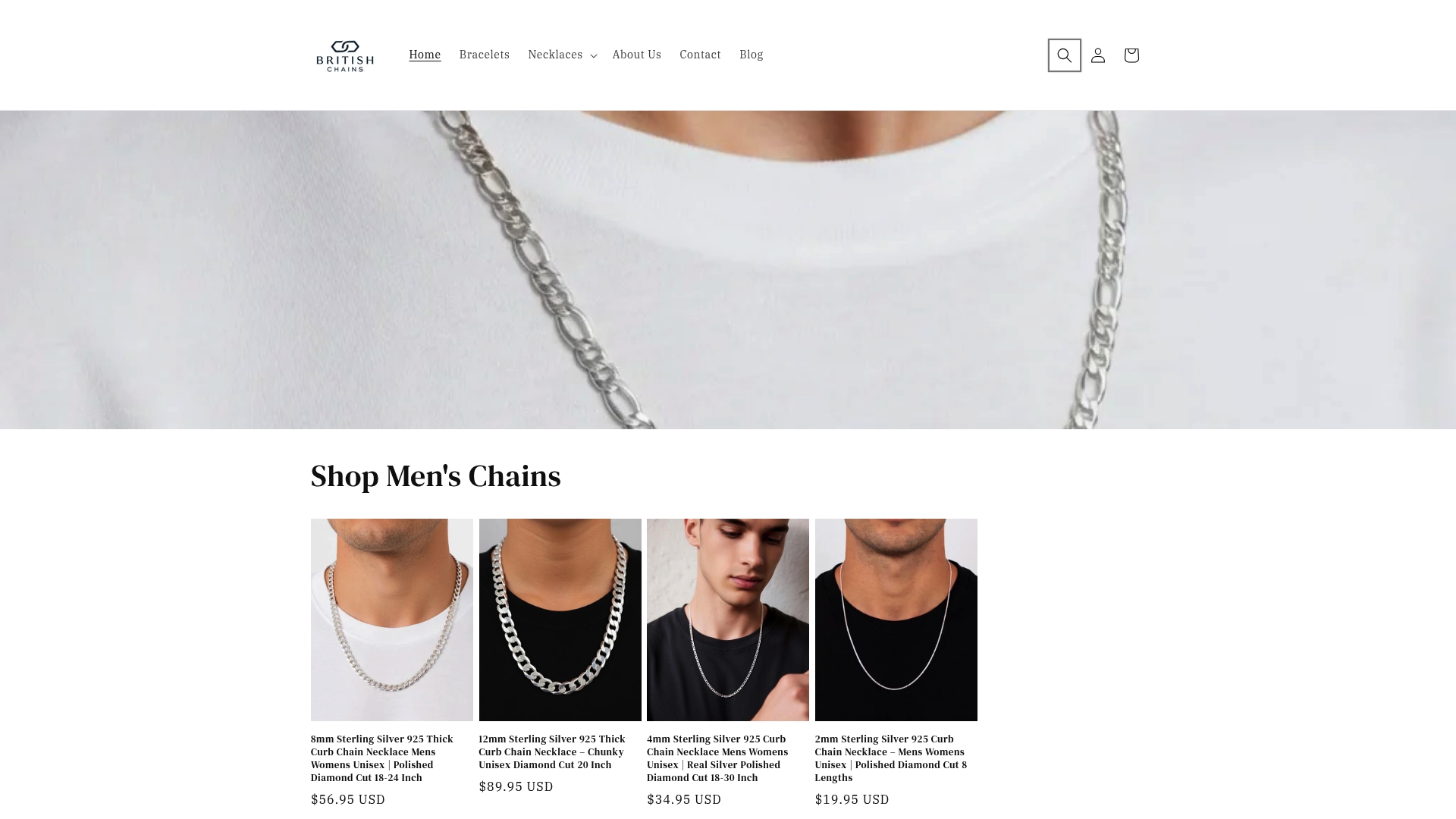
If you want to understand what those marks mean before you shop, the hallmarked sterling silver necklace guide walks you through reading each component. When you are ready to buy, browse the 2mm sterling silver curb chain — a clean, versatile piece that ships with full hallmarking documentation and suits both men and women.
Useful sources and further reading
The following primary and authoritative sources underpin this article. Check the official pages for the latest fees, sponsor registration forms, and urgent assay options, as these are updated regularly.
- Plate Assay (Sheffield and Birmingham) Act 1772 — legislation.gov.uk: the founding legislation establishing the Sheffield and Birmingham assay offices.
- Hallmarking Act 1973 — legislation.gov.uk: the primary statute governing hallmarking requirements in the UK today.
- Sheffield Assay Office — official website: current services, charges, sponsor registration, and analytical service details.
- Sheffield Assay Office history — official page: detailed account of the office’s founding, governance, and operational milestones.
- Sheffield Assay Office Records — The National Archives: archival catalogue covering records from 1773 to 2002, held at Sheffield City Archives.
- Sheffield Assay Office — Wikipedia: accessible summary of the office’s history and marks, including the White Rose of York town mark.
- 250 years of the Sheffield Assay Office — Professional Jeweller: industry coverage of the office’s anniversary, DVS service, and innovation in lab-grown diamond detection.


