

What do assay office marks mean in the UK?
An assay office mark is the town symbol struck into a UK hallmark that shows which of the four official assay offices tested the metal. It sits alongside a sponsor’s mark and a fineness mark to form a complete, legally recognised hallmark.
The four active UK assay offices and their marks are:
- London — the leopard’s head
- Birmingham — the anchor
- Sheffield — the York rose
- Edinburgh — the castle
Hallmarking in the UK isn’t a marketing flourish. It’s backed by the Hallmarking Act 1973 and overseen by the British Hallmarking Council, which makes an assay office mark a legal guarantee of purity, not a decorative stamp.
Key Takeaways
Every genuine UK hallmark legally requires a sponsor’s mark, a fineness mark, and an assay office mark struck by one of the four accredited offices in London, Birmingham, Sheffield, or Edinburgh.
| Point | Details |
|---|---|
| Four offices, four symbols | London (leopard’s head), Birmingham (anchor), Sheffield (rose), and Edinburgh (castle) are the only active UK assay offices. |
| Three marks are compulsory | A sponsor’s mark, fineness mark, and assay office mark must all appear together for a hallmark to be legally valid. |
| Date letters are optional | Since 1999, a missing date letter doesn’t mean a piece is unhallmarked or non-compliant. |
| Registration is office-specific | Birmingham charges £80 + VAT for a ten-year sponsor’s mark registration, with £40 + VAT renewal; other offices set their own fees. |
| Buy from a hallmark-transparent retailer | Britishchains publishes fineness and hallmark details on every product page, from curb chains to snake bracelets. |
Table of Contents
- What does a UK hallmark actually contain?
- Which assay offices operate in the UK, and what do their marks look like?
- How do you read a date letter on a hallmark?
- How do you get an item hallmarked, and what does it cost?
- How can you check a hallmark before buying?
- Why do hallmarks matter to UK buyers?
- What happens if an item isn’t hallmarked correctly?
- How does testing actually confirm metal purity?
- What do people get wrong about UK assay office marks?
- Where did the UK’s assay office system come from?
- How do UK hallmarks differ from marks used abroad?
- Why hallmarked stock matters to us
- Where to buy hallmarked sterling silver chains
- Sources
What does a UK hallmark actually contain?
A full UK hallmark is built from three compulsory elements, plus one that’s optional but common. Miss one of the three, and the piece hasn’t been legally hallmarked, whatever the retailer claims.
- Sponsor’s mark — the initials of the person or company responsible for the item, stamped inside a shaped shield. This identifies who submitted the piece, not who made it.
- Fineness (metal) mark — the millesimal number showing purity, such as 925 for sterling silver. Silver may also carry the lion passant, while gold has historically used a crown alongside its numeric mark.
- Assay office mark — the town symbol confirming which office tested and struck the piece.
- Date letter — an optional addition since 1999, though most reputable makers still apply one because it helps date a piece precisely.
Schedule 2 of the Hallmarking Act sets out exactly which symbols count as statutory marks and where they must legally appear.
Fact: all four marks together are what turns a piece of jewellery into a legally hallmarked item, not any single symbol on its own.
On items with multiple metal parts, such as a chain with a soldered clasp, the mark is struck on whichever component is made from the least precious metal. That’s a deliberate rule, not an oversight: it stops a low-grade fitting hiding behind a high-purity main body.
Which assay offices operate in the UK, and what do their marks look like?
Only four assay offices currently operate in the UK, each with its own town mark and a distinct institutional history worth knowing if you’re trying to place or date a piece.
- London — Goldsmiths’ Company Assay Office, marked with the leopard’s head. The mark lost its crown in 1821, so a crowned leopard’s head almost always signals a piece struck before that date.
- Birmingham — Birmingham Assay Office, marked with the anchor. It’s the busiest of the four offices today, handling a large volume of registrations from jewellery manufacturers across the Midlands.
- Sheffield — Sheffield Assay Office, marked with the York rose. Sheffield swapped its original crown symbol for the rose in 1975, so the crown version points to an older piece.
- Edinburgh — Edinburgh Assay Office, marked with the castle. Scottish silver sometimes carries a lion rampant alongside the castle, a detail collectors use to confirm Scottish origin.
You’ll also come across marks from offices that closed long ago, such as Chester or Exeter. These still turn up on antique and vintage pieces, and they’re a genuine clue for dating rather than a fault.
Pro Tip: If you spot a hallmark you can’t place, don’t assume the piece is fake. Cross-check the symbol against Sheffield’s own history and mark records before drawing any conclusions.
How do you read a date letter on a hallmark?
Each assay office changes its date letter annually, along with the shield shape or typeface it sits in, so no two years look identical once you factor in both.
That system is what lets you pin a piece to a specific year, provided you know which office struck it. London, for instance, introduced a new uppercase alphabet on 1 January 2025, so a piece bearing that style couldn’t predate this year.
- Date letters have been voluntary for many years. A piece without one can still be perfectly legitimate and fully hallmarked.
- To date a piece accurately, compare the letter, the shield or cartouche shape, and the typeface case against an official office chart, never the letter alone.
- Always confirm the assay office mark first. The same letter shape can mean different years at different offices.
How do you get an item hallmarked, and what does it cost?
Anyone submitting jewellery for assay, whether a small workshop, an established retailer, or an individual with a family piece, needs a registered sponsor’s mark before an office will test the item.
- Register a sponsor’s mark. This registration is office-specific. Birmingham Assay Office charges £80 + VAT for a ten-year registration, with renewal at £40 + VAT. Registering with one office doesn’t cover you at another.
- Submit the piece for testing. Offices use accredited methods, including XRF analysis, to check the metal’s composition without damaging the item.
- The office strikes the mark, usually by laser or punch, on the part made from the least precious metal where the item has mixed components.
- Small or delicate pieces may qualify for laser marking rather than traditional punching, which reduces the risk of distortion on fine chains.
Fees for testing and striking vary by office, metal, and item size, so it’s worth requesting a written quote before submission. Most offices publish current lead times and pricing on their own sites rather than through third parties, and that’s where you should check before committing a piece.
How can you check a hallmark before buying?
A magnifier is the cheapest verification tool you’ll ever buy. Most compulsory marks are tiny, often just a few millimetres across, and reading them properly is the difference between confirming a mark and guessing at it.
- Look for three elements together: the sponsor’s initials, the millesimal fineness number, and the assay office symbol.
- Match the assay office mark and date letter against an official office chart rather than relying on memory or a quick search result.
- If the marks are too small to read with the naked eye, ask the retailer for a clear macro photograph before you buy, not after.
- If something still doesn’t add up, the Goldsmiths’ Company offers a tracing service for recent hallmarks, and Trading Standards can get involved where fraud is suspected.
Pro Tip: A retailer who hesitates when you ask for a close-up photo of the hallmark is telling you something. A reputable seller will have that image ready.
Why do hallmarks matter to UK buyers?
The whole point of the assay office mark is independent verification. Nobody selling the item gets to test it themselves.
The British Hallmarking Council supervises the four offices and works with Trading Standards to enforce hallmarking law, giving buyers a system that exists specifically to stop them being sold underweight or misrepresented precious metal.
Retailers carry obligations too. Anyone dealing in precious metal is expected to display a Dealer’s Notice explaining what hallmarks mean, which is part of why Britishchains states fineness and hallmark information directly on its product pages rather than leaving buyers to work it out.
What happens if an item isn’t hallmarked correctly?
Selling an item described as gold, silver, platinum, or palladium above the legal exemption weight without a valid UK hallmark is a criminal offence, not a technicality. It falls under the same Hallmarking Act that defines what a legitimate mark looks like in the first place.
Trading Standards officers can seize unhallmarked stock, and a business found selling items with a false or counterfeit hallmark faces prosecution, fines, and reputational damage that tends to outlast any financial penalty. Faking a hallmark, or applying a genuine-looking mark to metal that hasn’t actually been tested by an assay office, counts as fraud under UK law.
There are legal exemptions for very lightweight items, chiefly because testing and marking tiny pieces isn’t always practical. Small silver items under a certain weight threshold can be sold without a full hallmark, though reputable retailers usually hallmark anyway simply because it removes any doubt for the customer.
For buyers, the practical risk isn’t jail time for a jeweller three counties away. It’s paying silver prices for something that turns out to be plated base metal, with no legal mark to prove otherwise. That’s precisely the gap the hallmarking system was built to close, and it’s why checking for a genuine assay office mark before you buy matters more than checking a certificate or a receipt.
How does testing actually confirm metal purity?
Assay offices don’t take a seller’s word for the metal content. They test it, and the process is more exacting than most buyers assume.
Modern UK assay offices rely on accredited laboratory methods, including X-ray fluorescence (XRF) analysis, to determine the precise elemental makeup of a submitted piece. XRF works by measuring the fluorescent radiation a metal emits when bombarded with X-rays, which reveals its composition without damaging or destroying the item. That matters for a finished chain or bracelet: the office can confirm purity without melting down or scratching the piece being tested.
Once testing confirms the metal meets its claimed standard, whether that’s 925 sterling silver or a specific gold carat, the office strikes the fineness mark and its own town symbol together. If the metal fails to meet the claimed standard, the piece is rejected outright and cannot legally carry a hallmark at that fineness. There’s no partial pass.
This is also why a hallmark on a finished piece tells you more than a supplier’s paperwork ever could. A certificate can describe raw material before it’s worked; a hallmark confirms the finished item, as sold, actually meets the standard stamped into it. That distinction is worth remembering the next time a listing leans heavily on “certified” language without mentioning an actual assay office mark.
What do people get wrong about UK assay office marks?
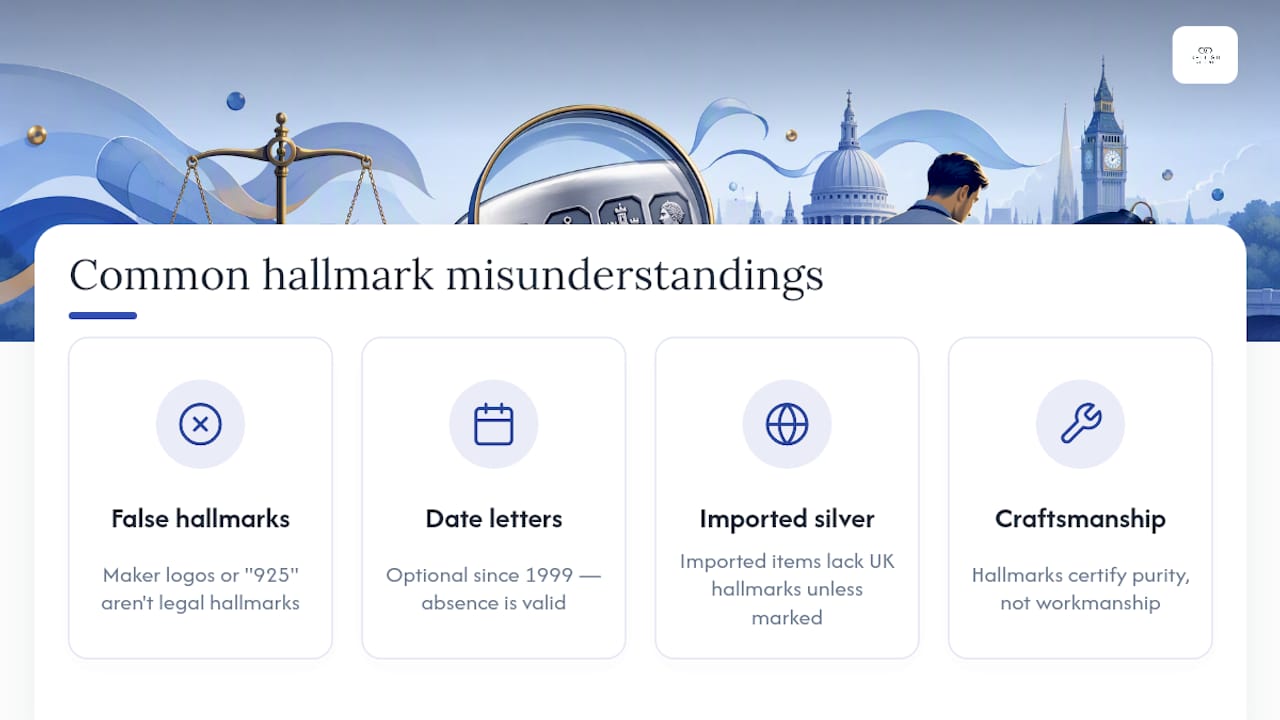
A surprising number of buyers misread hallmarks, and the mistakes tend to repeat in predictable ways.
The most common one: assuming any stamped symbol on jewellery is a hallmark. Many pieces carry a maker’s logo, a “925” stamp, or a decorative mark with no legal weight at all. A genuine UK hallmark requires the sponsor’s mark, fineness mark, and assay office symbol together, struck by one of the four accredited offices, not a single number pressed into metal by the manufacturer itself.
Another myth: that a missing date letter means a piece is fake or non-compliant. Date letters have been optional since 1999, so a perfectly legitimate, fully hallmarked item can simply not carry one.
There’s also confusion about imported jewellery. Some buyers assume any silver piece sold in the UK, regardless of origin, has passed through a UK assay office. It hasn’t, unless it carries a genuine British hallmark or a recognised international convention mark accepted under UK law.
Finally, plenty of shoppers believe a hallmark guarantees craftsmanship or design quality. It doesn’t. A hallmark verifies metal purity and traceability to a testing office. It says nothing about how well a clasp is soldered or how a chain will wear over time, which is a separate question worth asking your retailer directly.
Where did the UK’s assay office system come from?
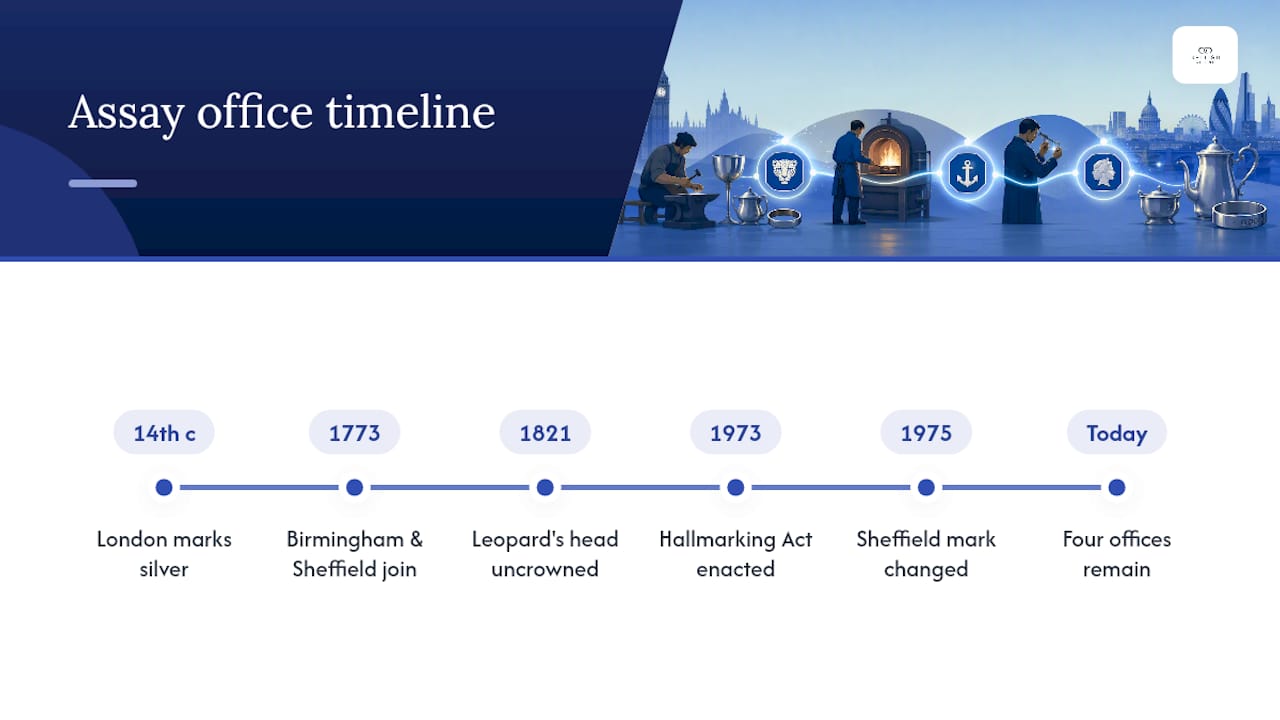
The hallmarking system is older than most people expect. London’s Goldsmiths’ Company was already marking silver by the 14th century, making it one of the longest continuously operating consumer protection schemes in Britain.
The leopard’s head became London’s mark early on, and it carried a crown from the medieval period until 1821, when the crown was dropped, giving collectors a genuinely useful dating clue on older pieces. Birmingham and Sheffield only joined the system in 1773, when a parliamentary act, driven partly by lobbying from Midlands manufacturers including Matthew Boulton, established assay offices outside London for the first time. Edinburgh’s office has its own separate history rooted in Scottish goldsmiths’ guild traditions predating the 1773 expansion.
Offices have opened and closed over the centuries. Chester, Exeter, Newcastle, and several others operated at various points before consolidation left the UK with the four offices working today: London, Birmingham, Sheffield, and Edinburgh. Sheffield’s own move from a crown to the York rose in 1975 shows the system still evolves rather than sitting frozen in tradition.
The legal framework caught up gradually too, culminating in the Hallmarking Act 1973, which brought the various historical practices under one consistent statutory structure and created the British Hallmarking Council to oversee it. That’s the same framework governing every hallmark struck in the UK today, nearly two and a half centuries after Birmingham and Sheffield first joined London in the trade.
How do UK hallmarks differ from marks used abroad?
The UK’s system is stricter, in one specific sense, than most countries’ equivalents: it’s compulsory and independently tested, rather than self-declared by the manufacturer.
Many European countries use their own national fineness marks, and some participate in the International Convention on hallmarks, which allows a piece hallmarked in one member country to be recognised in another without retesting. The UK is a signatory to that convention, so a Convention Mark from an approved overseas office can be legally sold in Britain without a separate UK strike.
The United States, by contrast, has no compulsory independent assay system at all. American sellers typically self-mark items with a fineness stamp such as “925,” and that mark is a manufacturer’s declaration rather than a third-party test result. There’s no equivalent to Britain’s assay offices verifying the claim before sale.
That gap catches out buyers more often than you’d think. A “925” stamp from an unfamiliar overseas seller looks identical to a genuine UK fineness mark at a glance, but only the UK version has actually been tested by an accredited office and paired with a legally required assay office symbol. If a piece carries a UK town mark, leopard’s head, anchor, rose, or castle, you know a specific accredited office in London, Birmingham, Sheffield, or Edinburgh has independently confirmed that metal’s purity. That’s a meaningfully different guarantee to a stamp the manufacturer applied to its own product.
Why hallmarked stock matters to us
We only sell sterling silver hallmarked to UK legal standards, because a customer shouldn’t have to take our word for what’s in a chain. Fineness and hallmark details sit on every product page, next to the specifications and photographs, not buried in a policy document somewhere else on the site.
— British
Where to buy hallmarked sterling silver chains
Every chain we sell carries a genuine UK hallmark, so the assay office mark, fineness number, and sponsor’s initials are there to check, not just to take on trust.
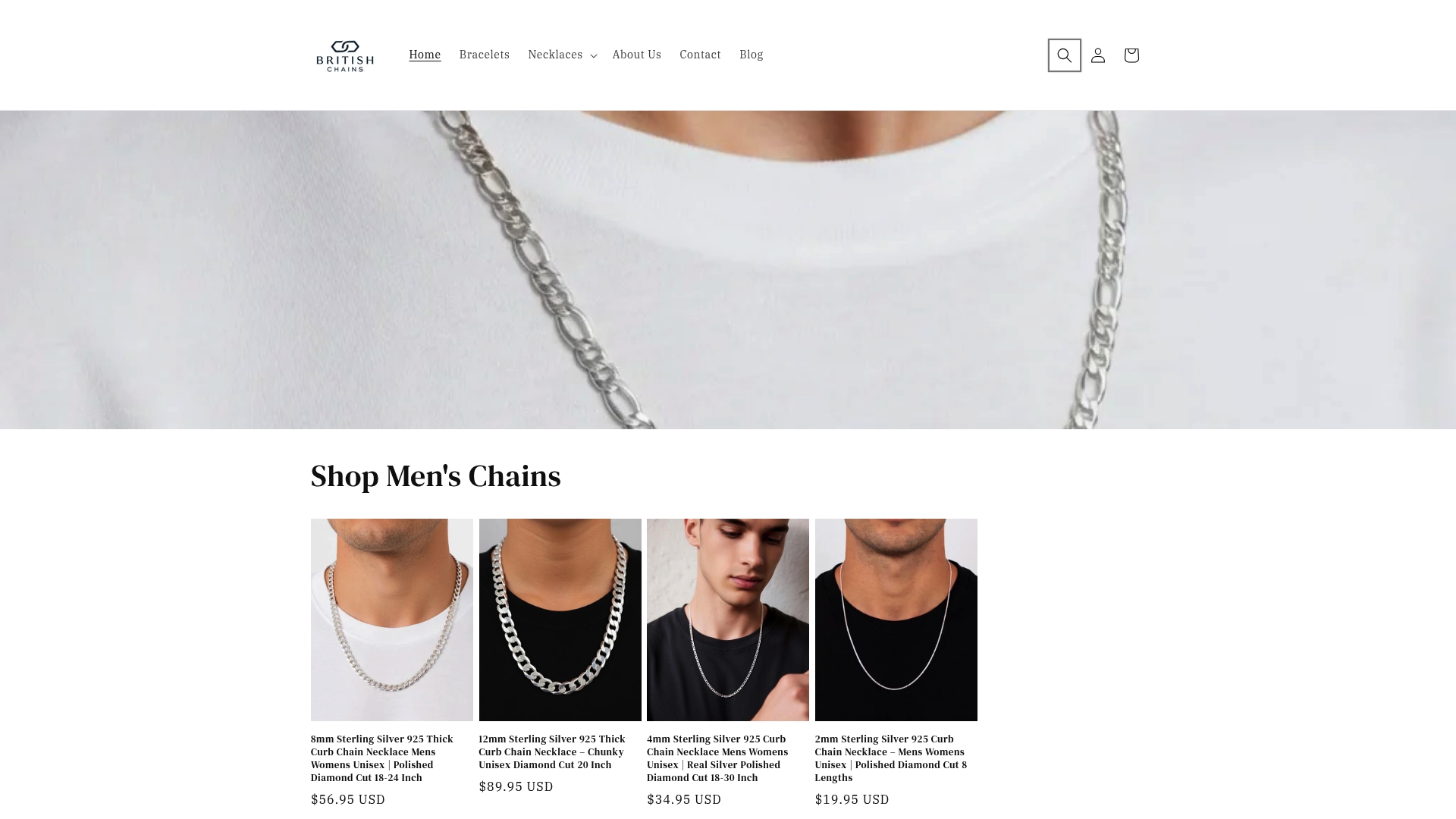
For everyday wear, the 2mm curb chain necklace is the one most customers reach for first: understated, hardwearing, and available across eight lengths so it fits most necks without alteration. If you want something with more presence, the 8mm thick curb chain has the weight and polish to work as a genuine statement piece rather than a background accessory.
Anyone shopping for a gift, particularly for younger wearers or anyone with sensitive skin, tends to land on the 2mm snake chain necklace, which is hypoallergenic and sits close to the neck without the links catching on clothing. And for a twisted finish that catches the light differently to a plain curb, the 4mm rope chain necklace is diamond cut for extra sparkle without the price jump of gold.
Hallmark and fineness details sit on every listing alongside the sizing and weight specifications. If you want a closer look before you buy, ask us for a macro image of the actual hallmark on your chosen piece, and we’ll send one over.
Sources
For up-to-date fees, trace requests, or legal detail beyond this guide, go directly to the official sources rather than a secondary summary.
- Gov
- Hallmarking | Birmingham Assay Office
- Hallmarking Act 1973 — Schedule 2: U.K. approved hallmarks


