

How to spot high-quality silver product photos
Seven checks decide whether a sterling silver product photo is trustworthy: a readable hallmark close-up, consistent surface finish, correct scale with a reference object, multiple angles including the clasp, a video or moving clip, provenance metadata (EXIF or Content Credentials), and clear seller documentation with a returns policy. Run them in that order and you can triage most listings in under two minutes.
- Hallmark close-up: visible, struck into the metal, not printed
- Consistent finish and texture across all images
- Scale reference (ruler, hand, or coin) in at least one shot
- Multiple angles including clasp and any joins
- Short video or GIF showing the chain moving
- Provenance check: EXIF data, C2PA credentials, or reverse image search
- Seller documentation: dealer notice, returns policy, contact details
Pro Tip: Start with the hallmark close-up. If that single image is missing, blurred, or looks printed, the rest of the listing’s photography is already under suspicion.
Key takeaways
Spotting high-quality silver product photos comes down to one rule: a readable hallmark close-up, combined with provenance confirmation and a clear returns policy, reduces buyer risk more than any amount of studio lighting.
| Point | Details |
|---|---|
| Hallmark close-up first | A struck, readable 925 mark sharing the metal’s surface finish is the strongest single trust signal. |
| Run provenance checks | Use Google Lens, TinEye, or Yandex to confirm the image is not reused stock from unrelated sellers. |
| Request specific photos | Ask for a hallmark macro, ruler shot, clasp close-up, video, and gram-scale weight if any doubt remains. |
| Walk away on key red flags | No returns policy, missing dealer notice, or seller refusal to supply originals are decisive reasons to stop. |
| Britishchains standard | Every Britishchains listing includes hallmark close-ups, full 925 documentation, and customer service support for extra images. |
Table of Contents
- What does a trustworthy silver product page look like at a glance?
- How do you read hallmarks in a product photo?
- What photo details reveal whether the silver finish is real or edited?
- Which tools help you check where a silver photo actually came from?
- What documentation should a reputable UK silver seller show?
- Exactly what photos should you ask a seller to send?
- Which red flags should make you walk away immediately?
- Why hallmarks and seller transparency matter more than photography style
- Britishchains hallmarked sterling chains: clear photos, full documentation
- Sources
What does a trustworthy silver product page look like at a glance?
A 30-second visual scan followed by a 60-second provenance check covers the majority of quality silver product images you will encounter. Work through the table below on any listing before you commit.
| Check | Visual cue | Expected action |
|---|---|---|
| Hallmark close-up present | Engraving readable at 10x zoom | Accept; proceed to next check |
| No hallmark visible | No close-up image offered | Ask seller for macro shot |
| Finish consistent across shots | Same sheen, no colour shift between images | Accept |
| Finish varies between shots | Different brightness or colour tone | Query or reject |
| Scale reference present | Ruler or hand in at least one image | Accept |
| No scale reference | Chain appears to float in white space | Ask for measurement shot |
| Provenance metadata present | EXIF shows camera model; C2PA manifest links | Accept |
| Metadata absent or stripped | No EXIF; no Content Credentials | Run reverse image search |
| Returns policy visible | Clearly stated on product or site page | Accept |
| No returns or contact details | Policy absent or hidden | Walk away |
The budget silver jewellery quality checklist from Britishchains covers the same logic for lower-priced listings where documentation is often thinner.
How do you read hallmarks in a product photo?
A clear, crisp hallmark visible in a close-up is the single strongest documentary signal of authenticity in any silver product photo. Everything else is supporting evidence.
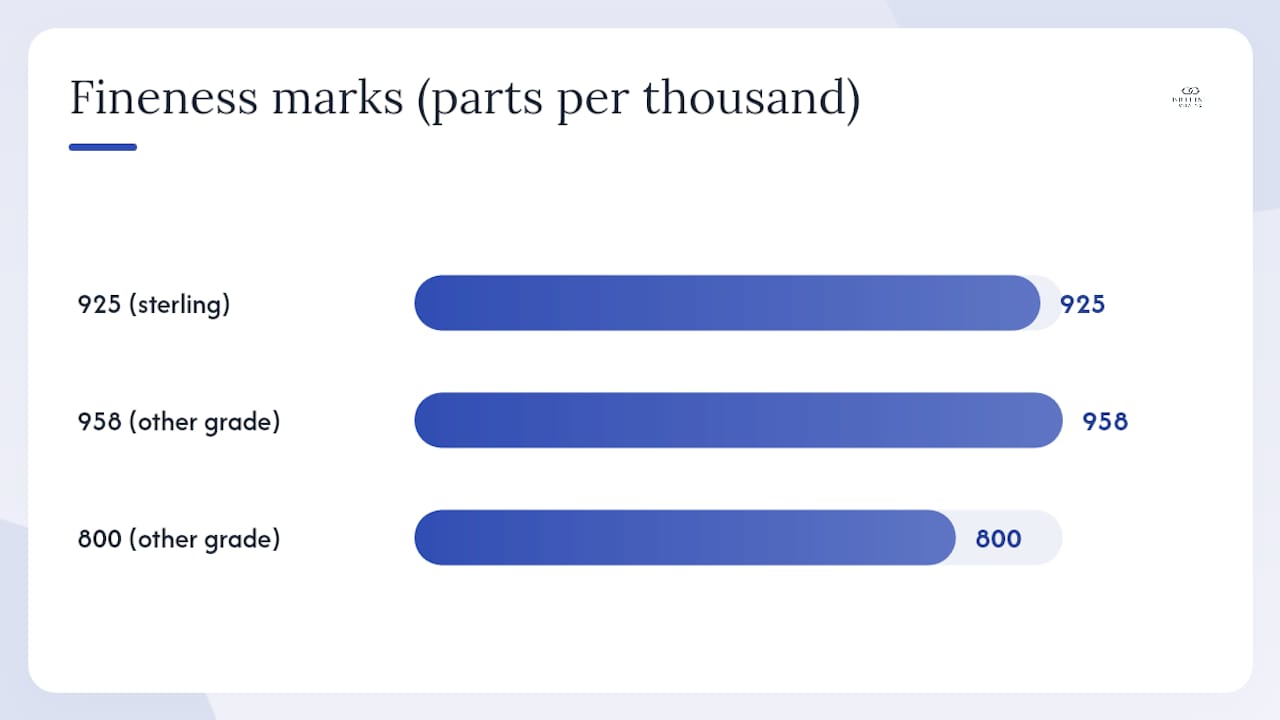
For sterling silver sold in the UK, expect four marks: the fineness mark (925 for sterling, sometimes 958 or 800 for other silver grades), the assay office mark (an anchor for Birmingham, a leopard’s head for London, a rose for Sheffield, a castle for Edinburgh), a sponsor or maker’s mark, and sometimes a date letter. The fineness marks on silver explained guide from Britishchains covers each symbol in detail.
On chains and necklaces, hallmarks are typically struck on the clasp, the barrel of a bolt ring, or a small attached tag. On pendants, check the bail. The mark should sit flush with the surrounding metal, sharing the same surface finish and depth, because a genuine hallmark is stamped or laser-etched into the physical structure of the piece. According to The Gem Press hallmarks guide, if a mark looks like a sticker, appears unusually shallow, or has a different sheen from the surrounding metal, treat it as a significant red flag.
- Zoom to 10x on your phone or use the browser’s zoom to 200% on desktop
- Check that the numerals are engraved, not a typeface overlay
- Confirm the mark shares the same surface finish as nearby metal
- Look for slight tool-mark irregularity around the stamp edges — that is normal on genuine pieces
Pro Tip: When requesting a hallmark photo from a seller, ask for the shot taken at a slight angle to the light source. Raking light reveals depth and surface integration far better than a flat-on flash shot.
What photo details reveal whether the silver finish is real or edited?
Look for physically plausible metal behaviour first: joins, shadows, texture, and natural variation. Then look for the artefacts that editing leaves behind.
Genuine sterling silver under magnification shows micro-variation: slight asymmetry between chain links, small solder joints at joins, and subtle oxidation in recessed areas. A polished diamond-cut curb chain will show crisp facets, but those facets will not be geometrically identical from link to link. That slight irregularity is a sign of a physical object, not a render.
Common manipulation artefacts are easier to spot than most shoppers expect. According to Viral, zooming to 150–200% reveals prong dropout on set stones, repeated texture patterns that tile across the image, and fused chain links where joins have been smoothed away entirely. AI generation in particular struggles with complex chain repeats and thin bezel walls, producing digitally perfect repetition that no physical handmade chain would show.
A single floating prong or a hallmark that appears to sit on top of the metal rather than within it is usually enough to confirm heavy compositing. You do not need to find multiple artefacts — one physically impossible detail is sufficient reason to ask for originals.
Which tools help you check where a silver photo actually came from?
Provenance tools are strong signals but not definitive proof. Use them to triage listings quickly, then follow up with the seller if results are inconclusive.
The recommended two-minute workflow runs in this order:
- Reverse image search. Drag the product image into Google Lens, TinEye, and Yandex. Yandex has a visual-similarity-heavy index that works well for jewellery; TinEye is strong for tracking reuse across sites. If the same photo appears on many unrelated seller pages, that is a clear red flag.
- Check EXIF data. Right-click the image and open properties, or paste the URL into an EXIF viewer. A camera model and original timestamp suggest a genuine studio shoot. Software markers like “Adobe Firefly” or “Midjourney” indicate AI generation.
- Check Content Credentials. Paste the image URL into Contentcredentials to see whether a C2PA manifest is attached. A valid manifest shows which software or pipeline produced the image.
- Run a classifier as a second opinion. Tools such as Google Gemini and OpenAI’s image verification features can detect SynthID watermarks or flag AI-generated content.
According to Malwarebytes, a missing watermark is inconclusive — messaging apps and screenshot workflows strip metadata routinely. A valid C2PA credential proves the pipeline, not the truth of the scene. Treat a clean provenance result as reassuring, not conclusive, and combine it with the visual checks above.
What documentation should a reputable UK silver seller show?
A trustworthy UK retailer will display hallmark information, a clear returns policy, and seller contact details on every precious metal product page. Under the Hallmarking Act 1973, dealers supplying items described as precious metal must display an approved dealer notice — either Dealers Notice A (printed in black and white, minimum A4 size, clearly legible) or Dealers Notice B (available as a PDF or short film for online settings).
| Documentation | Where to find it | What it signals |
|---|---|---|
| Hallmark close-up photo | Product image gallery | Metal purity verified |
| Assay office claim | Product description | UK hallmarking compliance |
| Dealers Notice A or B | Footer, product page, or dedicated policy page | Legal obligation met |
| Returns policy | Checkout or product page | Buyer protection present |
| Seller contact details | Header, footer, or contact page | Accountable seller |
If documentation is missing, ask the seller directly. For buying authentic sterling silver online, Britishchains notes that a seller who cannot or will not supply a hallmark close-up within a reasonable timeframe is itself a warning sign. For high-value purchases, Blackwell Jewellers advise that simple at-home checks — magnet test, cloth rub — can screen obvious fakes, but professional testing at an Assay Office remains the definitive step.
Exactly what photos should you ask a seller to send?
Ask for one specific set of images and a short video. That single request resolves most remaining doubt faster than any amount of back-and-forth.
- Macro close-up of the hallmark, shot at a slight angle to the light source to show depth
- Full chain laid flat on a neutral background with a ruler alongside it for scale
- Close-up of the clasp showing the join and any secondary marks
- Short video (10–15 seconds) of the chain moving or being lifted, showing how links behave
- Weight shot: the item on a gram scale with the reading visible
- One image on a plain mid-grey background showing natural shadow behaviour
Swift Values recommend laying items with their hallmarks and weights visible in a single clear photograph — that same standard is exactly what you should request from a seller.
Copy this message: “Could you please send a close-up of the hallmark (shot at a slight angle to show depth), the chain laid flat with a ruler, a clasp close-up, a short video of the chain moving, and a weight shot on a gram scale? Original JPEG or PNG files preferred, not screenshots.”
If the seller refuses or sends low-resolution substitutes, treat that as a red flag equivalent to a missing hallmark. A reputable seller photographs this material as standard; the request should take them minutes, not days.
Which red flags should make you walk away immediately?
Certain signals outweigh all other positive cues. If you see any of the following, stop.
- The same photo appears on multiple unrelated seller pages (confirmed by reverse image search)
- The hallmark reads as a typeface, looks printed, or sits on top of the metal surface
- The seller refuses to supply a hallmark close-up or original image files
- No returns policy or seller contact details are visible anywhere on the site
- The UK dealer notice (Dealers Notice A or B) is absent on a precious metal listing
- The price is implausibly low relative to the claimed weight and purity
Scam listings frequently use urgency: a limited-time price, a countdown timer, or a message that stock is nearly gone. That pressure is designed to make you skip the checks above. Slow down. A genuine seller with genuine stock will still have it tomorrow.
The how to spot fake sterling silver guide from Britishchains covers the photographic cues for plated and imitation silver in more detail.
Why hallmarks and seller transparency matter more than photography style
The conventional wisdom about quality silver product photos focuses on lighting and resolution. Those things matter, but they are also the easiest to fake. A beautifully lit, high-resolution image of a silver chain tells you almost nothing about the metal underneath it.
What actually reduces buyer risk is the combination of a physically struck hallmark visible in a close-up, a seller who meets their legal obligations under the Hallmarking Act, and provenance tools that confirm the image is original. Those three things together are far harder to fabricate than a polished studio shot.
At Britishchains, every product listing is built around this principle: hallmark close-ups, multiple angles, and full seller documentation are not optional extras — they are the baseline. When doubt remains after checking photos and documentation, the Assay Office or an independent tester is the final word. No photograph, however good, replaces physical verification for a high-value purchase.
Britishchains hallmarked sterling chains: clear photos, full documentation
Britishchains lists hallmarked sterling silver chains with product photography built around the checks described above: hallmark close-ups, multiple angles, clasp detail, and full seller documentation on every page.
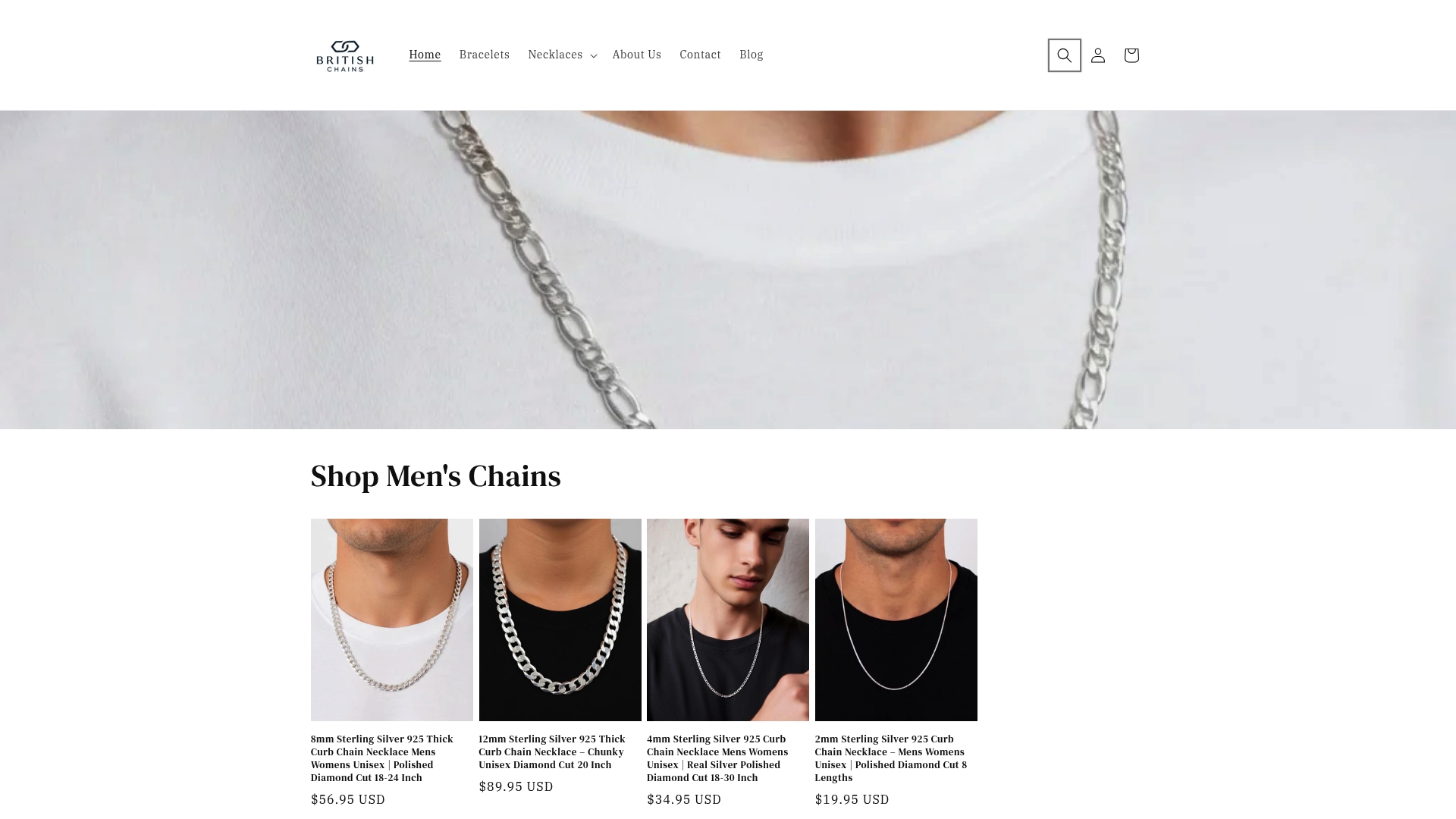
Three listings show this standard clearly. The 8mm sterling silver curb chain includes a polished diamond-cut finish across 18–24 inch lengths, with hallmark photography and full 925 documentation. The 12mm chunky curb chain shows multiple angles on a bold 20-inch unisex piece. For a slimmer option, the 2mm Figaro chain includes clasp close-ups across multiple lengths. If you need additional images or a hallmark macro shot for any listing, contact Britishchains directly — the customer service team supplies originals on request.
Sources
- Gov
- How to tell if an image is AI-generated | Malwarebytes
- UK Jewellery Hallmarks Explained: A Complete Guide — The Gem Press
- How to Spot Fake Silver Jewellery (UK Edition) — Blackwell Jewellers
- Viral


