

Use the 1.5× Bail Rule: Chain Links Explained for UK Buyers
A jewellery chain is simply a line of connected metal links, and the link shape decides everything: how it drapes, how strong it is, and how easily it’s repaired. For a pendant, choose cable, box, curb or wheat, all closed-link constructions a jeweller can mend. For a statement piece worn alone, curb, rope or paperclip hold their own. Herringbone and snake look sleek but kink permanently if bent sharply, so treat them as occasional wear rather than daily armour.
TL;DR:
- Closed-link chains like curb, cable, and box are easier to repair, more durable, and better suited for daily wear and carrying pendants.
- Open-link styles such as rope, paperclip, and wheat provide flexibility and distinct aesthetics, with moderate repairability depending on construction.
- Chain materials and manufacturing choices, like soldering versus unlinked joints or hollow versus solid links, significantly affect longevity and resistance to kinks or damage.
- For everyday use, choose chains with secure clasps and appropriate width based on intended wear, pendant size, and neckline considerations.
- Proper storage, regular inspections, and gentle cleaning extend a chain’s lifespan, especially for delicate or textured styles prone to permanent kinking.
Table of Contents
- Chain link types explained: the main families you’ll meet
- How to choose the right chain: width, length and link type
- Materials and construction: why some chains kink and others don’t
- Caring for your chain so it lasts
- Matching your chain to necklines and outfits
- Clasp types and how secure each one really is
- Measuring chain length and standard sizes
- Where these chain styles actually come from
- Why repairability should guide your next purchase
- Ready to choose your chain from Britishchains
- Sources
- FAQ
Chain link types explained: the main families you’ll meet
Walk into any jeweller and the names blur together fast. Curb, rolo, Figaro, wheat. They sound interchangeable until you’ve handled a few and felt the difference in your hand. Understanding chain links really comes down to spotting how each one is built, because construction dictates behaviour far more than appearance does.
Cable chain is the starting point for nearly everything else. Identical oval links loop through each other in a simple, repeating pattern. It’s the chain most people picture when they hear the word “necklace”, and its open, uniform links make it one of the easiest constructions for a jeweller to shorten or repair. Fine cable runs from around 1mm for delicate layering pieces up to 3mm or so before it starts reading as chunky.
Rolo (or belcher) is a close cousin: rounded, slightly flattened links that sit tighter together than standard cable, giving a smoother, more polished line. It’s a popular choice for charm bracelets because the round profile lets charms swing freely without snagging.
Curb chain, sometimes called Cuban link at heavier gauges, twists each oval link so it lies flat against the next, creating a tight, interlocking surface with almost no gaps. This is the workhorse of the chain world. According to Halstead’s chain glossary, curb is one of the constructions jewellers most commonly recommend for pendants because its closed, uniform links are straightforward to repair if a jump ring fails.
Figaro chain alternates one or two short curb links with a single elongated link, producing that distinctive rhythm you’ll recognise from classic Italian gold jewellery. It reads as more decorative than plain curb without sacrificing much strength.
Rope chain twists multiple small links together in a spiral, mimicking actual twisted rope. The texture catches light beautifully and hides minor surface scratches better than a flat chain would, which makes it a forgiving option for daily wear.
Box chain uses square links connected at right angles, so from any side it looks like a continuous line of tiny cubes. It hangs with a distinctive stiffness, sitting slightly away from the neck rather than draping loosely.
Snake chain is where construction starts working against durability. Tightly connected round or oval plates create a smooth, scaled surface with no visible individual links at all. It moves beautifully, almost liquid against skin, but that same tight construction means a sharp fold leaves a kink that no amount of gentle bending back will fully erase.
Herringbone chain takes flattened links and packs them at an angle, producing a wide, ribbon-like band with a mirror shine. It’s arguably the most visually dramatic option on this list and also the most fragile in the wrong hands. Opulent Opal’s chain guide groups herringbone among the solid, woven-style chains, distinct from open-link families like cable or curb.
Wheat (or spiga) chain braids oval links in a criss-cross pattern resembling a stalk of wheat. It’s dense, strong for its width, and holds its shape well, making it a solid middle ground between plain cable and something more ornamental.
Paperclip chain has surged in popularity: elongated, flattened oval links that genuinely resemble stationery paperclips laid end to end. The oversized open links give it a modern, architectural look and, being open links, they’re relatively repairable.
Mariner (or anchor) chain features oval links with a bar across the centre, echoing traditional ship anchor chain links. It’s chunky, distinctive, and tends to appear in heavier statement pieces rather than fine layering chains.
Bead (or ball) chain strings small spheres along a wire rather than using interlocking links at all. It’s the chain you’ll recognise from military dog tags, cheap and functional in its plainest form, though sterling silver versions elevate it considerably.
- Open-link families (cable, curb, rolo, box, wheat, paperclip, mariner): closed loops a jeweller can cut, resize or repair individually.
- Woven or solid families (herringbone, snake): smooth uninterrupted surfaces, prone to permanent kinking, harder to repair invisibly.
- Decorative or hybrid styles (Figaro, rope): borrow strength from open-link construction while adding visual interest.
| Chain type | Typical width | Repairability | Best suited to |
|---|---|---|---|
| Cable | 1mm to 3mm | Easy, closed links | Pendants, layering |
| Curb | 2mm to 6mm+ | Easy, closed links | Pendants, everyday wear |
| Figaro | 2mm to 5mm | Moderate | Decorative daily wear |
| Rope | 2mm to 6mm | Moderate | Statement, everyday |
| Box | 1.5mm to 4mm | Easy, closed links | Structured pendants |
| Snake | 1mm to 3mm | Difficult, kinks permanently | Occasional, careful wear |
| Herringbone | 2mm to 6mm | Difficult, kinks permanently | Dress wear, special occasions |
| Wheat | 1.5mm to 4mm | Moderate | Everyday, layering |
| Paperclip | 2mm to 5mm | Easy, open links | Modern statement, layering |
| Mariner | 3mm to 7mm | Moderate | Bold statement |
| Bead | 1mm to 2mm | Easy to restring | Casual, tags-style pieces |
How to choose the right chain: width, length and link type
Start with the job the chain needs to do, then work backwards. A chain meant to carry a pendant behaves completely differently to one worn bare, so sizing decisions that ignore that distinction usually end in disappointment.
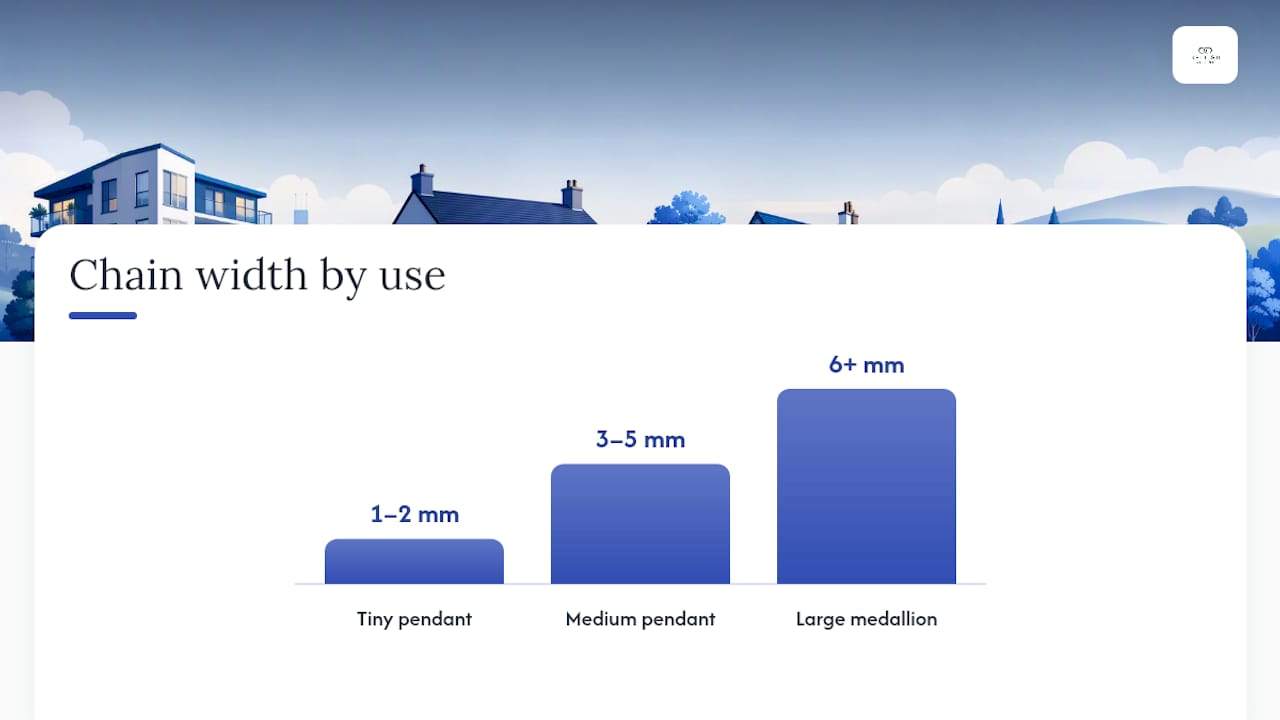
Width guidance by use case. Jewelers of America notes that chains are measured in millimetres for width, with fine everyday chains typically running 1mm to 2mm and statement pieces often reaching 3mm to 7mm or beyond. Wider chains hold their shape better when worn alone; thinner ones are built for carrying something else. Opulent Opal breaks this down further: roughly 1mm to 2mm for tiny pendants, 3mm to 5mm for medium pendants or lockets, and 6mm or heavier for large medallions.
The bail rule. A pendant’s bail, the small loop it hangs from, should comfortably slide over the chain without excess play. A useful rule of thumb from retail guidance is that chain thickness should sit at roughly 1.5 times the bail’s internal width. Too thin, and the pendant slides around and tilts awkwardly. Too thick, and it won’t pass through at all. Our guide on choosing a sterling silver necklace for pendants walks through this pairing in more detail.
Hollow vs solid links. Hollow chains look substantial for their weight and cost, which suits statement pieces you want to feel present without dragging on the neck. Solid links weigh more, last longer under daily stress, and generally survive a lot more abuse before showing wear. For anything worn most days, solid or semi-solid construction earns its keep.
Clasp quality matters as much as the chain itself. A beautifully made curb chain with a flimsy clasp is a chain you’ll eventually lose. Check the clasp before checking the links.
Length changes how a pendant sits. A longer chain gives a pendant more room to swing and can make it feel lighter in wear, while a shorter chain holds it closer and more still against the chest, which matters if you’re stacking multiple pieces.
Here’s a working checklist:
- Identify the job. Pendant support, everyday solo wear, or a statement piece worn alone.
- Pick the family. Open-link (cable, curb, box, wheat) for pendants and repairability; rope or curb for statement durability; herringbone or snake only if you’re prepared to handle them carefully.
- Check the width against the bail. Apply the 1.5x rule, or size up for solo statement wear.
- Confirm the clasp and soldering. Soldered links and a secure lobster or spring-ring clasp mean the chain will survive daily handling.
Pro Tip: If you’re buying a pendant separately from the chain, take the pendant with you (or measure the bail opening precisely) before choosing chain width. A mismatch is the single most common reason people end up with a pendant that won’t sit straight.
For a deeper look at how length affects the overall silhouette, see our guide on choosing the right silver chain length.
Materials and construction: why some chains kink and others don’t
The difference between a chain that lasts decades and one that fails within a year usually comes down to three manufacturing choices: how the links are joined, whether they’re hollow or solid, and how the surface is finished.
Soldering matters more than most buyers realise. A soldered link has been fused shut at the join, closing any gap that could snag, catch or pull open under tension. Unsoldered links, common in cheaper mass-market chains, are more vulnerable to snagging and gradual stretching over time. For anything worn daily, or for a chain carrying a pendant’s weight, soldered construction is worth paying for.
Swaging explains the kink problem. Herringbone and snake chains are typically produced through a process called swaging, where a double-cable or curb structure is drawn through a die and compressed into a flat, ribbon-like form. Continental Bead Suppliers explains that this mechanical compression is what produces the smooth, condensed look, but it also removes the flexibility that open links provide. Bend a swaged chain sharply and the deformation is usually permanent and visible, even after a jeweller attempts a repair.
Solid, semi-solid and hollow chains behave differently under stress. Solid links are cast or drawn from a continuous piece of metal, giving maximum durability at the cost of weight (and, in gold, cost). Hollow chains use a thin outer shell around an empty core, keeping weight and price down while looking similarly substantial. Semi-solid sits between the two. For jewellery you’ll wear most days, solid or semi-solid tends to survive longer.
- Soldered links close the gap that causes snagging and stretching.
- Swaged constructions (herringbone, snake) trade flexibility for a smooth finish.
- Solid links outlast hollow ones under daily wear, though hollow chains cost less and weigh less.
- Diamond-cut and hammered finishes add sparkle but expose more surface area, which can make scratches and tarnish more visible over time.
Diamond-cut faceting, where tiny angled cuts are added to each link to catch light, adds noticeable sparkle but also creates more edges where dirt and skin oils can collect. A hammered or brushed finish, meanwhile, hides minor wear better but shows fingerprints and oils differently. Neither is wrong, but knowing the trade-off helps you set realistic cleaning expectations.
Caring for your chain so it lasts
Good habits add years to a chain’s life, and most of them take seconds.
Storage should match the chain type. Flat, wide chains like herringbone are best stored lying flat in a lined box, since hanging them invites the exact sharp folding that causes permanent kinks. Fine cable and rope chains tangle easily, so keep them in separate compartments or pouches rather than tossed together in one drawer.
Cleaning sterling silver is straightforward. A soft polishing cloth handles light tarnish on plain sterling silver. For chains with detailed diamond-cut facets, a gentle soak in lukewarm water with a drop of mild soap, followed by careful pat-drying, reaches the grooves a cloth can’t.
Inspect solder joints and clasps periodically. Jewelers of America recommends checking clasps and joints regularly, since most lost chains fail at these two points rather than snapping mid-length.
Know when a kink is permanent. If a herringbone or snake chain has folded sharply, straightening it yourself risks weakening the metal further. Halstead’s glossary notes that box and cable chains are generally easy for a jeweller to repair invisibly, while snake and herringbone often retain visible damage even after professional attention.
- Store flat, wide chains lying down; keep fine chains separated to prevent tangling.
- Clean plain silver with a polishing cloth; soak textured or diamond-cut chains briefly in mild soapy water.
- Check clasps and solder joints every few months.
- Remove chains before swimming, sleeping or exercise to avoid the pulling that causes most breaks.
Pro Tip: Put chains on last when getting dressed and take them off first. Snagging on clothing while dressing is one of the most common ways a fine chain link gets stretched or pulled open.
Matching your chain to necklines and outfits
A chain that looks perfect on a mannequin can sit wrong the moment it meets a specific neckline, so it’s worth thinking about outfit shape before link style.
Crew necks and high collars pair well with slightly longer chains, 20 inches or more, that fall below the collar line rather than getting swallowed by fabric. A dainty cable chain disappears under a polo neck; a curb or Figaro at medium length sits visibly above it.
V-necks and scoop necks are the most forgiving, since almost any length works, but a chain that echoes the V shape, sitting at or just above where the fabric meets, tends to look most intentional. This is where a pendant on a fine cable or box chain earns its keep.
Off-the-shoulder and boat necks suit shorter chokers or collar-length chains that draw the eye along the exposed neckline rather than competing with it. A wide herringbone at 14 to 16 inches works beautifully here, precisely because it’s a special-occasion style rather than a daily one.
Layering multiple chains works best when you vary both length and width. Pair a short, thin cable close to the throat with a longer curb or paperclip chain beneath it. Matching widths and lengths too closely just makes chains look like one tangled mess rather than a deliberate stack.
Clasp types and how secure each one really is
The clasp is the part most likely to fail, so it deserves as much attention as the chain itself.
Lobster clasps, the small spring-loaded hook shaped like a claw, are the most common choice on modern chains and offer solid day-to-day security with one-handed operation for most people.
Spring ring clasps use a small ring with a spring-loaded gate. They’re compact and classic looking but can be fiddly to open one-handed, and the spring mechanism can weaken with age faster than a lobster clasp’s.
Toggle clasps pair a bar with a ring it slots through. They’re quick to fasten and make a visible design feature, though they’re generally considered less secure than lobster or spring ring styles because the bar can slip through under the wrong angle of pull.
Box clasps use a tongue that clicks into a box housing, often with a safety figure-eight added. They’re common on heavier statement pieces and rope chains where extra security matters given the weight involved.
Magnetic clasps offer effortless fastening, useful for anyone with limited dexterity, but they’re the least secure option for anything heavier than a light chain, since a firm knock can pull them apart.
For daily wear, lobster clasps paired with a soldered jump ring connection remain the most dependable combination.
Measuring chain length and standard sizes
Measuring a chain correctly takes one minute and prevents the most common return reason: buying the wrong length.
Lay an existing necklace flat and measure end to end in a straight line, not around the curve, or wrap a soft tape measure around your neck at the height you want the chain to sit, then add slack for how loosely you want it to hang. Standard UK lengths run roughly: 14 to 16 inches (choker, sits at the base of the throat), 18 inches (the most common length, resting at or just below the collarbone), 20 to 22 inches (falls at the top of the chest, good for pendants), and 24 inches or longer (statement or layering length, sitting below the chest line). Full step-by-step measuring instructions are in our guide on measuring chain length.
Where these chain styles actually come from
Chain-making is one of the oldest metalworking crafts, and several of today’s most popular styles carry genuine history behind their names. Curb chains take their name from horse tack, the “curb chain” that sits under a horse’s chin on certain bit types, a flat, interlocking design borrowed directly for jewellery because of how neatly it lies against skin. Figaro chains draw their name from Italian goldsmithing traditions and became closely associated with Italian gold jewellery through much of the twentieth century, prized for the rhythmic elegance of alternating link lengths. Mariner chains, unsurprisingly, echo maritime anchor chain, chunky, oval, cross-barred links designed originally for strength under load at sea, later adapted into bold jewellery pieces. Rope chains have symbolised connection and continuity across many cultures for centuries, their twisted structure a natural metaphor that long predates their use in fine jewellery. Snake chains take their name simply from their smooth, scaled resemblance to a serpent’s body, a look that became especially fashionable in mid-twentieth-century design. None of this history changes how a chain performs on your neck today, but it’s worth knowing that the “trend” you’re wearing often has genuine craft heritage behind it.
Why repairability should guide your next purchase
If there’s one thing worth taking from this guide, it’s a bias towards construction over decoration for anything you plan to wear regularly. Soldered, open-link chains such as curb, cable and box will outlast almost any woven alternative, and a jeweller can actually fix them when something goes wrong. Hallmarking and stated silver purity aren’t just formalities; they’re the clearest signal you have that a chain is what it claims to be, long before you find out the hard way whether it kinks or snaps.
— British
Ready to choose your chain from Britishchains
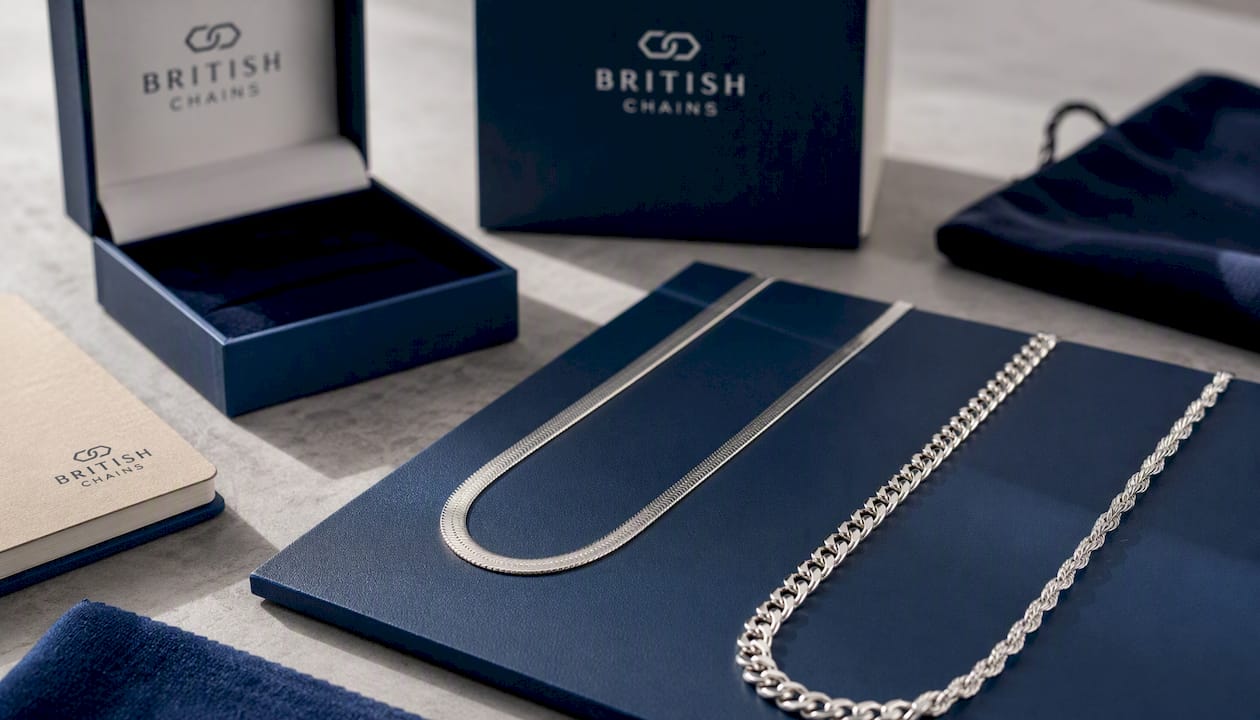
This decision is easier because every chain arrives hallmarked 925 sterling silver with the construction details stated plainly, so you’re never guessing whether a link is soldered or swaged before you buy. If you want a slim, everyday chain that suits a pendant and takes repairs well, the 2mm curb chain necklace is built exactly on the principles covered above: closed links, diamond-cut polish, multiple lengths. For a bolder everyday statement with genuine texture, the 3mm twisted rope chain holds up to daily handling far better than woven alternatives. If polished dress wear is more your occasion, the 2mm herringbone chain necklace delivers the shine, provided you store it flat and handle it with the care this guide outlined.
Not sure which link style fits your wardrobe yet? Browse the full necklace collection and filter by width and length to find the chain that matches how you actually get dressed each morning.
Sources
The company specialises in hallmarked 925 sterling silver, handcrafted in the UK, across the full range of link families covered above. For a slim, pendant-ready everyday chain, the 2mm curb chain necklace fits the open-link, repairable category. For a bolder unisex statement, the 3mm twisted rope chain delivers texture and durability. Sizing help lives in our guides on necklace measurement and chain thickness.
- Chains | Jewelers of America
- Types of Jewelry Chain Link Styles - Halstead
- Types of necklace chains: Every link style explained | Opulent Opal
- The different types of jewelry chains
FAQ
How do you know what size chain link you need?
Match the chain width to the job: 1mm to 2mm for small pendants, 3mm to 5mm for medium pendants or lockets, and 6mm or more for statement pieces worn alone, following the rule that chain thickness should sit at roughly 1.5 times the pendant’s bail width.
What are the different types of chain links?
The main families are open-link styles (cable, curb, rolo, box, wheat, paperclip, mariner), woven or solid styles (herringbone, snake), and decorative hybrids (Figaro, rope), each varying in strength, drape and repairability.
How do chain links work?
Each link interlocks with its neighbours to create a flexible line of connected metal that can bend and drape while distributing weight and tension along its full length rather than at a single point.
What is the point of a chain in jewellery?
Beyond suspending a pendant or standing alone as a statement piece, a chain’s link construction determines how it moves, how much weight it can carry safely, and how easily a jeweller like those working with Britishchains can repair it if a link or clasp fails.


