

3 Solid Silver Choices That Settle Box vs Rope for UK Buyers
Choose rope if you want the chain itself to catch every eye. Choose box if a pendant needs to sit still and stay centred. Rope wins on sparkle because its twisted strands throw light from multiple angles; box wins on stability because its square links form a rigid, geometric track. The one catch: always check whether that rope is solid or hollow, because hollow versions sacrifice most of the durability that makes the style worth wearing.
TL;DR:
- Hollow rope chains are more fragile and harder to repair if kinked or broken, whereas solid ones are more durable and easier to fix.
- Rope chains catch light from multiple angles, creating a brighter sparkle, especially when diamond-cut, but they are less stable for supporting pendants.
- Box chains resist twisting and hold pendants facing forward better, making them preferable for supporting heavier charms or medals.
- Thicker chains, above 4mm, increase sparkle and pendant capacity, but solid construction is essential to ensure longevity and prevent breakage.
- Proper care involves gentle cleaning and storage, with solid chains feeling heavier and more resistant to kinks compared to hollow, springy ones.
Table of Contents
- Box vs rope: the quick comparison
- How are rope and box chains built, and which lasts longer?
- Why does rope chain sparkle more than box chain?
- Which chain holds a pendant best?
- Caring for rope and box chains
- What should you check before buying a rope or box chain?
- Which BritishChains styles fit these buyer needs?
- What the box vs rope debate gets wrong
- Ready to choose your chain? Here’s where BritishChains fits in
- Sources
Box vs rope: the quick comparison
A rope chain looks like a plaited cable, textured and busy, catching glints as it moves. A box chain looks like a fine, continuous square tube, calm and architectural, even when it moves with you.
The trade-offs come down to what job you need the chain to do:
- Sparkle: rope reflects light from dozens of facets as you walk; box gives a flatter, steadier shine.
- Flexibility: rope drapes and coils fluidly against skin; box holds its shape and lies flatter.
- Pendant rotation: box keeps a pendant facing forward; rope can twist so the pendant turns side-on.
- Best use: rope for a standalone statement piece, box for supporting a pendant or medal.
- Thickness effect: a thicker rope (4mm+) amplifies sparkle and weight; a thicker box (4mm+) adds pendant capacity without adding much bulk.
If durability is your main worry, skip ahead to construction. If you already have a pendant waiting for a chain, jump straight to the sizing section below.
How are rope and box chains built, and which lasts longer?
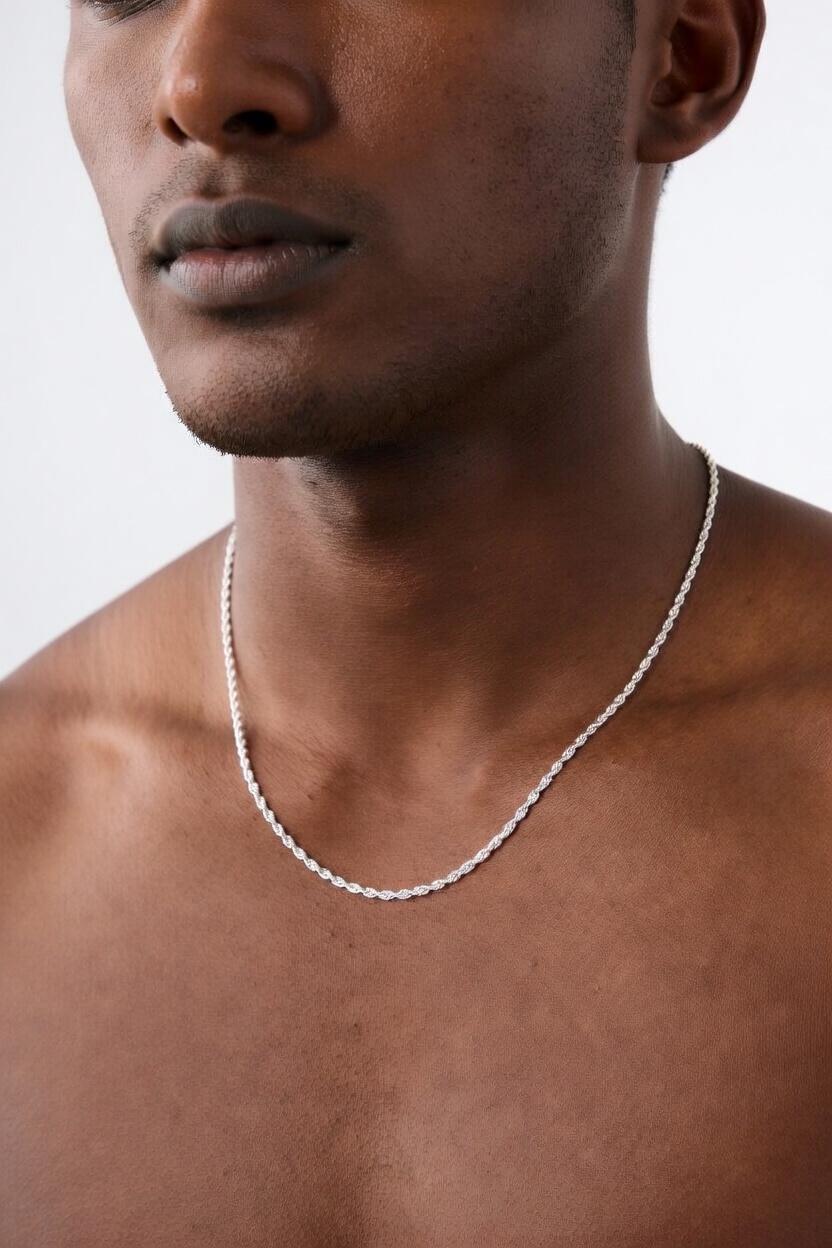
Rope chains are formed by twisting multiple strands of silver wire into a helix, similar to plaiting rope fibres, which is exactly where the name comes from. That twist is what generates the sparkle, but it also creates a structure that can catch on clothing and, if pulled hard enough, kink at a weak point.
Box chains are built from square or rectangular links connected at right angles, forming a tight, uniform tube. That geometry resists stretching and holds a pendant steadier than a twisted structure does, which is why jewellers reach for box or curb-style profiles when a heavier medal or charm is involved.
The bigger variable, in either style, is solid versus hollow construction. Hollow rope chains use less silver and cost less, but they’re markedly more fragile and far harder to repair once a link gives way. A hollow chain that kinks often has to be replaced rather than mended; a solid one can usually be soldered back together.
Common failure points to watch for:
- Kinking at a single twist point on hollow rope chains under sudden tension.
- Link deformation on box chains from crushing pressure, not stretching.
- Solder seam failure near the clasp on both styles after years of daily wear.
Pro Tip: Pinch the chain gently between your fingers. A solid chain feels dense and resists any give; a hollow one feels light and slightly springy. If in doubt, ask for the hallmark and check it against solid vs hollow guidance before buying.
Why does rope chain sparkle more than box chain?
Rope chains catch light from multiple angles because of their twisted strands, which act almost like dozens of tiny mirrors set at different tilts. Box chains, by contrast, reflect light on flatter planes, producing a more restrained, architectural shine rather than a scattergun flash.
Finish matters as much as shape. A diamond-cut rope chain amplifies that multi-angle glitter further, while a polished box chain leans into smoothness and understatement. Movement changes the effect too: rope chains flash more as you walk or turn your head, while box chains hold a steadier, more constant gleam under the same light.
A few styling cues worth knowing:
- Rope suits evening wear, statement outfits, and anyone happy to be the focal point.
- Box suits daywear, layered looks, and anyone who wants restraint rather than flash.
- Diamond-cut finishes favour rope; mirror-polished finishes favour box.
Which chain holds a pendant best?
Box chains keep pendants centred and facing forward because their square-link geometry resists twisting. A rope chain’s helical structure, useful for sparkle, works against it here: the pendant can rotate to show its edge rather than its face, especially with a loosely fitted bail.
A few pairing rules worth following:
- Match bail clearance to chain width. The bail’s inner loop should sit close to the chain’s diameter, not loosely oversized, or the pendant will swing and turn.
- Test rotation before buying. Slide the pendant onto the display chain and give it a shake. If it spins freely, it will do the same on your neck.
- Size the chain to the pendant’s weight. A 2mm to 3mm chain suits light charms; anything over roughly 5 grams needs a 4mm or thicker chain, ideally in box or curb profile, for stability and clasp longevity.
Retailers who’ve compared the two side by side routinely find that box chains rotate far less under light loads than rope chains carrying the same pendant, which is the practical reason box remains the default for anything meant to face forward all day. For readers pairing a chain with a specific charm shape, a pendant styling guide is worth a look before you commit to a width.
Caring for rope and box chains
Rope chains trap dirt in their twists, so a soft-bristled brush with a little mild soap works better than a cloth alone. Box chains have flatter surfaces, so a gentle wipe with a polishing cloth is usually enough to keep them bright.
Storage habits matter more for rope: coil it loosely rather than letting it hang tangled, since repeated kinking is what eventually snaps a weak point. Box chains are more forgiving in a jewellery box because their rigid links resist tangling in the first place.
- Store each chain separately, flat or gently coiled, away from other jewellery.
- Remove chains before swimming, exercising, or applying perfume and lotion.
- Take a chain to a jeweller at the first sign of a stretched link or an opening clasp, before it fails completely.
Pro Tip: A snapped solder joint is a five-minute repair for most jewellers. A crushed or kinked hollow link often means replacing the whole section, so treat hollow chains with extra care.
What should you check before buying a rope or box chain?
Run through this checklist before you commit to either style:
- Hallmark present? Confirms silver purity and traceable origin.
- Solid or hollow? Solid costs more but survives daily wear and repairs far better.
- Width in millimetres. 2 to 3mm for light layering, 4mm and above for statement wear or heavier pendants.
- Clasp type. A lobster or trigger clasp rated for the chain’s weight, not a decorative afterthought.
- Bail size, if buying for a pendant. Should sit snug against the chain, not loose.
- Returns and repair policy. Look for a retailer that stands behind hallmarked pieces after purchase.
The decision itself is simple once the checklist is clear: rope for a chain that’s meant to be noticed, box when a pendant needs to lead. Layering favours thinner rope chains at varied lengths, while a single box chain works better as a base layer under a heavier centrepiece.
Watch for red flags: no visible hallmark, suspiciously thin hollow rope sold as a “statement” piece, or a returns policy that’s vague about repairs. A genuinely solid silver chain will always weigh more in the hand than a hollow one of the same width, and that weight difference is the single most reliable in-store test you can perform without any tools.
Which BritishChains styles fit these buyer needs?
Some retailers hallmark chains to UK standards and offer rope and curb ranges in solid silver rather than hollow tube, which is the detail that determines whether a chain survives years of daily wear or ends up back at a jeweller’s bench within months.
For readers matching a chain to a specific job, three catalogue pieces cover the main cases:
- The 4mm Twisted Rope Chain suits anyone who wants the chain itself to be the statement, with diamond-cut facets built for maximum sparkle.
- The 3mm Twisted Rope Chain suits subtler wear or layering, giving texture without dominating the outfit.
- The 4mm Curb Chain suits pendant-first wear, offering the box-style stability that keeps a medal or charm facing forward.
| Chain | Best for | Care basics |
|---|---|---|
| 4mm rope | Statement wear, no pendant | Brush gently, coil to store |
| 3mm rope | Layering, light pendants | Same brush method, lighter touch |
| 4mm curb | Heavier pendants, daily wear | Wipe with polishing cloth |
What the box vs rope debate gets wrong
Most guides treat this as a beauty contest, rope’s sparkle against box’s polish, and leave it there. That misses the actual decision most buyers face, which isn’t aesthetic at all. It’s a question of what job the chain is doing. A rope chain worn alone is doing all the visual work itself. A rope chain trying to hold a pendant steady is doing a job it wasn’t built for, and that’s where most of the disappointment in this category comes from.
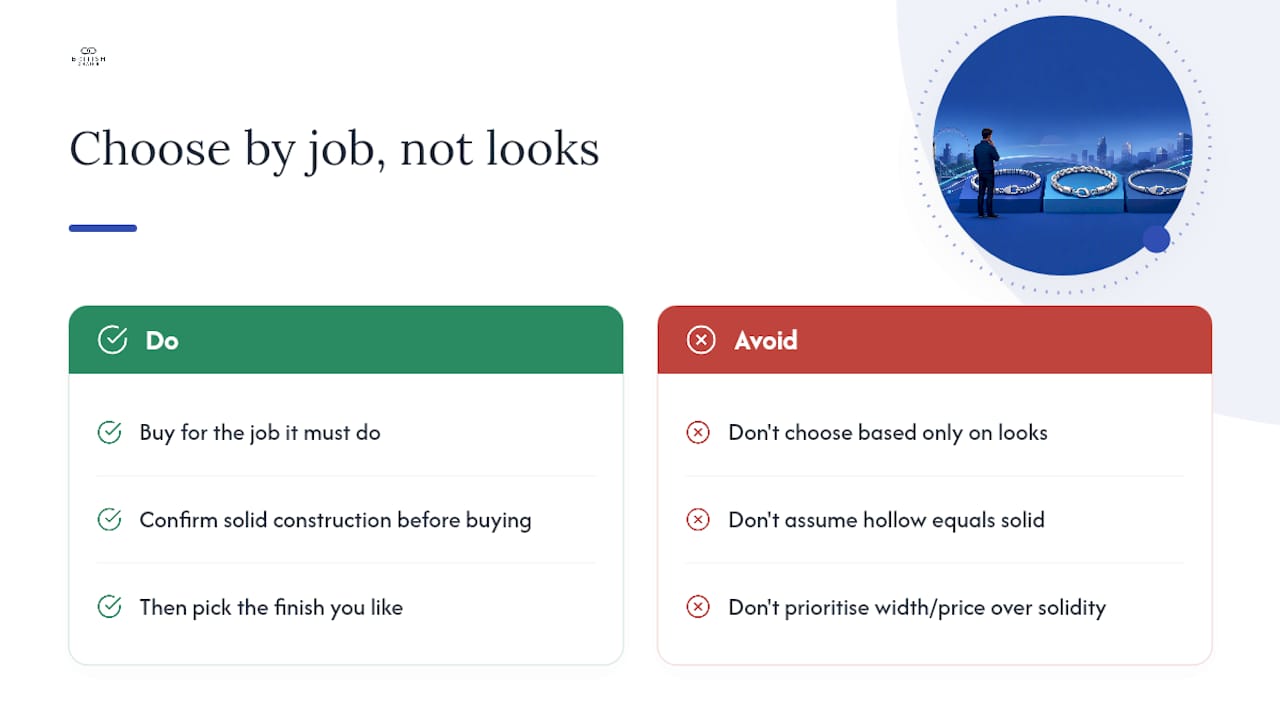
The conventional advice, “pick whichever looks nicer”, skips the one spec that actually determines whether either chain survives daily wear: solid versus hollow. A hollow rope chain photographed for a product listing looks identical to a solid one. Worn daily for a year, it doesn’t behave the same at all. That’s the detail worth prioritising over width, finish, or even price, because a beautiful chain that snaps at six months was never the bargain it looked like on day one.
Buy for the job the chain needs to do, confirm solid construction, then choose the finish you like.
— British
Ready to choose your chain? Here’s where BritishChains fits in
This guide highlights hallmarked, solid sterling silver chains built and finished to UK standards, in both rope and curb profiles, to help with choosing between sparkle and stability. Many chains carry a UK hallmark confirming silver purity, and solid construction is recommended for durability.
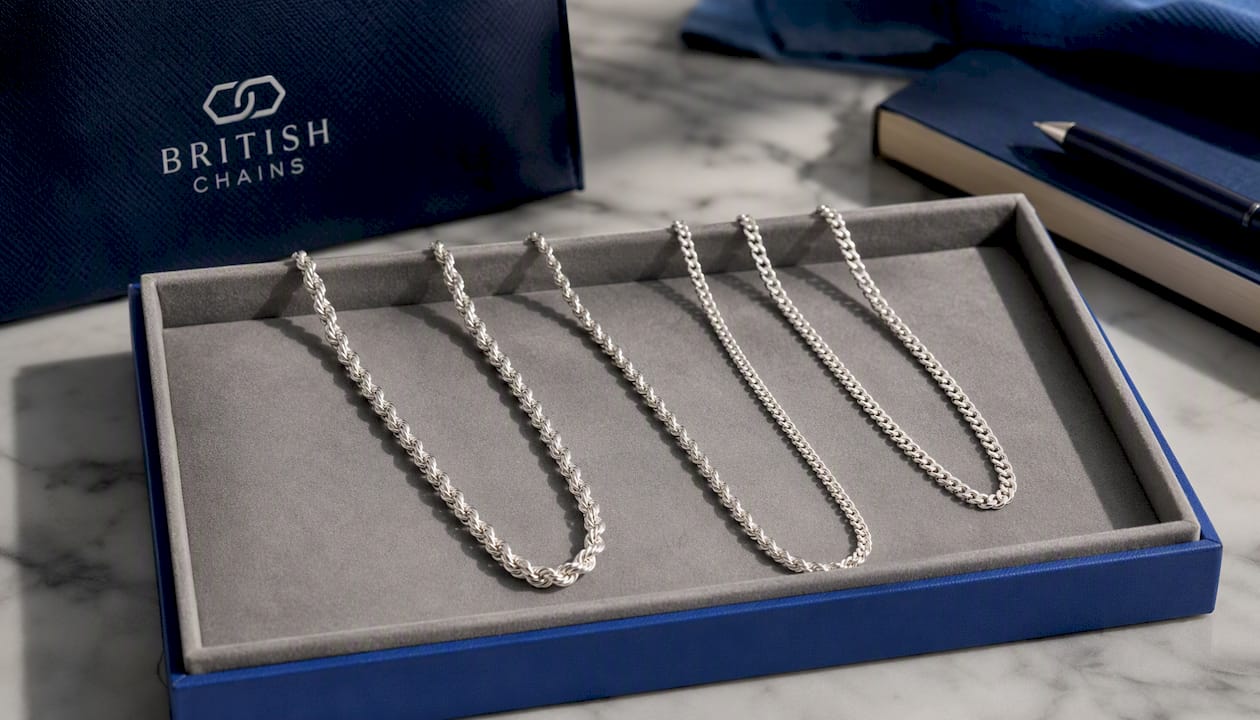
If you want the chain to be the statement, the 4mm Twisted Rope Chain delivers the diamond-cut sparkle this guide describes, in solid silver that won’t kink under normal wear. If you’re pairing a pendant that needs to stay facing forward, the 4mm Curb Chain gives you the box-style stability without the guesswork of an unhallmarked alternative. Browse the full range and check hallmark details, available lengths, and repair policy before you order.
Sources
- Productdif
- Chain Types Explained: Cable, Rope, Box, Figaro & Which Suits a Pendant - Noble Jewelers Aruba
- Gold Chain Styles Guide: Curb, Figaro, Rope and Box


