

Lion Passant Means Sterling 925, Retailer's Quick UK Check
A lion passant stamped into a ring, chain or pendant means the piece is sterling silver, at least 92.5% pure, and that it has passed independent testing at a UK assay office. The mark has denoted this English silver standard since 1544, and its use is regulated under the UK’s hallmarking law. Britishchains lists this information on every hallmarked product page. The sections below explain how to spot the mark, read what sits alongside it, and check it if you have doubts.
TL;DR:
- A genuine lion passant mark indicates at least 92.5% sterling silver and is usually accompanied by the sponsor’s mark, assay office mark, and optional date letter.
- The lion passant appears as a walking lion in profile, stamped on flat areas of jewelry, and is rarely the only mark present in a full hallmark set.
- Modern pieces may display only “925” without the lion, but both marks have the same legal meaning and must be verified by an independent assay office.
- Counterfeit or non-genuine marks include decorative lions, rearing lions (Scottish marks), or items labeled EPNS or plated that lack any official hallmarking.
- To verify suspect marks, check assay office symbols, request documentation, or consult a professional for testing at an assay office or jewelers.
Table of Contents
- What the lion passant denotes and its statutory basis in the UK
- How to recognise a genuine lion passant on a ring, chain or pendant
- Why an official hallmark protects UK buyers
- Common confusions: lion rampant, decorative lions and plated silver
- How to verify a suspect mark: assay offices, records and professional testing
- If you suspect a fake or need a valuation
- Why Britishchains prioritises hallmarked sterling silver
- Buy hallmarked sterling chains built for everyday wear
- Sources
What the lion passant denotes and its statutory basis in the UK
The lion passant is the pictorial fineness mark for sterling silver in England, a standard fixed at 925 parts silver per 1,000. It has carried that meaning since 1544, making it one of the oldest continuously used consumer marks in Britain. That longevity is precisely why it still carries weight with buyers today.
Hallmarking in the UK is not a voluntary courtesy scheme. Under the law governing hallmarking, any item described as silver above a small weight threshold must be independently tested and marked by one of the UK’s assay offices before sale. A retailer cannot simply claim a piece is sterling and stamp it themselves. An assay office has to verify the metal content first.
Since 1999, jewellers have also been allowed to strike the numeric mark 925 alongside or instead of the pictorial lion, following updated hallmarking guidance. That is why you will sometimes see only “925” on a modern chain with no lion at all. Both marks carry the same legal meaning; the lion is simply the older, more decorative version of the same promise.
How to recognise a genuine lion passant on a ring, chain or pendant
The lion passant appears as a small lion shown in profile, walking, with one front paw raised. On jewellery it is usually stamped inside a ring band, on a clasp, on a bracelet tag or on the back of a pendant, wherever there is enough flat metal to take an impression cleanly.
A genuine mark is never alone. UK hallmarking guidance and hallmark reference guides both confirm that a full set of British hallmarks typically includes:
- The sponsor’s (maker’s) mark, unique to the manufacturer or brand
- The fineness mark itself, either the lion passant or the number 925
- An assay office mark showing where the piece was tested
- A date letter, though this is now optional on many modern pieces
If you’re checking a piece yourself, a jeweller’s loupe or a phone camera zoomed right in helps enormously. Look for crisp, consistent stamping rather than a blurred or single lonely symbol; a genuine hallmark set rarely appears as just one mark on its own.
Why an official hallmark protects UK buyers
An assay office mark means someone independent has tested the metal, not just the seller’s own word for it. That distinction matters more than it sounds. Anyone can stamp “925” into a base metal blank; only an assay office’s mark confirms the claim has actually been checked.
That verification pays off later, too. A properly hallmarked piece is easier to value, easier to sell on, and easier to insure, because a jeweller, auction house or insurer can trust the mark without retesting the metal themselves. It also protects you against the more common problem in cheap silver jewellery: pieces sold as “silver” that turn out to be plated base metal once the surface wears through. Britishchains lists hallmark details on every relevant product page, and it’s worth checking what genuine hallmarking looks like before you buy from anywhere.
Common confusions: lion rampant, decorative lions and plated silver
Three mix-ups catch out most buyers. First, the lion rampant, a lion shown rearing up on its hind legs, is the Scottish sterling mark, not the English one. The difference between lion poses tells you which country assayed the piece, which matters for provenance even though both indicate sterling.
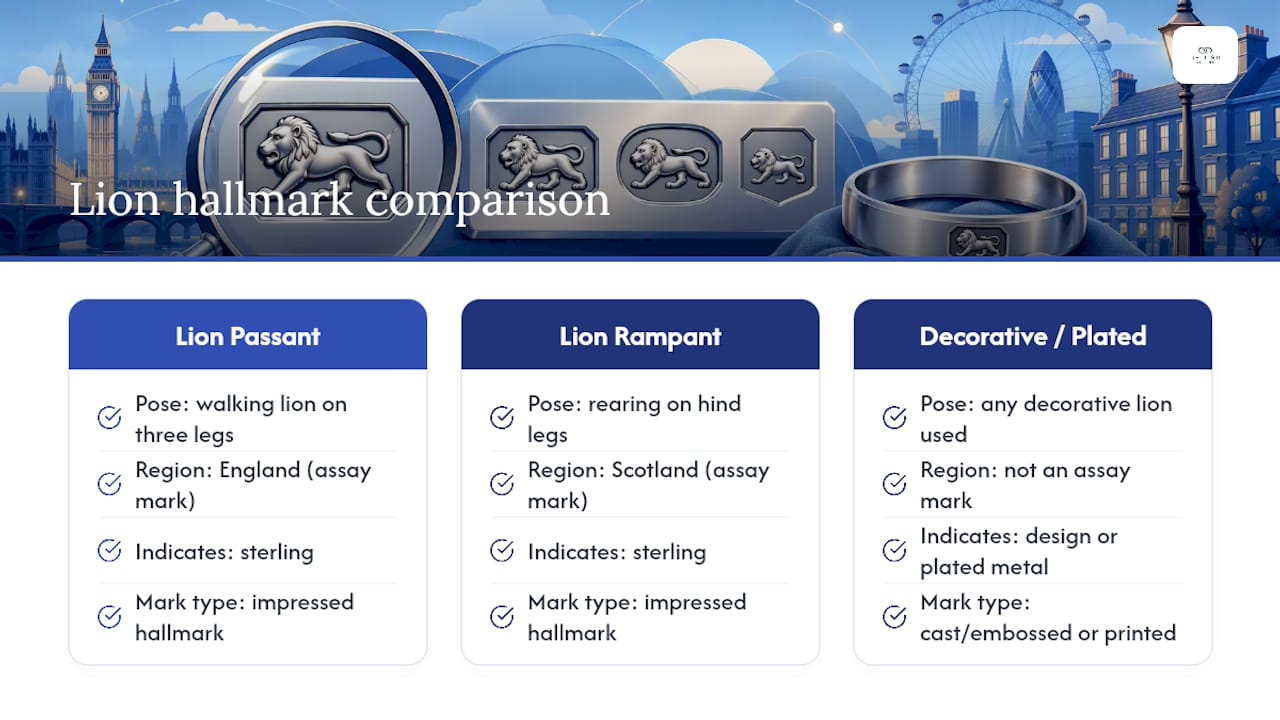
Second, plenty of jewellery carries a decorative lion that has nothing to do with hallmarking at all: cast or embossed into a design rather than struck as an official mark, and never accompanied by a sponsor’s mark or assay office symbol.
Third, watch for EPNS or “silver plated” stamps. These indicate a base metal coated in silver, and genuine hallmarks are impressed, not printed, so plated items simply won’t carry a legitimate mark set at all.
Pro Tip: If you only see one solitary lion with no other marks nearby, treat it as decorative until proven otherwise. A real hallmark never travels alone.
How to verify a suspect mark: assay offices, records and professional testing
England’s assay offices each use a distinct symbol, London’s leopard’s head and Birmingham’s anchor among them, and reading them correctly tells you exactly where a piece was tested. Since 1999, the compulsory trio on any UK hallmark is the sponsor’s mark, fineness number and assay office mark, so start there.
If a mark still looks off, work through this escalation path:
- Ask the seller for the assay reference or paperwork tied to the piece.
- Cross-check the assay office symbol against official GOV.UK hallmarking guidance or a reputable hallmark guide.
- Take the piece to a local jeweller or an assay office directly for a professional opinion or an XRF metal test if genuine doubt remains.
Most confusion resolves at step two. It’s only borderline cases, worn stamps or suspiciously vague sellers, that need step three.
If you suspect a fake or need a valuation
Ask the seller for clear photographs of every mark and any assay documentation, and keep your receipt and listing details regardless of what they say. A reputable UK jeweller can confirm authenticity on the spot, or send the piece for a proper assay test if you want certainty. If you believe you’ve been sold a fake, contact the seller for a refund first, then escalate to consumer-rights advice if they refuse, since selling unmarked items as hallmarked silver is a legal, not just an ethical, problem.
Why Britishchains prioritises hallmarked sterling silver
Every piece we sell is sterling 925, and we state its hallmark status plainly on the product page rather than leaving buyers to guess. That transparency exists because we’d rather lose a sale than sell something we can’t back up. Customer service and returns work the same way: if a hallmarked item doesn’t meet expectations, our team sorts it out directly, no interrogation required.
— British
Buy hallmarked sterling chains built for everyday wear
Britishchains gives you a straightforward alternative to guessing whether a “silver” chain from a marketplace listing is actually what it claims: every chain is sterling 925, and hallmark details sit on the product page itself rather than buried in small print.
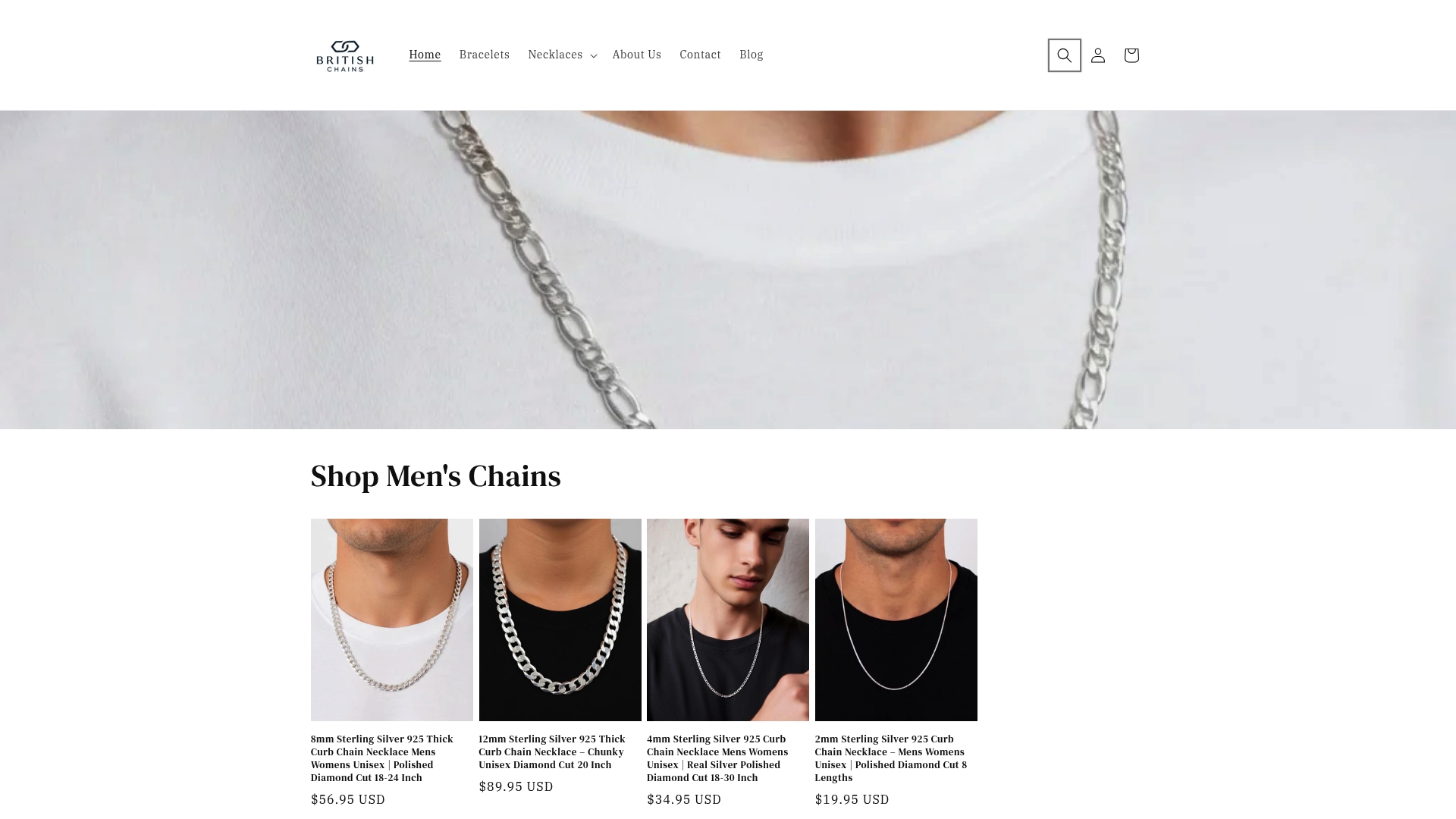
For everyday wear, the 4mm twisted rope chain and 3mm twisted rope chain both hold up well against daily knocks, while the 2mm curb chain suits anyone after a classic, unisex staple. If you want something bolder, the 12mm chunky curb chain makes a genuine statement piece rather than a subtle accent. For sensitive skin, the 2mm snake chain is hypoallergenic and sits close to the neck without irritation, and the herringbone chain or Figaro chain both offer a distinctive link pattern if you want something a step beyond the basics. You can also browse general jewellery placement ideas at Elegance By Design to see where hallmarks typically sit across earrings, rings and chains.
Have a look through the full hallmarked collection and pick the chain that matches how you’ll actually wear it.

Sources
For more detail beyond this guide, the GOV.UK hallmarking guidance and The Silver Society’s identification guide are the two most reliable starting points, alongside Britishchains’ own sterling silver hallmarks guide.


