

Pendants over 3g: Box vs cable chain, choose a 2mm box for UK buyers
For a heavier pendant, a box chain is the stronger, more rigid option; for everyday layering and lighter charms, a cable chain wins on flexibility and easy repair. Neither beats the other outright. The right pick depends on pendant weight, how often you plan to wear it, and how much you mind visiting a jeweller if something goes wrong. The sections below explain the mechanics, styling and care behind that trade-off.
TL;DR:
- Box chains are ideal for heavier pendants because their interconnected square links distribute tension and resist stretching better than cable chains.
- For lightweight pendants or frequent layering, cable chains offer greater flexibility, easier repairability, and a softer drape around the neck.
- Avoid hollow chains under significant pendant weight, and always select solid, medium-gauge links to reduce risk of deformation or breakage.
- Repairs for cable chains are quicker and less costly, whereas box chains may require more careful, longer-lasting fixes by a jeweler.
- Proper care, such as avoiding sleeping or exercising with the chain and inspecting stress points regularly, extends the lifespan of both styles.
Table of Contents
- Box chain vs cable chain: the quick comparison
- How link geometry decides strength and drape
- Which chain looks better on the neck?
- How much pendant weight can each chain carry?
- Durability, repair and everyday care
- How to choose the right chain for your situation
- Why Britishchains backs this guidance
- Our honest take on box vs cable chain
- Find your match in the Britishchains collection
- Sources
- FAQ
Box chain vs cable chain: the quick comparison
Both are workhorse styles, but they solve different problems. A box chain is built from folded square links that lock together like tiny cubes, which gives it a rigid, geometric strength. A cable chain uses rounded oval links joined at solder points, which makes it flexible and forgiving on the neck.
Here’s the shorthand version before the deeper detail:
- Box chain strengths: higher resistance to stretching, reflects light in flat planes, holds shape well under a heavier pendant.
- Box chain weaknesses: a sharp kink can be permanent, and repairs need a jeweller who knows how to re-interlock the links.
- Cable chain strengths: drapes softly, layers well with other necklaces, quick and cheap to repair at a solder point.
- Cable chain weaknesses: more prone to gradual stretching under sustained weight, especially at the clasp end.
Quick picks: daily pendant under 3 grams, go cable. Heavier pendant or a piece you never want to swap, go box. Layering three or four chains together, cable every time. Wanting one clean statement piece with real presence, choose a box chain, or step up to a thick curb chain if you want serious heft. The construction section below explains why the physics works out this way.
How link geometry decides strength and drape
The difference between these two chains comes down to how the metal is shaped before it’s joined.
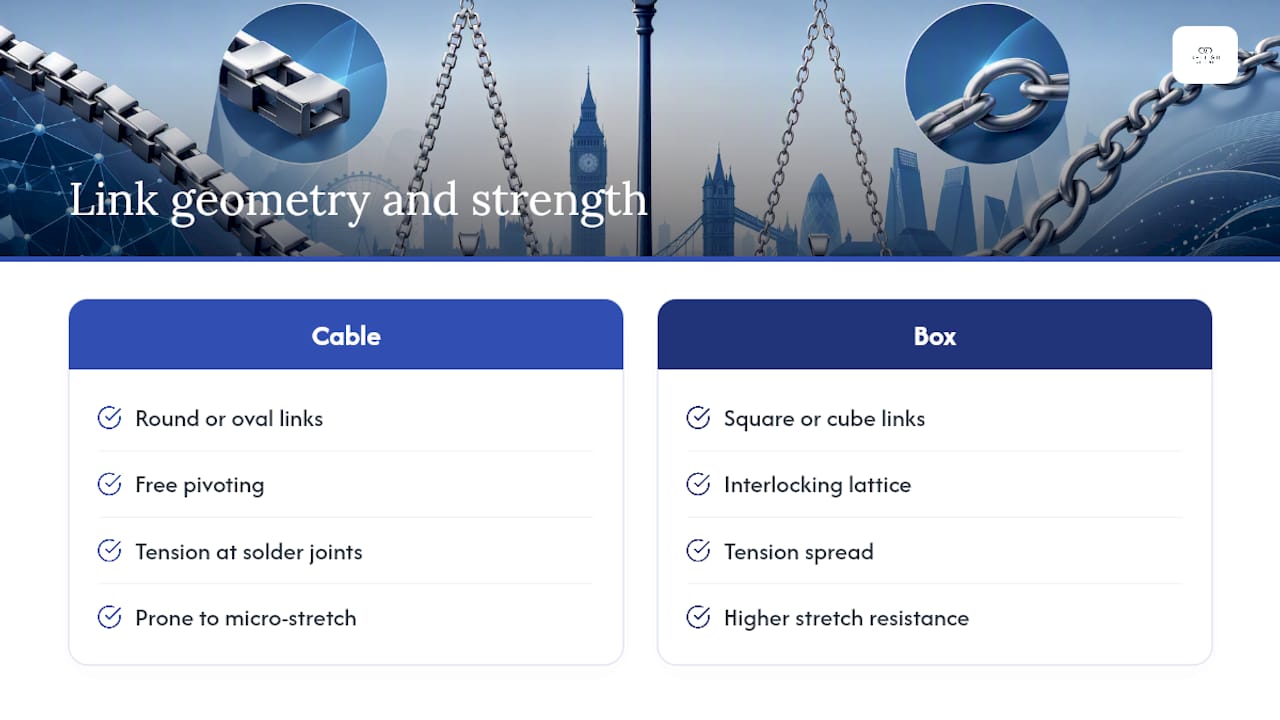
A cable chain is built from uniform round or oval links soldered end to end. Each link can pivot freely against its neighbours, which is exactly why the chain flows and drapes so easily around the neck. The trade-off is that every solder point carries the full load of whatever hangs below it, so repeated stress there causes gradual micro-stretching over time.
A box chain works differently. Square or cube-shaped links interlock tightly, forming what is effectively a cubic lattice down the length of the chain. That geometry spreads tension across multiple contact points rather than concentrating it at a single solder joint, which is why box chains commonly show higher tensile resistance and better long-term stretch resistance than a cable chain of comparable gauge. The catch: because the links are folded rather than simply joined, a sharp bend can crease a link permanently. Cable chains flex; box chains resist bending until they don’t, and then the damage tends to stay.
Gauge matters more than link style in isolation. A thin 1mm box chain is not automatically tougher than a solid 3mm cable chain. Hollow constructions of either type save weight and cost, but they’re the first to deform under strain, so a solid build is worth paying for on anything you’ll wear daily.
Which chain looks better on the neck?
Box chains have a sleek, almost architectural quality. Their flat square links catch light in distinct planes, giving a crisp, mirror-like sparkle rather than a soft glow. Cable chains scatter light more gently across their rounded links, producing a classic, understated shine that reads as timeless rather than trend-led.
Some practical styling notes:
- Box chains suit modern, minimalist looks and single statement pendants worn alone.
- Cable chains are the easier choice for layering, since their softer profile doesn’t compete with neighbouring chains.
- Wider gauges on either style read as more formal and substantial; anything under 1.5mm tends to look delicate regardless of link shape.
- Retail guidance consistently frames cable as the versatile default and box as the cleaner, more contemporary option, which aligns with how each performs in practice.
Both styles work equally well unisex, though box chains at wider gauges (6mm plus) have become a popular gender-neutral statement piece in their own right, doing a similar job to a Figaro or curb but with a flatter, more geometric line.
How much pendant weight can each chain carry?
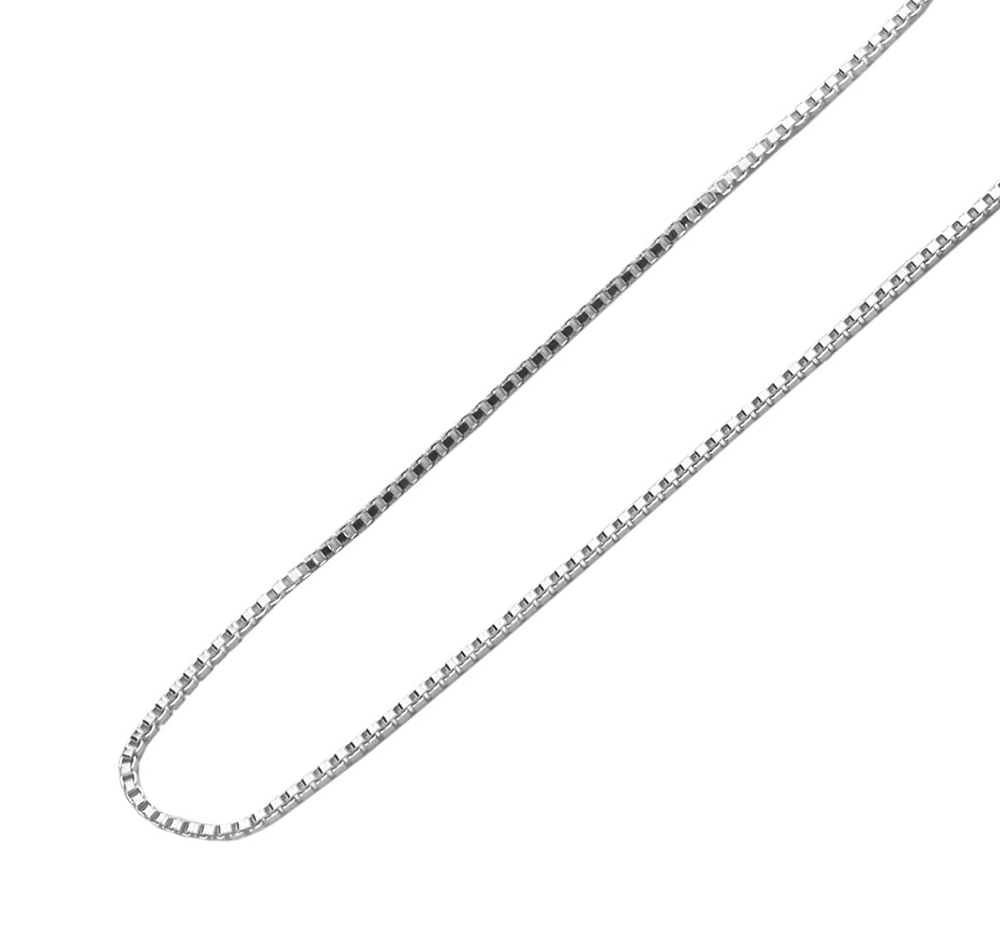
This is where most buying decisions actually get made. A box chain is generally the safer bet for anything with real heft, because its interlocked structure resists sagging and stretching under sustained load better than a cable chain of the same width. If you’re hanging a solid pendant, a locket, or a chunky charm that won’t come off, sizing up to at least a 2mm solid box chain is sensible.
A cable chain is perfectly fine for lighter pendants, small charms, or anything you’ll swap regularly. It’s not undersized for the job, it just has a lower comfortable ceiling. Because cable chains show more micro-stretch under repeated lateral load than box chains at equal gauge, some manufacturers suggest keeping pendant weight noticeably lighter than you would on a comparable box chain.
The rule that matters more than link style: go solid, not hollow, once a pendant has any real weight to it. For detailed pairing tables matched to pendant type and size, our guide to choosing a sterling silver necklace for pendants walks through the specifics.
Durability, repair and everyday care
Neither chain is indestructible, but they fail differently. Cable chains tend to stretch gradually at the solder points and rarely snap without warning. Box chains resist stretching for far longer, then can develop a sharp, sometimes permanent kink if caught on a zip or yanked hard.
Repair complexity follows the same pattern. Cable chains are generally quicker and cheaper to fix, since a jeweller can re-solder a single weak point in minutes. Box chains often require more careful repair to re-interlock the folded links correctly, which can take longer and cost more.
A short maintenance routine keeps either chain in good shape for years:
- Store it flat or hanging, never balled up in a drawer where links can crush against each other.
- Take it off before sleeping, showering, or exercising, since sweat and friction accelerate wear on both styles.
- Check the clasp and the first few links near it every few months, since that’s where stress concentrates first.
- If you spot a kink or a stiff link on a box chain, stop wearing it and see a jeweller before it worsens.
Pro Tip: Take your chain off by unclasping it, not by pulling it over your head. That single habit removes most of the sideways strain that causes kinks in box chains and premature stretching in cable chains.
How to choose the right chain for your situation
Work through four questions before you buy, and the answer becomes obvious fairly quickly.
- How often will you wear it? Daily wear favours a solid build regardless of link style; occasional wear gives you more flexibility to choose on looks alone.
- How heavy is the pendant? Anything beyond a light charm points towards a box chain, ideally 2mm or wider and solid rather than hollow.
- Do you plan to layer it? Cable chains layer more comfortably; box chains work best worn alone as the main piece.
- How much do you mind repair visits? If you want the lowest-maintenance option, cable’s quick solder fix beats box chain’s specialist repair every time.
Two red flags apply whichever style you land on. Avoid very thin hollow chains under any real pendant weight, and avoid any chain where the soldering looks uneven or the links don’t sit flush. Manufacturer guidance backs this up directly: choosing at least a medium gauge with solid construction reduces failure risk far more reliably than agonising over link shape alone. If none of the four questions above gives you a clear lean, our strongest chain styles for heavy pendants guide breaks the decision down further by pendant type.
Why Britishchains backs this guidance
Britishchains works exclusively in 925 sterling silver, hallmarked to British standards, across chain styles including box, curb, Figaro, rope, snake and herringbone. That range means the recommendations above aren’t theoretical: readers wanting a box chain for a heavier pendant, a curb chain for maximum robustness, or a Figaro for a flatter statement look all have a direct, hallmarked match in the catalogue.
The editorial guidance here draws on established construction and durability principles for each chain type, cross-checked against manufacturer and designer notes on tensile behaviour and repair complexity. It’s written to help you match a chain to a pendant correctly the first time, not to push one style over another regardless of fit.
Our honest take on box vs cable chain
If pushed to pick one default for a pendant that matters, we’d reach for a box chain every time, purely because it carries weight without stretching out of shape over the years. That said, plenty of people are better served by a cable chain, especially if layering or easy repairs matter more to you than raw strength. Style preference counts for a lot here. If you already know what you want, the product links below will get you there.
— British
Find your match in the Britishchains collection
If a heavier pendant is the whole reason you’re reading this, the 2mm Sterling Silver 925 Box Chain Necklace is built for exactly that job, hallmarked, diamond-cut, and available across four lengths so it sits correctly whatever pendant you’re pairing it with.
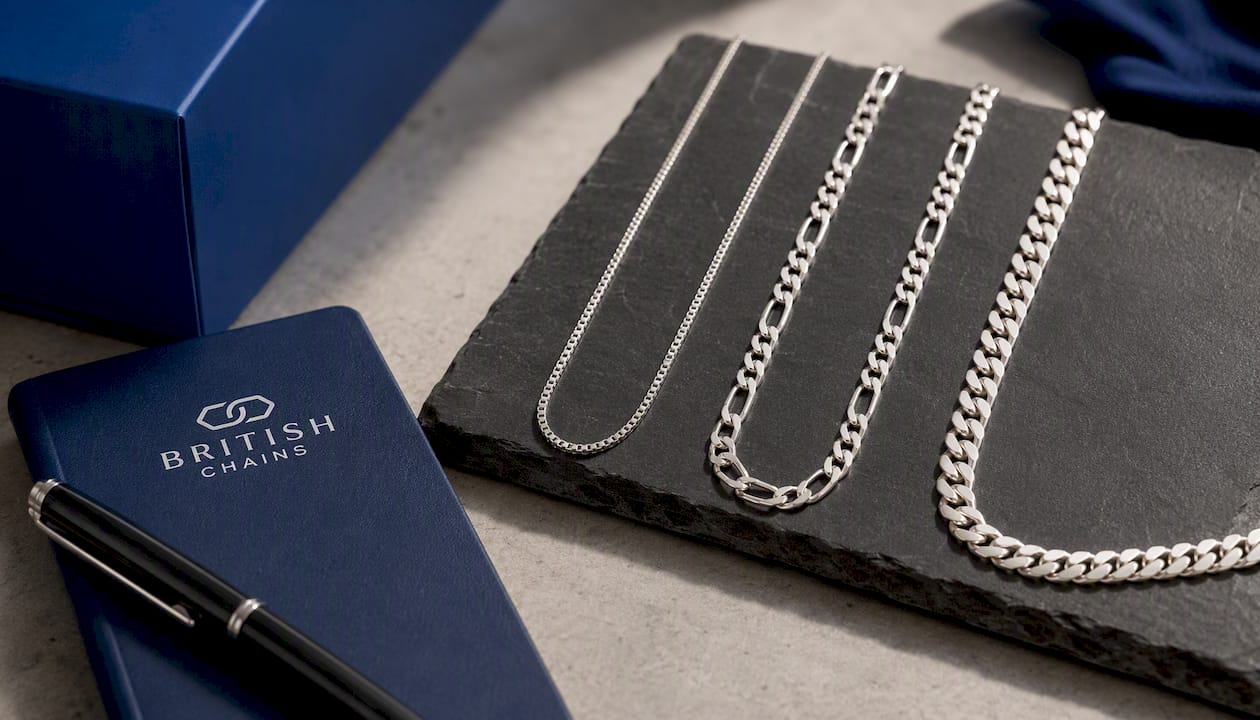
Want more presence without going hollow or thin? The 8mm Thick Figaro Chain Necklace gives a flatter, more graphic alternative to a straight box chain, while the 8mm Thick Curb Chain Necklace is the option to reach for if you want the single toughest everyday chain in the range, sized 18 to 24 inches. All three arrive hallmarked, diamond-cut and polished, with the full sizing detail listed on each product page so you can check the fit before you buy. Browse the wider silver necklace collection if you’re still comparing styles side by side.
Sources
- Types of Necklace Chains
- Cable vs Box Chain: Designer’s Guide for 2026
- Chain Types Explained: Cable vs Figaro vs Rope vs Box
FAQ
Do box chains kink easily?
Box chains resist everyday bending well, but a sharp, forceful bend, such as a snag on clothing, can crease a link permanently. Once kinked, the fix usually needs a jeweller to re-interlock the affected links rather than a quick solder repair.
Is a box chain necklace strong?
Yes. The interlocking square links spread tension across multiple contact points, giving box chains higher tensile resistance and better long-term stretch resistance than a comparable cable chain, which makes them a solid pick for heavier pendants.
Are box chains prone to breaking?
Box chains are less likely to stretch or snap under steady wear than cable chains, but they can suffer a permanent kink from a sudden sharp bend. A solid, medium-gauge box chain like Britishchains’ 2mm box chain minimises that risk further.
Are box chains timeless?
They lean more contemporary than a classic cable chain, thanks to their flat, reflective planes and geometric line. Cable remains the classic everyday default, while box chains suit a cleaner, more modern wardrobe, so “timeless” depends on which look you’re after.
Which is better for daily wear, box or cable chain?
For a light charm worn daily, a cable chain is easier to layer and cheaper to repair if it stretches. For a heavier pendant worn daily without swapping, a solid box chain holds its shape better over years of wear.


