

Hallmarked 925: Strongest Chain Styles for Heavy Pendants (UK)
Franco chains rank as the strongest style overall, thanks to their tightly interlocking square links, with heavy-gauge wheat and solid curb or Cuban chains close behind. What separates a genuinely strong chain from a weak one is rarely the style name alone; it’s whether the links are solid, soldered, and thick enough for the job. A 20 inch chain rated for a light pendant may fail under a significantly heavier one, regardless of pattern.
TL;DR:
- Solid Franco chains with soldered, thick links provide the best balance of strength and durability for medium to heavy pendants.
- Wheat chains excel in tensile strength and resistance to kinking, making them suitable for heavier pendants but offering a textured feel against the skin.
- Chain gauge is a critical factor, with 3mm or thicker recommended for heavy pendants, while hollow or under 1.5mm chains are only suitable for light use.
- Soldered links and clear specifications of solid construction and gauge are essential indicators of true chain strength, especially when buying online.
- Sterling silver at 92.5% purity offers practical durability, with solid construction outperforming hollow varieties; gold lower karats tend to be harder and more wear-resistant.
Table of Contents
- Which chain styles are strongest for pendants and everyday wear?
- What makes a chain strong: link pattern, gauge and construction
- Do metal type and purity affect chain strength?
- How do you choose the right chain for a pendant?
- How do you keep a strong chain strong?
- What we look for when we assess chain strength
- Three sterling silver chains built for strength
- Sources
Which chain styles are strongest for pendants and everyday wear?
Not every “strong” chain suits every job. A chain that shrugs off a heavy pendant might still kink badly under a seatbelt, and a chain built for flexibility might stretch under a locket it was never designed to carry. Here’s how the main contenders actually perform.
Franco chains use square or round links twisted into a tight V pattern, and that geometry is the whole story. Each link grips its neighbours at multiple points rather than a single pivot, so tension spreads across the chain instead of concentrating on one weak link. That makes Franco a strong all-rounder for medium to heavy pendants, provided it’s sold solid rather than hollow.
Wheat chains (also called Spiga) braid four strands of oval links together. That braided structure gives them exceptional tensile strength and real resistance to kinking, which is why jewellers often push them for heavier pendants rather than delicate everyday wear. The trade off is texture: wheat chains have visible ridges, so if you want something smooth against the skin, look elsewhere.
Rope chains twist multiple links into a spiral, similar in spirit to wheat but usually rounder in profile. Thick rope chains handle weight well and resist twisting because the spiral shape naturally distributes load along the whole length. Thin rope chains, though, are notorious for unravelling at a weak point once one link opens, so gauge matters even more here than with other styles.
Curb and Cuban link chains use flat, interlocking oval links twisted so each one lies against the last. Thicker curb chains show markedly higher break resistance in practical tests than their thin counterparts, and the flat profile means the chain sits well against the chest without twisting. This is the classic choice for statement pendants and chunky solo wear.
Box chains link square-shaped units in a repeating cube pattern. The geometry resists snapping well in most everyday scenarios, but strength here depends heavily on gauge: thin box chains can stiffen or fail under directional strain, particularly if they’re pulled sideways rather than along their length. Are box chains strong enough for a pendant? A solid box chain at 3mm or above generally is; anything thinner is better reserved for a chain worn alone.
Figaro chains alternate one or more small oval links with one longer rectangular link. The pattern is decorative first and structural second, so Figaro’s strength depends almost entirely on thickness and solid construction. An 8mm solid Figaro handles daily wear and a moderate pendant comfortably; a fine 2mm version is really a fashion piece, not a workhorse.
A few practical purchase cues apply across all of these:
- Look for the word “soldered” on links, not just “solid” (a chain can be solid metal but still have unsoldered, operable links at points of weakness).
- Check the stated mm gauge rather than trusting a photo. A thick-looking hollow chain can weigh less, and less strongly, than a slim solid one.
- Be wary of listings that don’t specify solid versus hollow construction at all. If it isn’t mentioned, ask before buying.
What makes a chain strong: link pattern, gauge and construction
Chain strength comes down to four overlapping factors, and understanding them lets you judge any chain, not just the ones on this list.
Link pattern determines how tension spreads. A chain like Franco or curb, where each link touches its neighbours at several points, redistributes force rather than letting it build at a single junction. Insight worth remembering: flat interlocking styles and tight-interlock patterns consistently outperform styles built purely for flexibility when it comes to load-bearing.
Wire gauge is the single biggest predictor of everyday durability. As a rough guide:
- Under 1.5mm: fine chains, best for light pendants under 3g and delicate use only.
- 1.5mm to 3mm: moderate-duty, suitable for medium pendants and daily wear without heavy strain.
- 3mm and above: heavy-duty, appropriate for statement pendants, lockets, or chains worn without any pendant at all as a standalone piece.
Solid versus hollow construction changes everything. Informal strength testing has shown that hollow chains can be multiple times weaker than solid chains of similar style and appearance, even when they look identical on a product photo. Hollow construction exists to cut cost and weight, which is fine for a chain worn without a pendant, but it’s a poor match for anything meant to carry load.
Soldering closes the weak point. An unsoldered link has a tiny gap that can be prised or worked open over months of wear. Soldered links are fused shut, which is why retail guides treat soldering, clasp condition and mm gauge as the three checks that best predict real-world durability.
The clasp and the jump rings at either end are usually the actual failure point, not the chain body itself. A lobster clasp with a thin, cheap spring mechanism will often give out long before a well-made Franco or curb chain does.
Pro Tip: If you’re buying online, message the seller and ask directly: “Is this solid or hollow, and are the links soldered?” A retailer confident in their construction will answer in one line. Vague answers are a red flag.
Do metal type and purity affect chain strength?
Yes, and the differences are bigger than most buyers expect. Metal choice affects both raw strength and how a chain wears over years, not just its price tag.
Gold karat is a trade off, not a hierarchy. Counterintuitively, lower-karat gold alloys like 10K and 14K are harder and more wear-resistant than higher-karat 18K or 24K, because the added alloy metals stiffen the structure. Pure gold is soft. A 24K chain looks richer but dents and stretches more easily under daily wear.
Sterling silver, sold solid, is a genuinely durable option. At 92.5% pure silver alloyed with other metals for hardness, solid sterling silver at adequate gauge performs well against everyday wear, and it costs meaningfully less than gold or platinum at comparable thickness. The trade off is tarnish, which needs occasional cleaning but doesn’t affect structural strength.
Platinum is the densest and most wear-resistant of the common choices, holding its shape under decades of use, but it comes at a price point that puts it out of reach for most everyday chains.
Stainless steel resists scratching and corrosion well and needs almost no maintenance, though it lacks the resale value and traditional appeal of precious metals.
- Vermeil (gold-plated silver) and gold-plated base metals wear through with friction, exposing the metal underneath within months of daily use.
- Hollow gold or silver chains flex and dent far more easily than solid equivalents of the same visual thickness.
- A UK hallmark on sterling silver confirms purity independently of the seller’s own claims, making it the fastest quality check available on a physical piece.
How do you choose the right chain for a pendant?
Match the chain to the job before you match it to your taste. A chain that looks perfect but sags under its pendant within a year isn’t a bargain, whatever it cost.
- Weigh your pendant, or estimate its category. Light pendants (under 3g) work on most chains; medium pendants (3 to 8g) need at least 2mm solid gauge; heavy pendants (8g and up) need 3mm or thicker, ideally in a curb, Franco, or heavy wheat pattern.
- Check the bail size against the chain’s link width. A pendant bail that’s too tight will wear a groove into thin links over time, weakening exactly the point that carries the most stress.
- Favour soldered, solid construction for anything valuable or heavy. This is worth paying slightly more for, especially on a pendant that’s sentimental or expensive.
- Choose style by how you’ll actually wear it. Franco or curb for heavy daily loads; rope or wheat where you want flexibility and comfort alongside strength.
- Ask sellers direct questions before buying: gauge in mm, solid or hollow, soldered or open links, clasp type, and whether they offer a repair service if something does go wrong.
A chain built for supporting a pendant properly should feel like it was chosen for the job, not just picked because it was on sale.
Pro Tip: If a seller can’t tell you the gauge in millimetres, or only describes a chain as “thick” or “heavy duty” without a number, treat that as a gap in the listing rather than a reassurance.
How do you keep a strong chain strong?
Even the best-built chain degrades under bad habits. Most damage isn’t dramatic. It’s slow thinning, a stretched clasp, or one kink that never quite comes out.
- Keep chains away from chlorine, perfume, and household chemicals, all of which accelerate wear on both silver and gold alloys.
- Remove chains before exercise or contact sports, where sudden pulls cause most clasp failures.
- Store chains hanging flat or in individual pouches. Coiling them in a drawer is the single most common cause of kinks.
- Watch for thinning links, a loose or wobbly solder joint, or a clasp that no longer clicks shut firmly.
Repair costs vary by damage type, but re-soldering a broken link or swapping a worn clasp is usually straightforward and inexpensive relative to the chain’s value. Practical jewellery testing shows curb and Figaro styles are among the easiest to repair because their link shapes are simple and consistent, while herringbone and snake chains are notoriously difficult or impossible to fix once kinked, since their flat, tightly packed designs distort permanently under stress. If a chain has already failed once and the repair would cost close to half its original price, replacement is usually the safer long-term choice.
Pro Tip: A chain that kinks repeatedly in the same spot has a structural weakness there, not bad luck. That’s a sign to replace it rather than keep repairing the same point.
What we look for when we assess chain strength
Customers ask us three things more than anything else: is it solid or hollow, what’s the actual gauge, and will it hold this specific pendant. Those questions tell you most of what you need to know before you buy anything.
Every chain description should state the millimetre gauge, whether construction is solid, and carry UK hallmarking for sterling silver purity, as those three details answer the questions that actually matter. A chain description that skips them is a description that’s hiding something, whoever sells it. We’d rather a customer walk away informed than buy something that doesn’t suit their pendant.
Strength claims mean nothing without the specifics behind them. That’s the standard we hold our own product pages to, and it’s the standard we’d suggest you hold any seller to.
— British
Three sterling silver chains built for strength
If you want a chain that matches everything above, a few options from retailers specializing in sterling silver chains are worth considering. Each solves a slightly different problem.
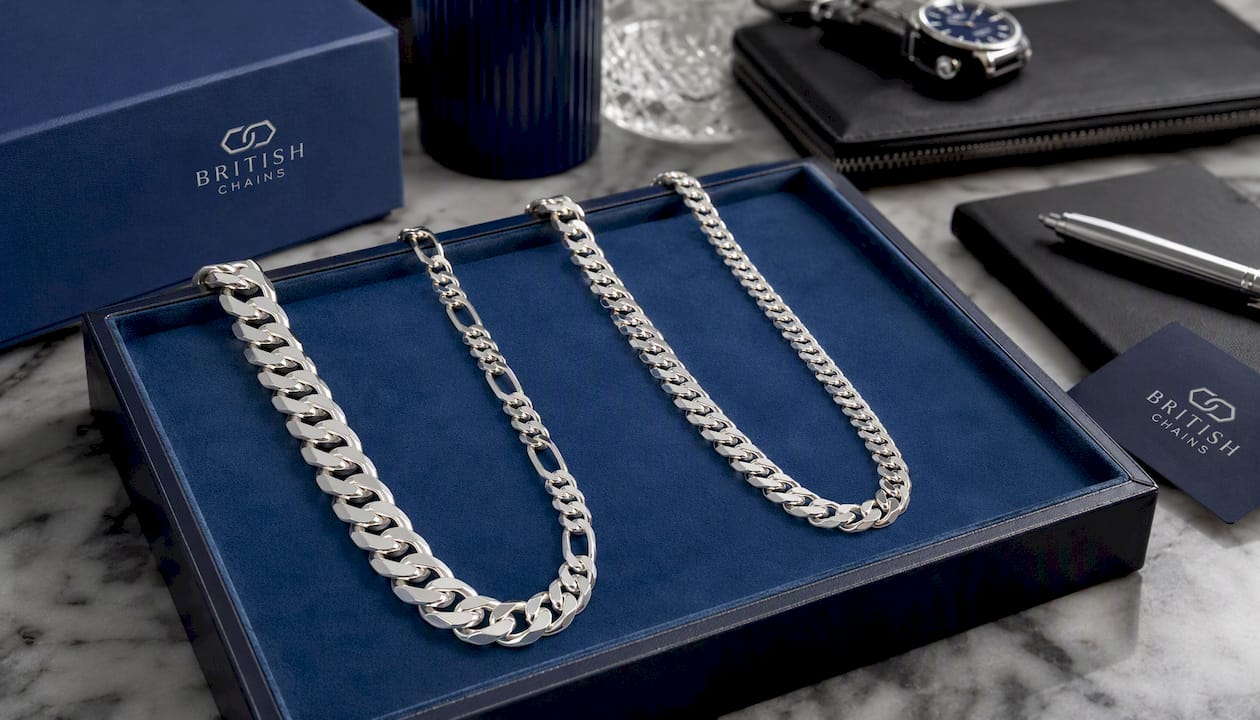
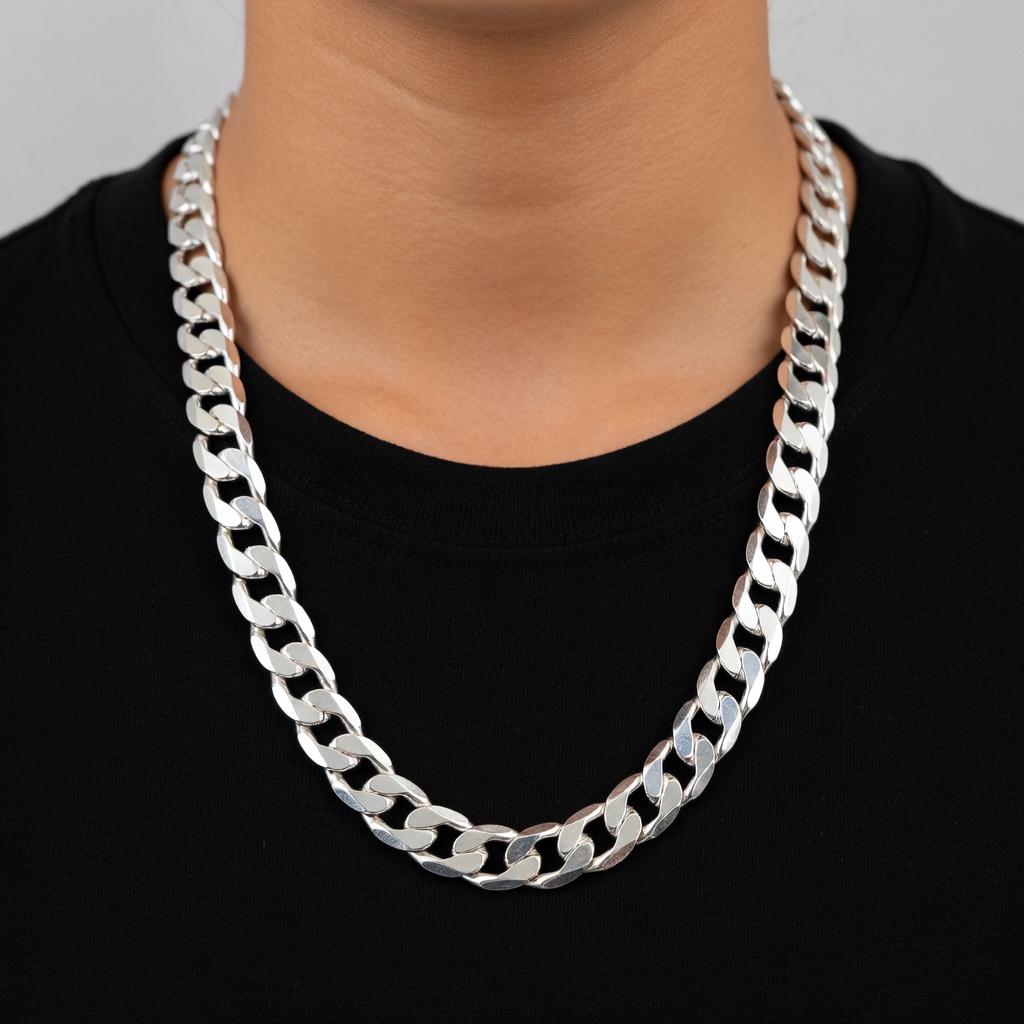
The 12mm sterling silver curb chain is built for the heaviest end of the spectrum. At 12mm and solid sterling silver 925 with a diamond cut finish, it’s the option for a chunky standalone statement piece or a pendant with real weight, rather than something delicate.
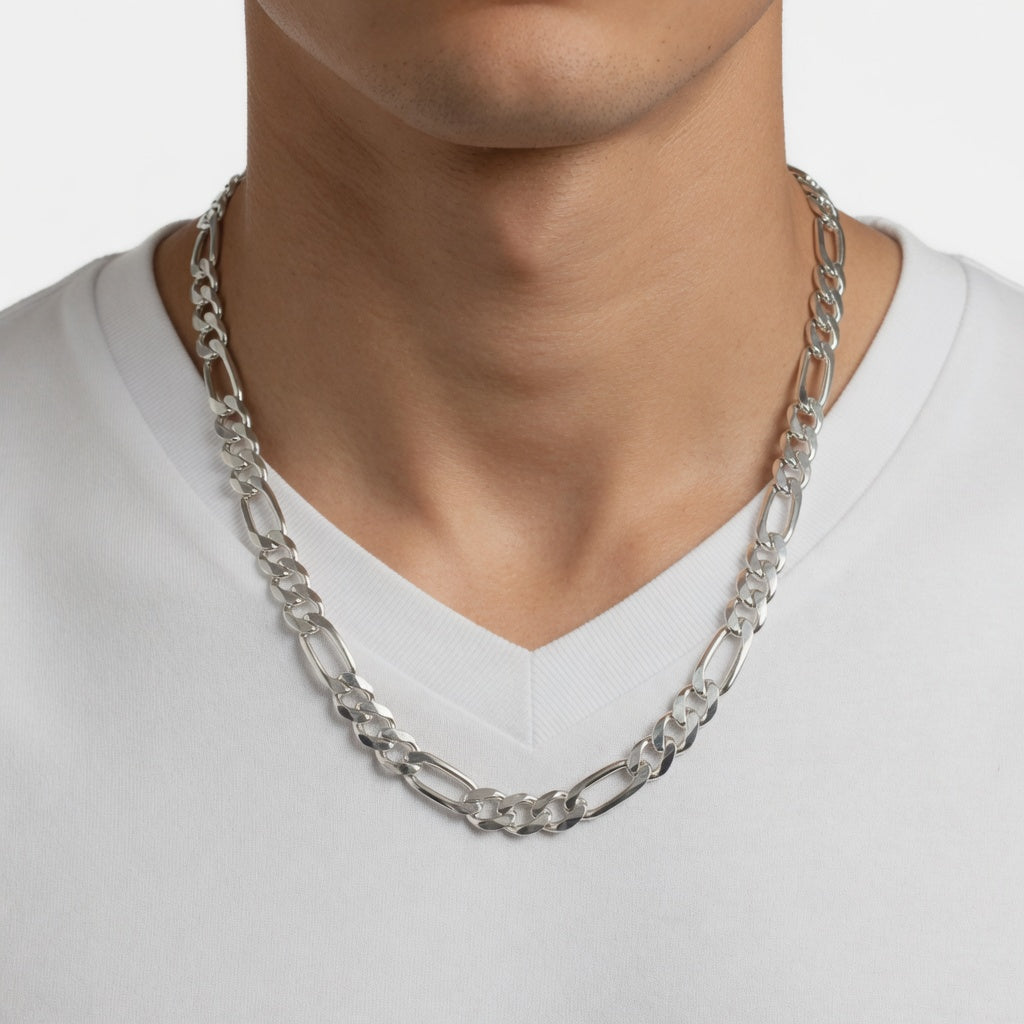
For a lighter but still robust everyday option, the 8mm Figaro chain delivers the classic alternating link pattern at a gauge thick enough to carry a moderate pendant without the stiffness of a full curb chain. It’s polished with a diamond cut finish, giving it shine without sacrificing the mm thickness that determines real durability.
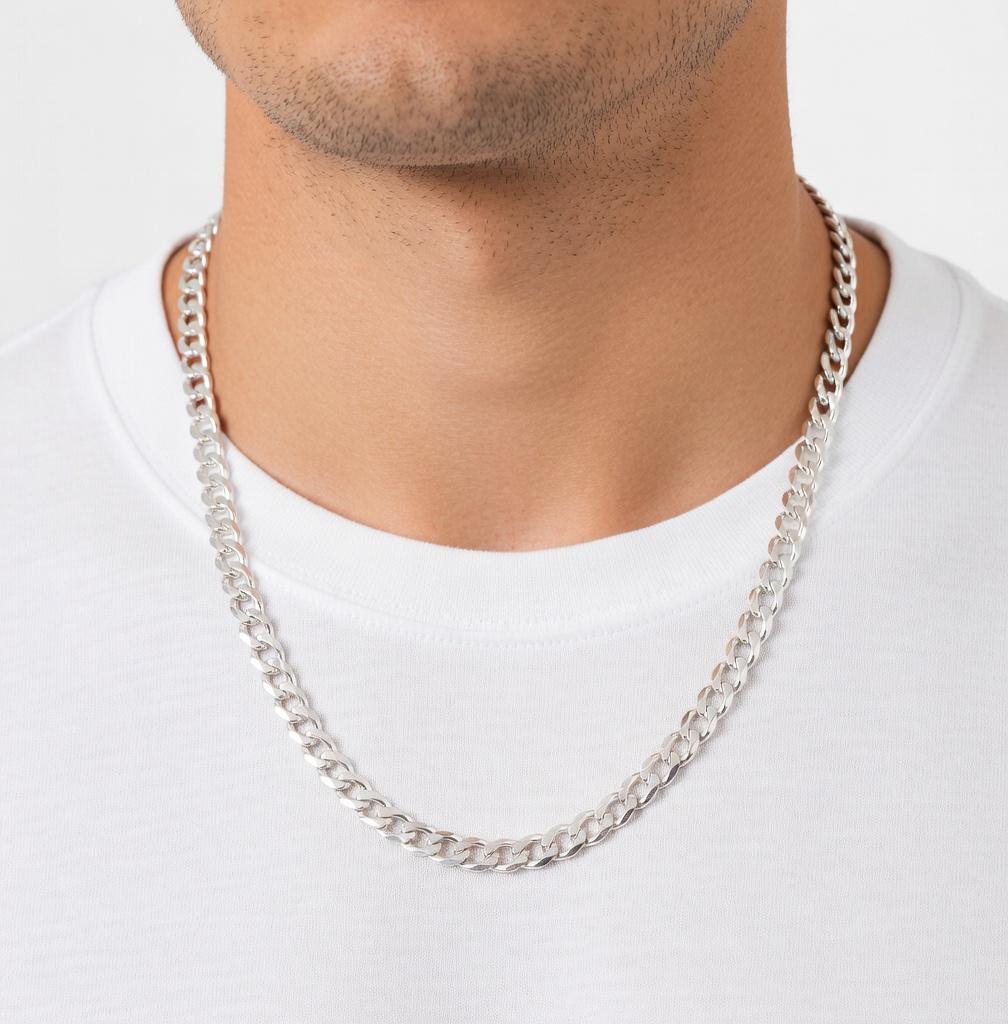
Sitting between the two, the 8mm curb chain in 18 to 24 inch lengths is the most versatile of the three: substantial enough for daily wear and pendant support, available across a length range that suits most builds, and unisex by design. For anyone weighing up which chain suits a heavier pendant or an everyday statement piece, this is usually the sensible middle ground.
These options are solid sterling silver 925, not plated or hollow, and typically carry hallmarking that confirms purity. Check the length options on product pages before ordering, since getting the drop right matters as much as getting the gauge right.
Sources
For readers who want to dig deeper into the engineering side of chain durability, BlueStone’s comparison of chain styles covers link geometry in more detail, while Borsheims’ guide to chains for heavy pendants focuses specifically on pendant-support scenarios. The Arden Jewelers strength comparison test is worth watching if you want to see solid versus hollow construction demonstrated directly rather than described. For a broader look at style and length choices for men’s silver necklaces, that guide pairs well with the strength criteria covered here.
- Which Chain Style Is the Strongest? Best Chains for Everyday Wear - BlueStone Blog
- What Are the Strongest Necklace Chains? A Guide to Chains for Heavy Pendants | Borsheims


