

Why handcrafted chains last longer: a buyer's guide
Handcrafted chains outlast mass-produced ones because every link is made from solid drawn wire, individually closed and soldered, then finished with repairability in mind. That is not a marketing claim — it is a structural fact. The wire-drawing process compacts the metal’s grain structure, increasing tensile strength before a single link is formed. Soldered closures distribute tensile stress evenly across a fully closed loop, whereas unsoldered interlocked links carry stress at the seam and gradually open under repeated pulling or snagging. Solid metal means no hollow collapse, no seam fatigue, and a piece a jeweller can actually repair.
Three things to carry into any chain purchase:
- Soldered links distribute load across the whole loop; unsoldered seams are where most chains fail first.
- Solid drawn wire has greater density and tensile strength than cast or hollow components.
- Repairability depends on link geometry and metal accessibility — it is a design choice, not an afterthought.
When buying, check for weight, visible solder seams, a UK hallmark, and a link style a jeweller can resolder. Those four signals separate a chain built to last from one built to sell.
Table of Contents
- Why handcrafted chains last longer: the bench process explained
- Does the metal itself determine how long a chain lasts?
- Which chain patterns actually hold up to daily wear?
- What finishing details actually reduce wear over time?
- How do UK hallmarks tell you about a chain’s durability?
- How long does a well-made handcrafted chain actually last?
- The technical evidence: drawn wire, porosity, and soldered loops
- Key takeaways
- The craftsmanship gap most buyers miss
- Britishchains: solid sterling, hallmarked and built to last
- Useful sources
Why handcrafted chains last longer: the bench process explained
The durability of handmade chains begins before the first link is formed. Wire drawing pulls metal through progressively smaller dies, compacting and aligning the grain structure. The result is denser, stronger metal than anything poured into a mould. Cast components can contain microscopic porosity — invisible voids that become stress concentrations under load.
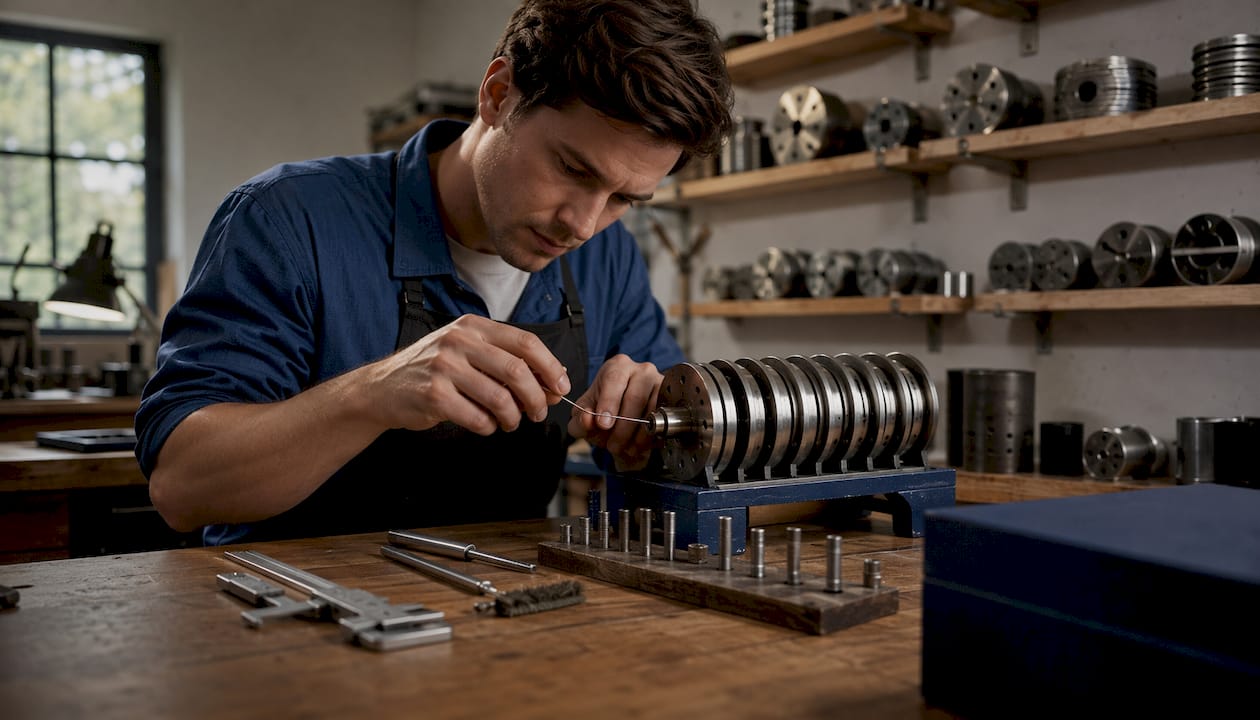
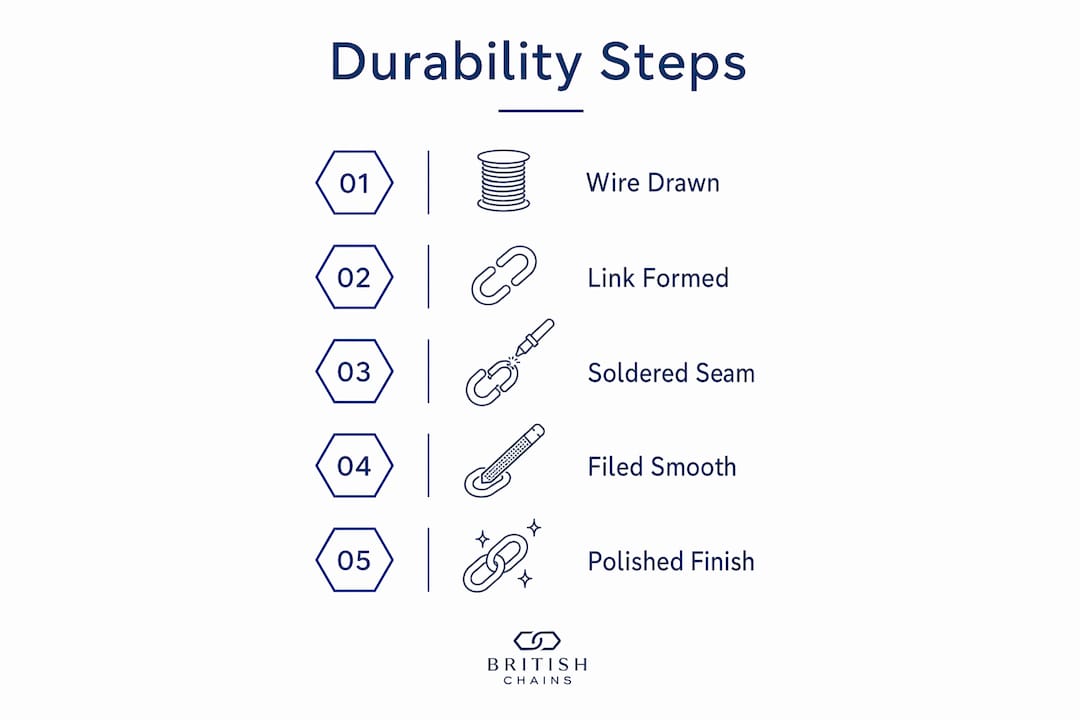
Once the wire is drawn, each link is formed individually, closed by hand, and soldered. Soldering fuses the seam completely, so the link behaves as a single continuous loop rather than two ends held together by friction. In mass production, links are often stamped from sheet metal and interlocked without soldering. Speed is the priority. The result is a chain where every closure is a potential failure point.
Filing and polishing follow soldering on the bench. A craftsperson removes solder flash, smooths the joint flush with the link surface, and checks gauge consistency along the length. That sequence matters because an uneven gauge concentrates stress at the thinnest point, and a rough solder joint snags fabric and skin, accelerating wear.
Pro Tip: Run a fingernail slowly across the seam of each link near the clasp. A snag or visible ridge indicates an unsoldered or poorly finished closure — a reliable sign of future failure. A well-soldered link feels completely smooth.
Does the metal itself determine how long a chain lasts?
Yes, and the difference between solid and hollow construction is stark. Hollow chains are significantly weaker than solid chains of the same external size. They stretch, dent, and thin irreversibly under long-term tension — a particular problem when carrying a pendant. Solid sterling silver, by contrast, deforms before it fractures, giving you warning and giving a jeweller something to work with.
Alloy choice adds another layer. For pendant-bearing chains, ductile alloys such as solid sterling silver (925) or 18ct gold bend under overload rather than snapping without warning. Harder, more brittle alloys like 9ct gold can fail catastrophically with no visible precursor. Ductility is not softness — it is a safety margin built into the metal.
Plated chains introduce a third failure mode: the base metal beneath the plating is often a cheaper alloy or hollow form, and once the plating wears through (which it will, typically at the clasp and highest-flex points first), the structural limitations of that base become the chain’s real story. Solid sterling silver chains avoid that problem entirely.
| Construction type | Tensile strength | Failure mode | Repairability |
|---|---|---|---|
| Solid drawn wire, soldered | High | Gradual deformation with warning | Good — jeweller can resolder |
| Cast solid | Moderate | Porosity-driven crack propagation | Moderate |
| Hollow | Low | Stretch, dent, seam collapse | Poor to none |
| Plated base metal | Varies (base metal) | Plating loss, then base failure | Poor |
Which chain patterns actually hold up to daily wear?
Link geometry is as important as metal quality. Some patterns distribute stress well; others concentrate it at predictable points.
- Curb and belcher chains are the strongest for everyday wear and pendant use. Flat, interlocking links spread load across a wide contact area, and individual links are straightforward to replace or resolder.
- Figaro chains share the curb’s geometry with a repeating long-short-short pattern. The varied link lengths add visual interest without sacrificing the repairability that makes curb styles so practical.
- Box chains use square links that interlock at right angles. They are strong, hold their shape well, and suit lighter pendants.
- Rope chains twist multiple strands together, which gives them good tensile strength, though rope chain repair requires more skill because the twist must be matched precisely.
- Herringbone and snake chains sit flat against the skin and look elegant, but their flat, interlocked construction makes them structurally fragile. They kink easily and are effectively unrepairable once kinked or broken without visible disruption to the pattern.
Gauge matters just as much as pattern. A thicker wire diameter means more metal cross-section carrying the load. A 12mm curb carries a heavy pendant comfortably; a 2mm herringbone is a style choice, not a workhorse.
Pro Tip: For a heavy pendant, choose a curb, belcher, or Figaro in at least 4mm gauge and solid construction. For a delicate everyday piece worn alone, a 2mm box or fine rope is fine — but avoid herringbone if you plan to wear it continuously, as it has almost no tolerance for kinking.
What finishing details actually reduce wear over time?
Finishing is where bench skill separates a chain that lasts a decade from one that fails in eighteen months. The solder joint is the critical point. A well-finished joint is flush, polished to match the surrounding metal, and made with correctly alloyed solder — meaning the solder’s melting point and hardness are matched to the parent metal. A poor joint leaves a visible ridge, a colour difference, and a snag point that catches on clothing and skin with every movement.
Finishing work including burnishing, stress-relief filing, and even polishing reduces micro-abrasion and seam fatigue. These are not cosmetic steps. Burnishing compresses the metal surface, closing micro-pores and hardening the outermost layer. Stress-relief filing removes sharp transitions at the solder joint that would otherwise concentrate bending stress. Even polish across the full length means no single link wears faster than its neighbours.
Clasp quality is the final check. A well-set lobster clasp or bolt ring should open and close with consistent resistance — not stiff, not loose. Clasps that are soldered rather than crimped onto the end link hold far longer under daily use.
- Flush, polished solder joints with no colour variation
- Consistent gauge along the full length of the chain
- Burnished surface with no rough patches or tool marks
- Clasp soldered to the end link, not crimped
- Even drape with no links that sit proud or twist out of plane
The role of chain finish in longevity is genuinely underappreciated — most buyers focus on link type and miss the finishing entirely.
How do UK hallmarks tell you about a chain’s durability?
A UK hallmark is not just a quality badge. It is a legally verified statement about metal purity, traceable to one of the four UK Assay Offices (London, Birmingham, Sheffield, or Edinburgh). For sterling silver, the fineness mark is 925, confirming 92.5% pure silver content. The hallmark also includes a town mark identifying the Assay Office, a date letter, and the sponsor’s or maker’s mark.
Why does that matter for durability? Because the hallmark guarantees the metal is what the seller claims. A chain stamped 925 but not hallmarked by an Assay Office carries no independent verification. Unverified metal purity means unknown alloy composition, which means unpredictable hardness, ductility, and tarnish behaviour.
Visual signs of genuine hand fabrication to look for:
- Individual solder seams visible under magnification at each link closure
- Slight, consistent variation in link spacing (not defects — evidence of hand forming)
- Heavier feel relative to size compared with hollow or plated alternatives
- Crisp, flush solder joints with no discolouration
- A maker’s or sponsor’s mark alongside the fineness stamp
The ‘hand-finished’ label is worth treating with scepticism. It can mean mass-produced components were polished or had clasps added by hand — not that the links themselves were hand-formed and soldered. Ask specifically whether the links are soldered and whether the chain carries a full UK hallmark.
How long does a well-made handcrafted chain actually last?
A solid sterling silver chain with soldered links, properly maintained, can last decades under daily wear. Passed down with occasional professional cleaning and a resolder where needed, it becomes an heirloom. A hollow or plated chain under the same conditions typically shows visible wear within two to three years and is often unrepairable by year five.
Maintenance routine:
- Clean monthly with warm water, a drop of washing-up liquid, and a soft cloth. Rinse thoroughly and dry completely before storing.
- Store flat or hung, not coiled tightly, to avoid kink stress at the same link points repeatedly.
- Check the clasp every six months for stiffness or looseness — a failing clasp is the most common cause of chain loss.
- Have a jeweller inspect and clean the chain professionally every two to three years, particularly if you wear it daily.
Repairability is the real cost-of-ownership argument. Curb, Figaro, and box chains can have a broken link replaced or resoldered for a modest fee. Snake and herringbone chains, once kinked or snapped, cannot be invisibly repaired. Buying a repairable style is a financial decision as much as an aesthetic one. A solid sterling curb bought once and maintained costs far less over ten years than three or four hollow replacements.
Pro Tip: If a chain has significant sentimental or monetary value, have it independently valued and consider adding it to your home contents insurance as a named item. UK insurers typically require a valuation from a registered jeweller.
How long sterling silver lasts depends heavily on construction and care — solid drawn wire with soldered links is the baseline for anything you expect to wear for years.
The technical evidence: drawn wire, porosity, and soldered loops
The metallurgical case for hand fabrication comes down to two processes: wire drawing and soldering. Drawing wire through dies aligns the metal’s crystalline grain structure along the axis of the wire. This alignment increases tensile strength and reduces the internal voids that form when metal is poured into a mould and cooled. Cast components can contain porosity — microscopic gaps that are invisible to the naked eye but act as crack initiation sites under cyclic stress.
A soldered closed loop distributes tensile stress evenly around the full circumference of the link. An unsoldered seam carries the entire load at two points: the two ends of the wire where they meet. Under repeated stress and snagging, those ends gradually separate. The failure is not sudden — it is cumulative, which is why unsoldered chains often seem fine until they are not.
| Factor | Hand-fabricated (drawn wire, soldered) | Mass-produced (cast or stamped, unsoldered) |
|---|---|---|
| Grain structure | Aligned, dense | Random, potentially porous |
| Link closure | Fully fused solder seam | Friction-held or open seam |
| Stress distribution | Even around full loop | Concentrated at seam ends |
| Failure mode | Gradual deformation | Sudden seam opening or crack |
| Repairability | High | Low to moderate |
The practical consequence is straightforward: a hand-fabricated chain from solid drawn wire, with properly soldered links and good finishing, has fewer structural weak points than a cast or stamped equivalent at every stage of its life.
Key takeaways
Handcrafted chains last longer because solid drawn wire, individually soldered links, and quality finishing eliminate the structural weak points that cause mass-produced chains to fail.
| Point | Details |
|---|---|
| Soldered links are the foundation | Fully fused closures distribute stress evenly; unsoldered seams open gradually under load. |
| Solid metal outperforms hollow | Hollow chains stretch, dent, and fail irreversibly; solid drawn wire deforms before fracturing. |
| Link pattern determines repairability | Curb, Figaro, and box styles are repairable; herringbone and snake are effectively not. |
| UK hallmarks verify metal purity | A 925 Assay Office hallmark confirms sterling silver content and supports long-term value. |
| Britishchains prioritises these standards | Britishchains stocks hallmarked solid sterling chains in repairable styles, built for daily wear and longevity. |
The craftsmanship gap most buyers miss
The conventional wisdom says “buy quality, not quantity.” That is true but vague. The more useful framing is: buy repairability. A chain that can be fixed by any competent jeweller is a chain you will own for twenty years. One that cannot be repaired is a chain you will replace.
What surprises most buyers is how much the finishing stage matters relative to the link type. Two curb chains in identical sterling silver can have very different lifespans depending on whether the solder joints were properly filed and polished. The one with rough joints will wear faster at those points, snag more, and feel worse against the skin. The one finished correctly will feel smooth from day one and stay that way.
The other trap worth naming: ‘hand-finished’ is not the same as hand-fabricated. A chain can be cast in bulk, polished by a person, and sold as hand-finished. That label tells you nothing about link construction, solder quality, or metal density. Ask for the hallmark. Ask whether the links are soldered. Those two questions cut through most of the marketing noise.
Britishchains: solid sterling, hallmarked and built to last
If the technical case above describes what you are looking for, Britishchains makes it straightforward to find. Every chain in the range is hallmarked 925 sterling silver, with solid construction and link styles chosen for daily wearability and repairability.
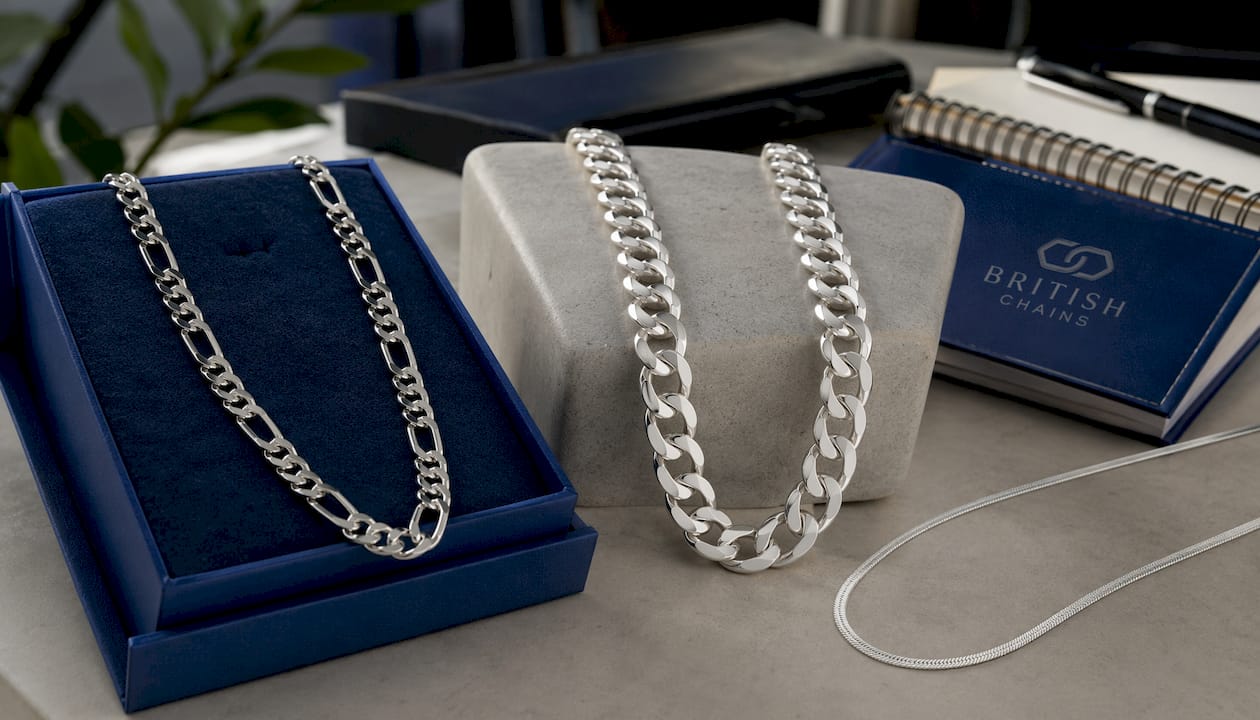
Three styles worth looking at directly:
- The 8mm Figaro chain is a statement piece with the repairable geometry of a curb. Solid, diamond-cut, and heavy enough to carry a pendant without strain.
- The 12mm curb chain is the benchmark for heavy-duty daily wear. Chunky, unisex, and built with the flat interlocking links that distribute load best.
- The 2mm herringbone is the style trade-off: elegant and flat-lying, but worn best as a solo piece without a pendant, given the repair limitations of the pattern.
Browse the full range at Britishchains.com and filter by gauge and construction to find the right balance of strength and style for how you actually wear jewellery.
Useful sources
- Curb, Trace, or Belcher: which gold chain is strongest for heavy pendants? — supports claims on drawn wire, hollow chain weakness, ductile alloy selection, and repairability by link type.
- Soldered vs. machine-made chain links — supports finishing and workmanship section; solder joint quality and stress-relief filing.
- How to spot a quality machine-made chain vs. handmade — supports the ‘hand-finished’ marketing trap warning.
- Chain link construction: weight, gauge and quality — supports buyer guidance on weight as a proxy for solid construction and gauge selection.
- Britishchains.com — UK hallmarking context, Assay Office marks, and fineness standards for sterling silver.


