

The role of chain finish in jewellery: a craft guide
Chain finish is defined as the surface treatment applied to jewellery chain links to determine their wear resistance, tactile comfort, and visual character. The role of chain finish in jewellery extends far beyond appearance. A well-executed finish reduces friction between links, prevents microscopic surface damage, and determines how a piece feels against skin from the very first wear. In sterling silver chains, finishing techniques such as mirror polishing, diamond cutting, and physical vapour deposition (PVD) coating each serve distinct mechanical and aesthetic functions. Understanding these differences helps you choose chains that last, look right, and feel comfortable.
How does chain finish affect wear resistance and durability?
The mechanical case for finishing is stronger than most buyers realise. Every time a chain moves, its links rub against each other and against skin. Without finishing, microscopic surface peaks, called asperities, catch and tear at each other. Over time, this abrasive wear degrades both the metal and the wearer’s comfort.
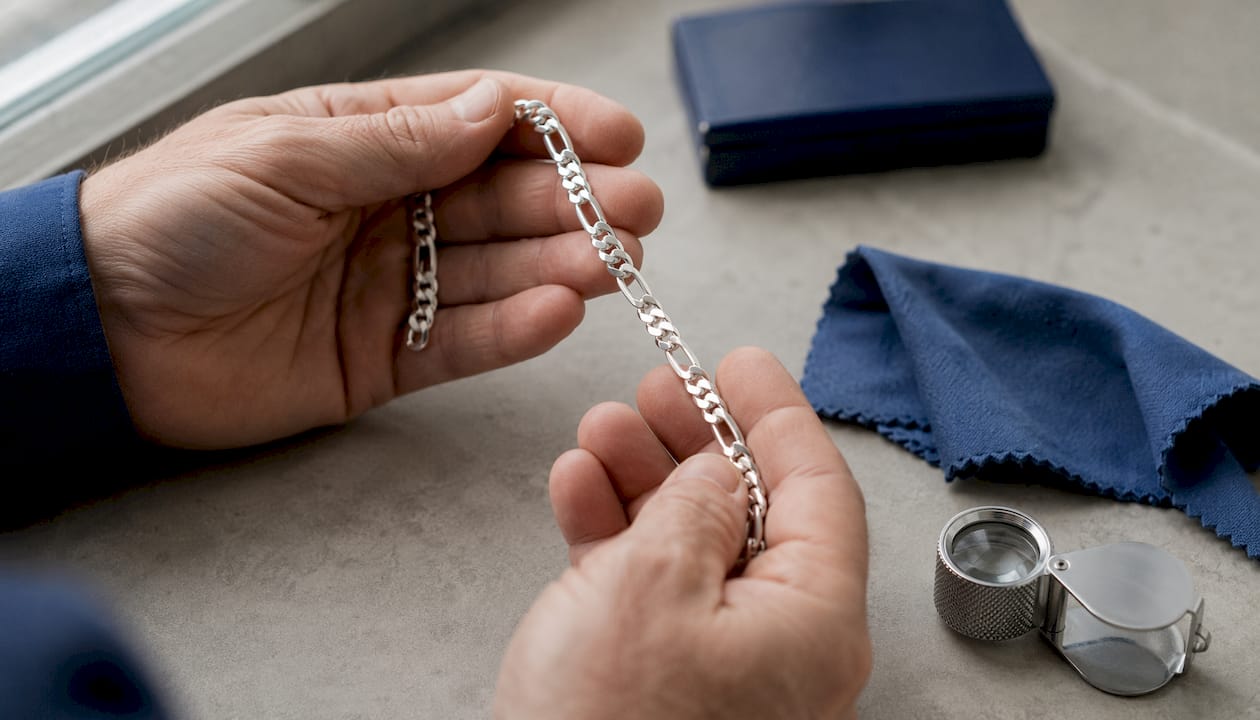
A mirror finish reduces friction by smoothing surface roughness to nanometre levels, preventing particle trapping between links and lowering the coefficient of friction significantly. This matters because trapped particles act like sandpaper inside the chain, accelerating wear with every movement. A mirror finish is therefore as much a mechanical necessity as a stylistic choice.
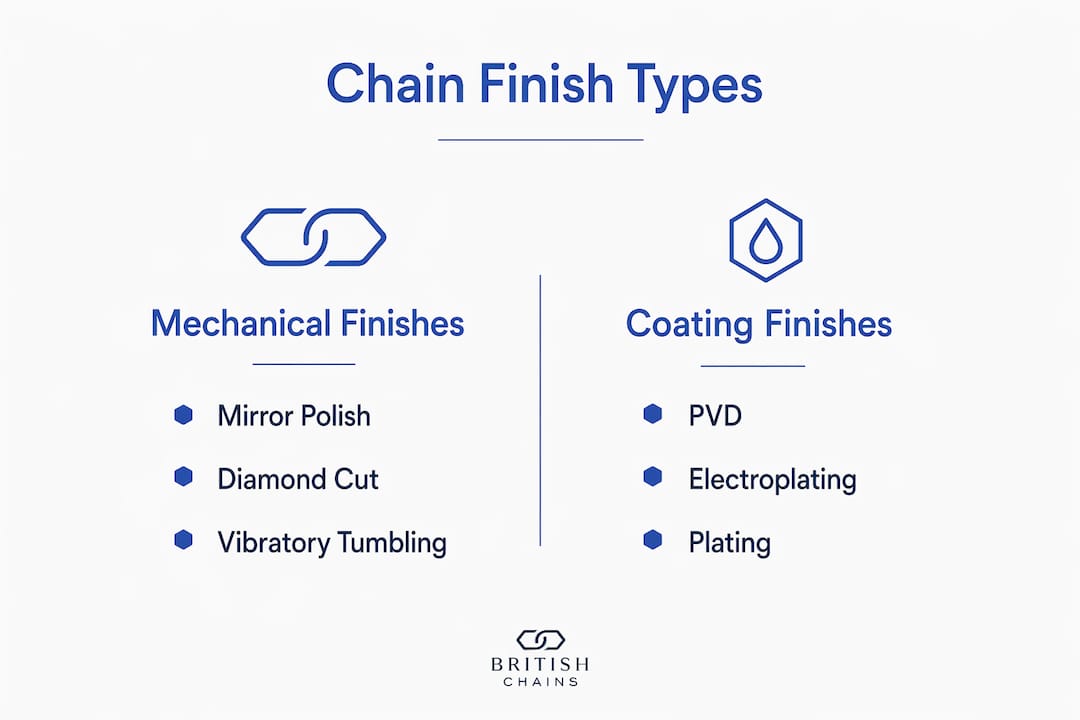
Two finishing categories dominate modern chain production: solid metal finishing and surface coating.
- Mirror polishing removes surface irregularities from solid metal, leaving a reflective surface that resists abrasive wear and can be restored later.
- Brushed and satin finishes introduce controlled surface texture, which diffuses light and softens the chain’s appearance but offers slightly less abrasion resistance than mirror polish.
- Electroplating deposits a thin layer of gold or rhodium over a base metal. The bond is chemical and relatively shallow, meaning the layer can peel or wear through at high-contact points.
- PVD (physical vapour deposition) uses a vacuum chamber to bond gold at a molecular level, preventing the surface peeling common in electroplating. PVD produces a far more durable coating than standard plating.
Chain construction also interacts directly with finish performance. Soldered chains eliminate link seams that can open under stress, which means the finished surface remains intact at stress points. Machine-made chains are cost-efficient and suit lightweight wear, but their unsealed seams can trap debris and compromise the finish over time.
Pro Tip: When buying a chain for daily wear, check whether the links are soldered. A soldered construction keeps the finish intact at the highest-stress points and significantly extends the chain’s lifespan.
What is the visual and design significance of chain finishes?
Finish shapes how a chain reads visually, but the relationship between finish and sparkle is more nuanced than most buyers expect. Chain sparkle arises primarily from link geometry and facet count rather than finish alone. Finish enhances brilliance, but it does not create it. A curb chain with flat, wide links will always outshine a round-wire rope chain under the same polish, because the flat facets interact with light more dynamically.
That said, finish consistency across a chain is what separates a premium piece from a mediocre one. A single dull link in a mirror-polished chain breaks the visual rhythm and signals poor quality control. This is why Britishchains applies uniform finishing across every link in its sterling silver collections.
Different finishes produce distinct design personalities:
- Mirror polish creates a high-contrast, reflective surface that reads as formal and confident. It suits Figaro, curb, and herringbone styles particularly well.
- Brushed finish produces a matte, understated look. It works well on box and rope chains where the texture adds visual depth without competing with clothing.
- Diamond cut finish uses a precision wheel to carve facets directly into the metal surface, multiplying the number of light-reflecting angles. The result is a chain that catches light from multiple directions simultaneously.
- Antiqued or oxidised finish darkens recessed areas to create contrast and a vintage character. It suits heavier, more sculptural chain styles.
Finish also carries brand meaning. A consistent, high-quality polish signals that a maker controls their production process at every stage. Buyers who understand this use finish quality as a proxy for overall craftsmanship.
How to choose the right chain finish for your jewellery
Selecting a finish is not purely a matter of taste. Usage, chain construction, metal type, and skin sensitivity all determine which finish performs best for a given wearer.
-
Daily wear chains need the most durable finish available. Mirror polish on solid sterling silver or PVD coating on plated chains both hold up well. Avoid lightly plated finishes on chains worn every day, as the coating wears through at collar and clasp contact points within months.
-
Pendant chains carry additional stress at the bail point. A soldered chain construction is preferable here because it prevents link seams from opening under the pendant’s weight. The finish at the bail point should be as smooth as the rest of the chain.
-
Layered chains sit against each other and against skin simultaneously. High-polish finishes reduce friction between layers, preventing the chains from abrading each other. Mixing a mirror-polished chain with a brushed chain in a layered set will cause the brushed chain to scratch the polished one over time.
-
Skin sensitivity is a practical concern. High-polish finishing removes microscopic burrs that cause neck chafing, making it the best choice for wearers with sensitive skin. A rough or poorly finished chain will irritate skin at the nape of the neck within hours.
-
Restoration potential differs significantly between finish types. Solid sterling silver chains with a mirror or diamond cut finish can be repolished by a jeweller, restoring their original appearance even after years of wear. Plated finishes, once worn through, expose the base metal and cannot be restored without replating.
A common pitfall is choosing a finish based on photographs alone. Brushed and satin finishes photograph beautifully but can look flat in person under certain lighting. Mirror and diamond cut finishes photograph as bright and stark but look far more dynamic when worn and moving. Whenever possible, view a chain in natural light before purchasing.
Pro Tip: For a diamond cut Figaro chain, the faceted links catch light from multiple angles simultaneously. This makes the chain appear more substantial than its actual weight, which is a genuine advantage for wearers who want visual impact without heaviness.
Solid noble metal finishes allow repolishing and restoration after wear, unlike plated finishes which wear through and expose the base metal beneath. This means a solid sterling silver chain is a long-term investment, not a consumable.
What finishing techniques do modern chain makers use?
Modern chain finishing draws on both industrial machinery and skilled hand work. The combination of the two is what separates a truly premium chain from a mass-produced one.
| Technique | Method | Best for | Durability |
|---|---|---|---|
| Vibratory tumbling | Links tumble in abrasive media to remove burrs and smooth surfaces uniformly | Machine-made chains, base smoothing | Good |
| Centrifugal disc finishing | High-speed rotation produces a finer, more consistent surface than standard tumbling | Delicate chains, pre-polish preparation | Very good |
| Manual buffing | Skilled hand polishing with progressively finer compounds | High-end pieces, final mirror finish | Excellent |
| Electroplating | Chemical deposition of gold or rhodium layer | Cost-efficient colour application | Moderate |
| PVD coating | Vacuum-chamber molecular bonding of 14K or 18K gold | Men’s chains, high-wear pieces | Superior |
| Diamond cutting | Precision wheel carves facets into solid metal links | Figaro, curb, herringbone styles | Excellent |
Vibratory and centrifugal disc finishing smooth link surfaces uniformly before hand finishing begins. This two-stage approach, machine finishing followed by skilled manual buffing, produces the total comfort and aesthetic quality that single-stage processes cannot match.
PVD is the preferred finishing method for men’s jewellery requiring a gold appearance. PVD bonds gold at a molecular level in a vacuum chamber, producing a surface that resists peeling and maintains its colour under the friction of daily wear. Electroplating remains common in lower price brackets, but its thinner bond means the colour layer lifts at high-contact points far sooner.
Diamond cutting represents the most craft-intensive finish in sterling silver production. A precision wheel removes metal from the link surface in controlled passes, creating flat facets that reflect light sharply. The technique works best on chains with flat link geometry, such as Figaro and curb styles, where the facets have maximum surface area to catch light. Britishchains applies diamond cut finishing to several of its sterling silver collections, including the herringbone chain range and the unisex Figaro range, where the flat link geometry makes the most of every facet.
Key takeaways
Chain finish determines durability, comfort, and visual quality in equal measure, making it the single most important variable in chain jewellery selection.
| Point | Details |
|---|---|
| Finish is mechanical, not just aesthetic | Mirror polish reduces friction and prevents abrasive wear between links, extending chain lifespan. |
| Construction and finish work together | Soldered chains preserve finish integrity at stress points; machine-made chains suit lighter, decorative wear. |
| Sparkle comes from geometry first | Link facet count and shape determine brilliance; finish enhances but does not create sparkle. |
| Solid metal allows restoration | Sterling silver chains with mirror or diamond cut finish can be repolished; plated finishes cannot be restored once worn through. |
| Skin sensitivity demands high polish | Multi-stage polishing removes microscopic burrs that cause neck chafing, making it the safest choice for sensitive skin. |
Why finish is the detail that defines a chain
Most buyers focus on chain style and metal type. Finish is the detail they overlook, and it is the one that determines whether a chain still looks good in five years. I have handled hundreds of chains across price points, and the difference between a well-finished piece and a poorly finished one is immediately apparent in the hand, not just the eye. A properly polished chain feels almost frictionless between the fingers. A poorly finished one catches and drags.
The mistake I see most often is treating finish as a cosmetic afterthought. A brushed finish on a daily-wear chain sounds appealing in a product description, but the texture traps skin oils and debris faster than a mirror finish does. Within weeks, it looks dull and dirty rather than deliberately matte. Mirror and diamond cut finishes are far more forgiving in real-world wear because their smooth surfaces clean easily and show their quality consistently.
For anyone serious about chains that last, the finish question deserves as much attention as the chain style question. A Figaro chain in poorly finished silver will disappoint. The same Figaro in well-executed diamond cut sterling silver will hold its character for years. The finish is not decoration. It is the engineering that makes the design work.
— British
Sterling silver chains with expert finishing from Britishchains
Britishchains designs its sterling silver chains with finishing quality as a core specification, not an afterthought.
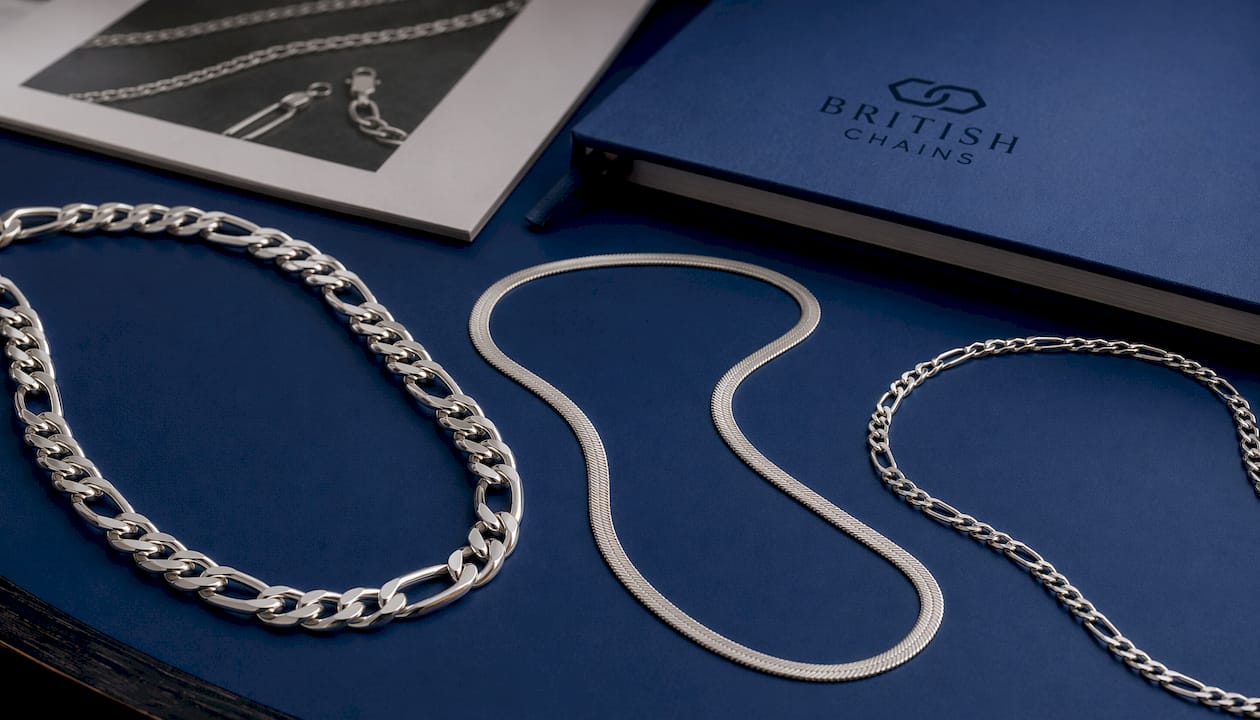
The 8mm polished Figaro chain combines a diamond cut finish with solid 925 sterling silver construction, producing a chain that reflects light sharply and resists the abrasive wear of daily use. For those who prefer a finer profile, the unisex Figaro range and the herringbone collection apply the same diamond cut polishing to lighter link profiles. Every chain carries a British hallmark, confirming silver purity and craftsmanship standards. For a full view of what chain styles suit men and women across different finishes, the Britishchains collection pages provide detailed finishing specifications alongside multiple length options.
FAQ
What does chain finish mean in jewellery?
Chain finish refers to the surface treatment applied to chain links after manufacture. It determines the chain’s wear resistance, tactile comfort, and visual appearance.
Is PVD better than electroplating for chain jewellery?
PVD bonds gold at a molecular level in a vacuum chamber, making it significantly more durable than electroplating, which deposits a thinner chemical layer that peels at high-contact points.
Can a worn chain finish be restored?
Solid sterling silver and solid gold chains with mirror or diamond cut finishes can be repolished by a jeweller. Plated finishes cannot be restored once the coating wears through without full replating.
Does chain finish affect skin comfort?
High-polish finishing removes microscopic burrs from link surfaces, preventing the neck chafing that rough or poorly finished chains cause. Multi-stage polishing protocols produce the smoothest, most skin-friendly surface.
Does a better finish make a chain sparkle more?
Finish enhances sparkle, but link geometry is the primary factor. Chains with more facets and flat link surfaces interact with light more dynamically, regardless of how well they are polished.


