

How To Tell If Silver Chain Is Real: Easy At-Home Tests
You just bought a silver chain, or maybe you've had one sitting in your jewelry box for years. Either way, you're wondering: how to tell if silver chain is real? It's a fair question. The market is flooded with silver-plated, nickel-core, and outright fake chains sold as genuine sterling silver. Knowing the difference protects both your skin and your wallet, since fake silver can tarnish quickly, irritate sensitive skin, and lose its appearance within weeks.
At British Chains, every piece we sell is genuine sterling silver 925, meaning it contains 92.5% pure silver, the international standard for real silver jewelry. We know what authentic silver looks, feels, and behaves like because we work with it every day. That hands-on experience is exactly what shaped this guide, and it's why we can walk you through the same tests we trust ourselves.
Below, you'll find straightforward at-home methods to verify whether your silver chain is the real deal. From hallmark stamps and magnet tests to ice tests and smell checks, each method is simple enough to do right now with things you probably already own. No jeweler visit required, though we'll also cover when it makes sense to get a professional opinion.
What real silver means for chains
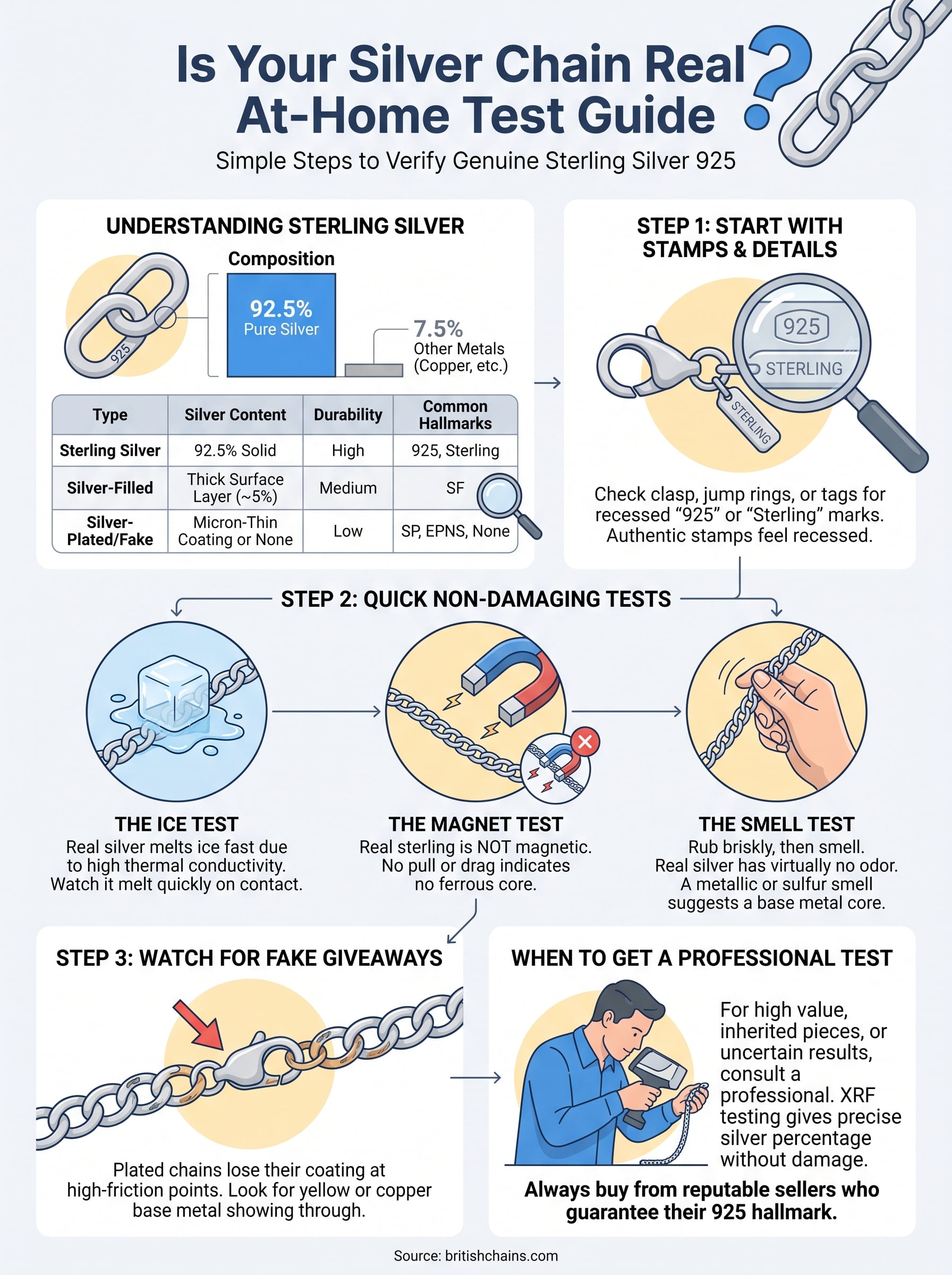
Real silver jewelry follows a defined standard, not just a label. Sterling silver 925 means the metal contains 92.5% pure silver, with the remaining 7.5% usually copper, added to give the chain enough hardness for daily wear. That 7.5% non-silver content is what gives your chain structural integrity without compromising its appearance or value. Pure silver at 99.9% is actually too soft to maintain its shape through normal use, which is why the sterling standard exists in the first place. When you're learning how to tell if silver chain is real, understanding that standard gives you a clear benchmark to test against.
Sterling silver must contain at least 92.5% pure silver by weight. Anything below that threshold is not sterling silver, no matter how it is marketed or packaged.
Sterling silver vs. silver-plated vs. silver-filled
Silver-plated chains have a thin silver coating applied over a base metal core, often brass, copper, or nickel. That coating can be just a few microns thick, which explains why plated chains tarnish fast, discolor at contact points, and wear through within months of regular use. Silver-filled is a step above plated since it uses a thicker bonded silver layer, but it still has a base metal core underneath and does not carry the same value or longevity as solid sterling silver 925.
| Type | Silver Content | Durability | Common Hallmark |
|---|---|---|---|
| Sterling Silver | 92.5% solid silver | High | 925, Sterling |
| Silver-Filled | Thick surface layer (~5%) | Medium | SF |
| Silver-Plated | Micron-thin coating | Low | SP, EPNS |
| Fake / Costume | None or trace amounts | Very Low | None or misleading |
Why chain style matters when judging silver quality
Heavier chain styles like curb and rope chains reveal silver's physical properties more clearly because you can actually feel the weight and density in your hand. Real sterling silver feels noticeably cool to the touch and holds that slight temperature difference for a moment when you first pick it up. Thin snake or herringbone chains, by contrast, can feel lighter, but genuine sterling versions still have a distinct solidity that base metal copies lack. Chain style also affects where wear appears first, so knowing your specific style helps you spot a base metal core breaking through at high-friction points like clasps, links, and bends.
Step 1. Start with stamps and chain details
The first thing to check when figuring out how to tell if silver chain is real is the hallmark stamp. Authentic sterling silver chains carry engraved markings pressed directly into the metal, usually on the clasp or on a small tag attached near it. These stamps are physically punched into the surface, not printed or painted, so they feel slightly recessed when you run your fingernail across them.
Where to look for hallmark stamps
Grab a magnifying glass or use your smartphone camera to zoom in on the clasp, the jump rings, or a small attached tag. These are the three spots where manufacturers consistently place hallmarks. If your chain has no stamp anywhere on it, that is a serious red flag. Some very thin chains may skip a stamp due to size limitations, but most reputable manufacturers find a way to mark even their finest pieces.
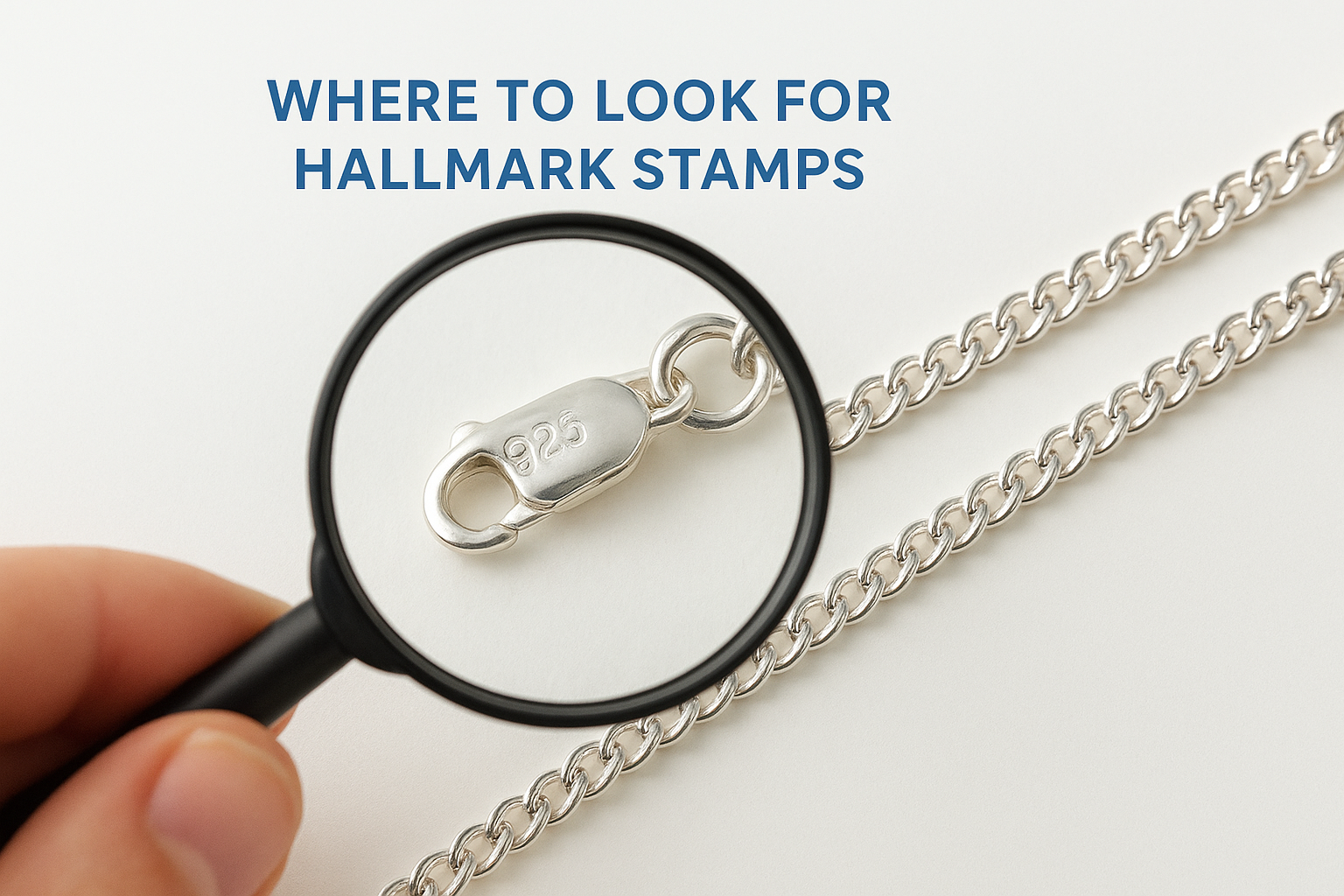
A missing stamp alone does not guarantee a chain is fake, but a genuine sterling silver chain from an established source will almost always carry one.
What the numbers and letters mean
The most common stamp on genuine sterling silver is "925", which confirms the 92.5% silver content. You might also see "Sterling" written out in full, or country-specific marks like a lion passant on British-made pieces. Markings such as "800" or "900" indicate lower silver content. Stamps reading "SP," "EPNS," or "German Silver" tell you the chain contains no solid silver at all.
Step 2. Do quick non-damaging tests at home
Once you've checked for stamps, move to physical tests that won't scratch or damage your chain. These methods give you extra confirmation when figuring out how to tell if silver chain is real, and you can run all of them in under five minutes using items you already have at home.
The ice test
Set your chain flat on top of an ice cube and watch what happens. Real sterling silver conducts heat at an exceptional rate, so the ice directly under the chain starts melting almost immediately on contact. Base metals and silver-plated chains conduct heat far more slowly, producing little to no visible reaction in the same timeframe. Silver holds one of the highest thermal conductivity ratings of any element, which makes this a reliable and completely harmless first test.
If your chain melts ice noticeably faster than a copper coin placed in the same spot, you have a strong indicator of genuine sterling silver in your hands.
The magnet test
Hold a strong rare earth magnet near your chain and watch for any pull. Real sterling silver is not magnetic and won't move toward the magnet at all. If your chain snaps to it or drags along the surface, the core is almost certainly a ferrous base metal, and you can rule out sterling immediately.
Keep in mind that brass and copper are also non-magnetic, so passing this test alone doesn't confirm sterling silver. What it does is eliminate the most obvious counterfeits quickly before you move on to further checks.
Step 3. Watch for plated or fake silver giveaways
Knowing how to tell if silver chain is real also means knowing what fake or plated chains reveal over time. Plated chains leave behind physical evidence that solid sterling silver never produces. You can spot the most common giveaways with your eyes and nose alone, no tools required.
Look for discoloration and wear-through
Plated chains lose their surface coating at high-friction points first. Check the clasp, the inner curves of each link, and anywhere the chain bends repeatedly against your skin. If you see yellow, copper, or dark-grey tones breaking through, you're looking at the exposed base metal underneath. Solid sterling silver tarnishes too, but it does so uniformly as a whole piece rather than peeling or flaking at specific contact points.
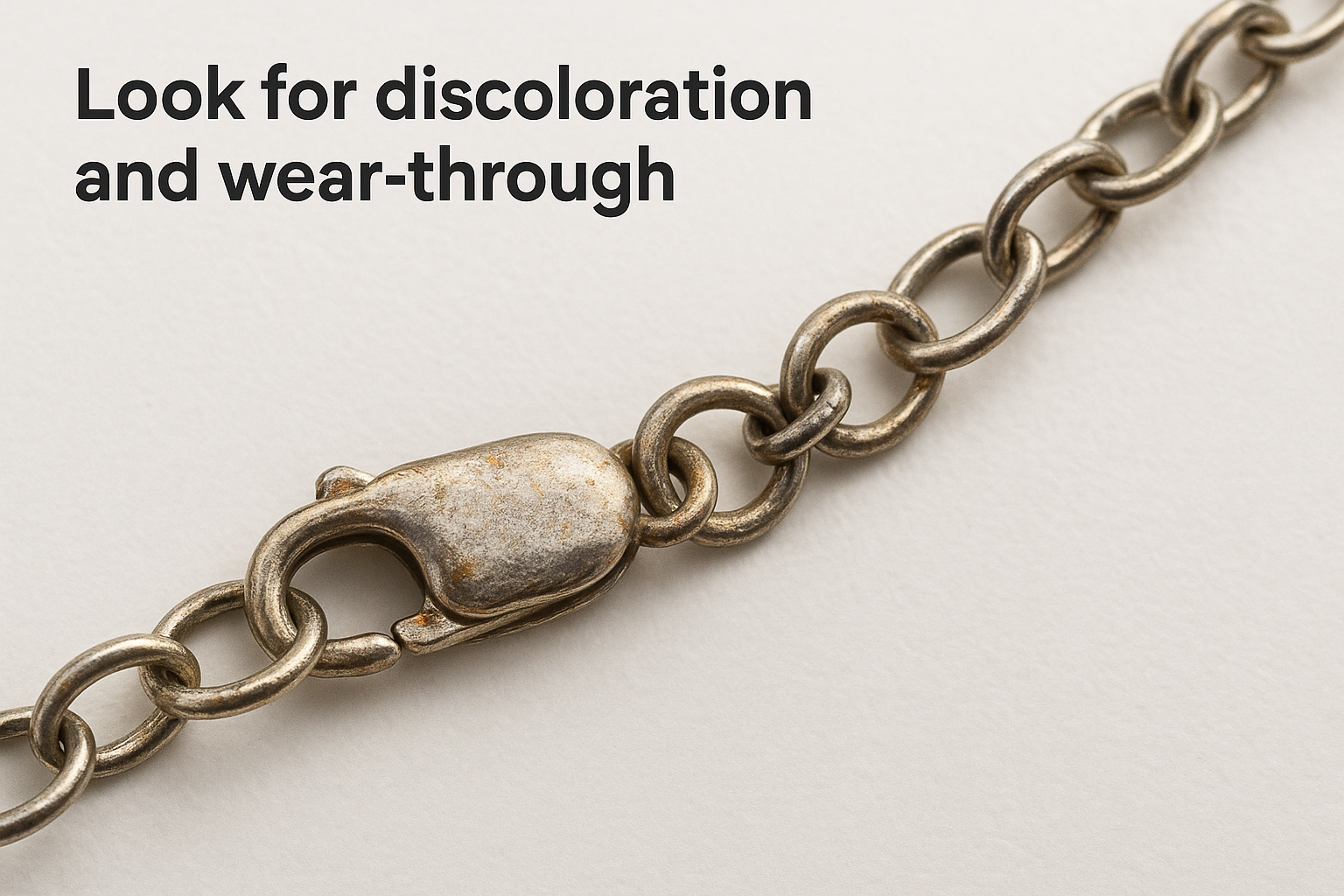
Discoloration concentrated at one spot rather than spread across the full chain almost always means a base metal core is showing through a worn coating.
Common spots to inspect for early wear signs include:
- The lobster claw clasp and connecting jump rings
- Inner curves where links rub against each other
- Any section that rests against a pulse point or neckline
The smell test
Rub the chain briskly between your fingers for several seconds, then bring it close and smell it. Real sterling silver carries [virtually no odor](https://britishchains.com/blogs/news/925-silver-chain-authenticity-checks) even after friction. If your chain gives off a distinct metallic or sulfur-like smell, that points strongly to a copper or brass core underneath.
Run this test on a chain you haven't recently cleaned with chemical polishes, since those products can temporarily mask the underlying base metal odor and produce a misleading result.
Step 4. Know when to get a professional test
At-home methods give you solid evidence, but they work best when you're dealing with obvious counterfeits or clear hallmarks. If your chain passes the magnet test and carries a 925 stamp but something still feels off, a professional assessment removes all remaining doubt. Knowing how to tell if silver chain is real sometimes means admitting the job calls for better equipment than a magnet and an ice cube.
When home tests leave you uncertain
Some situations make at-home testing unreliable. Silver-plated chains with thick coatings can pass the ice test in the short window you're watching, and worn-down hallmarks become genuinely hard to read even under magnification. You should also seek professional testing if you're evaluating an inherited piece, considering a high-value resale, or planning to use a chain as collateral. In any of those cases, the cost of a professional test is far smaller than the risk of being wrong.
If you're spending more than $50 on a chain or verifying a piece for resale, a professional test is worth every cent.
What a professional silver test involves
A licensed jeweler or assay office uses XRF (X-ray fluorescence) testing, which fires X-rays at the metal surface and reads the exact elemental composition without any damage to your chain. Some professionals use acid testing as a lower-cost alternative, applying a small nitric acid drop to a scratch mark and reading the color reaction against a reference chart. Either method gives you a precise silver content percentage, not just a pass or fail result.
Quick recap and next steps
You now have a reliable system for how to tell if silver chain is real without leaving your home. Start with the 925 hallmark stamp, check for magnetic pull, run the ice test, and look closely for wear-through at the clasp and link curves. Each test works independently, but they're strongest when you run them together. A genuine sterling silver chain will pass all of them consistently, while a plated or fake piece will fail at least one. If the results still leave you uncertain, a professional XRF test resolves it quickly and without damaging the chain.
When you're ready to buy with confidence, look for pieces that carry the 925 stamp and come from sellers who stand behind their materials. Our sterling silver curb chains are made from genuine 925 silver and include the hallmarks you just learned to read. Every piece is built to pass every test on this page.


