

How To Measure Necklace Chain Length For The Perfect Fit
Ordering a chain necklace online comes with one common frustration: picking the wrong length. Too short and it feels like it's choking you. Too long and it throws off the look you were going for. Knowing how to measure necklace chain length before you buy saves you the hassle of returns and the disappointment of a piece that just doesn't sit right. The good news is that measuring takes less than five minutes with tools you already have at home.
At British Chains, we sell sterling silver 925 chain necklaces and bracelets in lengths ranging from 8 to 30 inches and widths from 2mm to 12mm. That's a lot of options, and we hear from customers all the time who aren't sure which combination will work best for them. The right length depends on several factors, including your neck size, body frame, the chain style you're choosing, and whether you plan to wear a pendant. A 20-inch curb chain, for example, falls differently than a 20-inch rope chain because of how each style drapes and carries its weight.
This guide walks you through two straightforward methods: measuring an existing necklace you already love, and measuring your neck from scratch to find your ideal fit. You'll also find a necklace length chart showing where each size typically falls on the body, so you can confidently choose before adding anything to your cart.
What necklace chain length really means
When a chain necklace is listed as 18 inches, that number refers to the total length of the chain from one end of the clasp to the other, measured flat in a straight line. It does not mean the chain will sit 18 inches below your collarbone. That single number needs context before it can help you make a confident buying decision, and understanding what it actually tells you is the first step toward getting the fit right.
The measurement is the full loop, not half
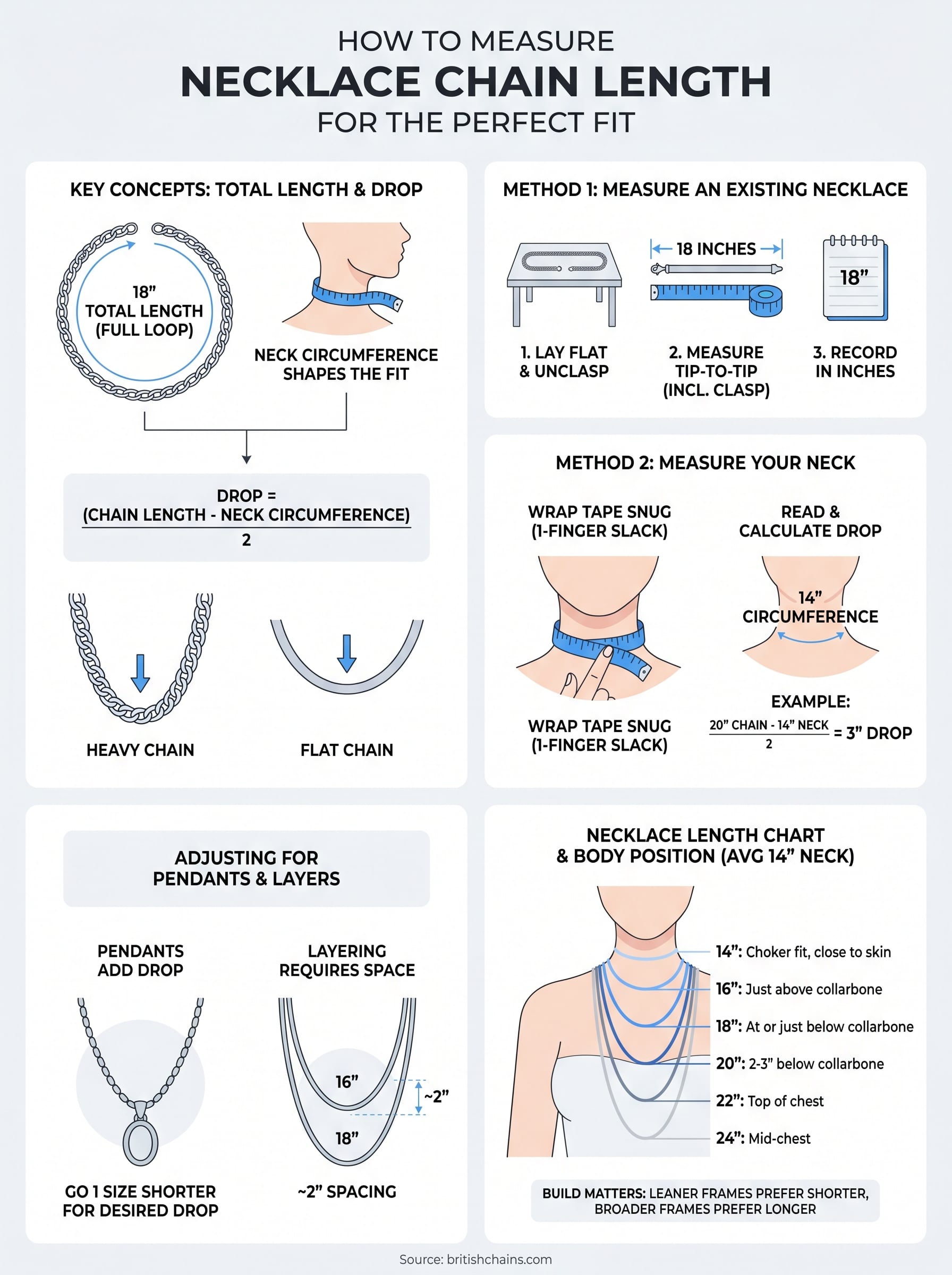
When you wear a chain, it forms a loop around your neck. An 18-inch chain wraps 18 total inches around your neck and hangs at a point determined by how much of that length clears your neck circumference. If your neck measures 14 inches around, an 18-inch chain leaves 4 inches of extra length, which means the bottom of the chain sits roughly 2 inches below your collarbone. That calculation is the core of understanding how to measure necklace chain length correctly.
Here's a simple way to estimate drop based on neck size and chain length:
| Chain Length | Neck Circumference | Estimated Drop Below Collarbone |
|---|---|---|
| 16 inches | 14 inches | ~1 inch |
| 18 inches | 14 inches | ~2 inches |
| 20 inches | 14 inches | ~3 inches |
| 20 inches | 16 inches | ~2 inches |
| 24 inches | 14 inches | ~5 inches |
The drop of a chain is roughly half the difference between the total chain length and your neck circumference.
How neck circumference shapes the fit
Neck size varies significantly from person to person, and this is the factor most buyers overlook. The average adult neck circumference sits between 13 and 16 inches, but that range makes a real difference in where a chain lands on your body. A 20-inch chain on someone with a 13-inch neck drops about 3.5 inches below the collarbone, while the same chain on someone with a 16-inch neck drops closer to 2 inches.
Neither result is wrong, but knowing your own measurement makes every length listed on a product page instantly more useful. Without it, you're essentially guessing, and the chain you receive might sit an inch or two higher or lower than you expected.
Why chain style changes how a length sits
Not all chains hang the same way at the same length. Heavier chains like curb and rope styles carry more weight, which pulls them downward and makes them sit lower than a lighter chain of identical length. A snake or herringbone chain, by contrast, lies flat against the skin and can look shorter on the body even when the stated measurement matches exactly, because smooth, flat chains follow the contour of your chest rather than hanging away from the skin with any slack.
Each chain style also has a different visual weight. A thick 8mm curb chain at 20 inches makes a bold statement at the chest, while a delicate 2mm box chain at the same length reads as subtle and understated. The style you choose changes how the length looks on you, not just where the chain physically lands.
Length as a style decision, not just a size
Chain length is as much about aesthetics as it is about fit. Once you understand how your neck size and the chain's weight interact, you can start making intentional choices rather than defaulting to whatever a size chart says is average. A shorter chain that sits at or above the collarbone reads as classic and clean, while a longer chain that falls to the sternum or below works well with pendants and layered looks.
Thinking about how you plan to wear the chain is just as important as taking a measurement. Knowing your goal before you buy means you end up with a piece that looks right, not just a piece that fits.
Tools you need and quick prep
You don't need anything special to figure out how to measure necklace chain length accurately. Most of the tools are already in your home, and getting set up takes about two minutes before you start either measurement method covered in this guide. Having everything ready before you begin means you won't lose your place mid-measurement.
What to gather before you start
Grab the following items depending on which method you plan to use. If you're measuring an existing necklace, a flexible tape measure gives you the most accurate result in the fewest steps. If you don't have one available, a piece of non-stretchy string paired with a ruler works just as well and costs you nothing.
Here's what to have on hand:
- Flexible tape measure (the kind used for sewing or body measurements) - works for both measuring an existing chain and measuring your neck
- Non-stretchy string or thin cord - a reliable substitute when you don't have a tape measure
- A ruler or flat measuring surface - used alongside string to read the final number in inches
- A flat, well-lit surface - a table or countertop works perfectly for laying a chain out straight
- A pen and notepad - to record your measurements before you move on
Writing your measurements down immediately saves you from repeating the whole process right before you place your order.
How to confirm your tape measure is set up correctly
Before you take any measurement, confirm your tape measure reads in inches rather than centimeters only. Chain lengths are listed in inches, so working in the same unit from the start avoids conversion errors. Most flexible tape measures show both inches and centimeters on opposite sides of the tape, so flip it over if the centimeter side is facing up.
If you're using string instead, cut a length of at least 24 inches so you have more than enough slack for any neck size or chain you're working with.
One tool to avoid entirely
Do not use a stretchy elastic band or rubber cord as your substitute measuring tool. Elastic stretches under even light tension, which means your measurement will read shorter than your actual size. The result is a chain that arrives too long because your neck measurement came up artificially small. Stick with a rigid ruler, a sewing tape measure, or a firm piece of string for numbers you can actually rely on.
Step 1. Measure an existing necklace
If you already own a necklace that fits the way you like it, that chain is your best reference point. Measuring it directly gives you the exact length to look for when buying a new one, and it takes less than two minutes to get a reliable number.
Lay the chain out flat
Place the chain on a flat, hard surface like a table or countertop. Unclasp it completely and straighten it into a single line from one end to the other. Kinks and curves in the chain will throw off your measurement, so take a moment to gently work out any coiled or tangled sections before you start.
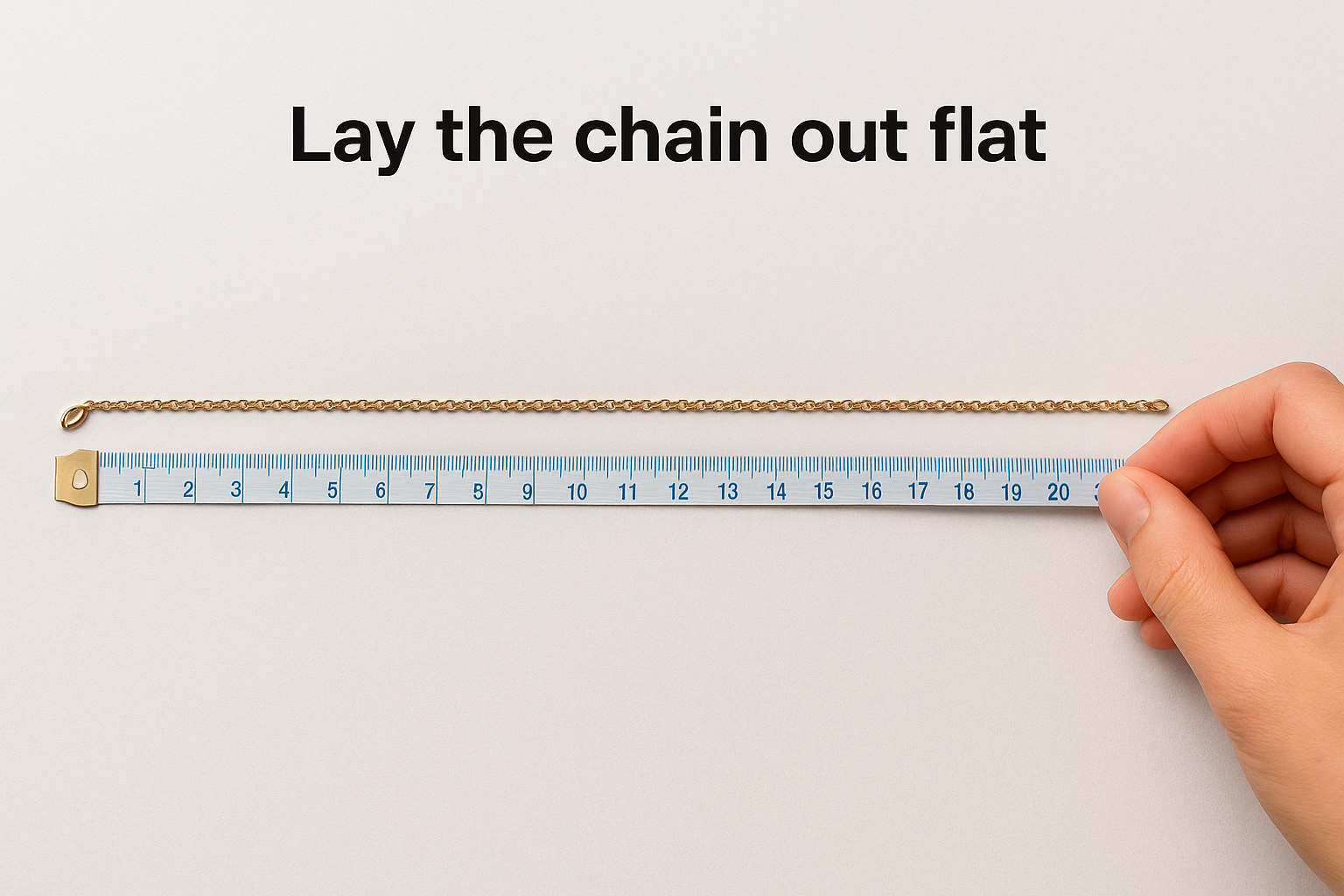
Once the chain is flat, position the zero end of your flexible tape measure at one tip of the clasp hardware (not at the first chain link, but at the very end of the clasp itself). Pull the tape straight along the chain to the opposite end, including the full clasp on that side too. The total chain length includes both clasps, so measuring tip to tip gives you the accurate stated length you'll see listed on any product page.
Read the number in inches
Read the measurement at the far tip of the second clasp in inches and write it down right away. That number is the chain length to use when you shop.
If your tape measure only shows centimeters, divide the number by 2.54 to convert to inches.
Here's a quick reference for common conversions:
| Centimeters | Inches |
|---|---|
| 40 cm | ~15.7 inches |
| 45 cm | ~17.7 inches |
| 50 cm | ~19.7 inches |
| 55 cm | ~21.7 inches |
| 60 cm | ~23.6 inches |
Account for extender chains
Some necklaces include a short extender chain at the clasp, typically adding 1 to 2 inches of adjustability. If your existing chain has one, decide whether you normally wear it at the shortest setting or with the extender in use. Measure the chain at the length you actually wear it, not at its maximum possible length, to capture a number that reflects your real preference.
Skipping this step is one of the most common errors people make when figuring out how to measure necklace chain length, and it leads to buying a piece that sits noticeably lower than expected.
Step 2. Measure on your body with tape or string
When you don't have an existing necklace to reference, measuring your neck directly gives you the foundation you need to choose the right chain length with confidence. This method is also useful when you want to try a different style or fit than anything you already own. Knowing your neck circumference turns every chain length listing from an abstract number into something you can actually visualize on your body.
Wrap the tape or string around your neck
Stand in front of a mirror with your shoulders relaxed and your posture natural, not stiffened or slouched. Take your flexible tape measure and wrap it around the base of your neck where a chain would actually rest, not high under your chin and not low on your collarbone. Hold the tape snug but not tight so that it lies flat against your skin without digging in. You should be able to slide one finger underneath it comfortably.
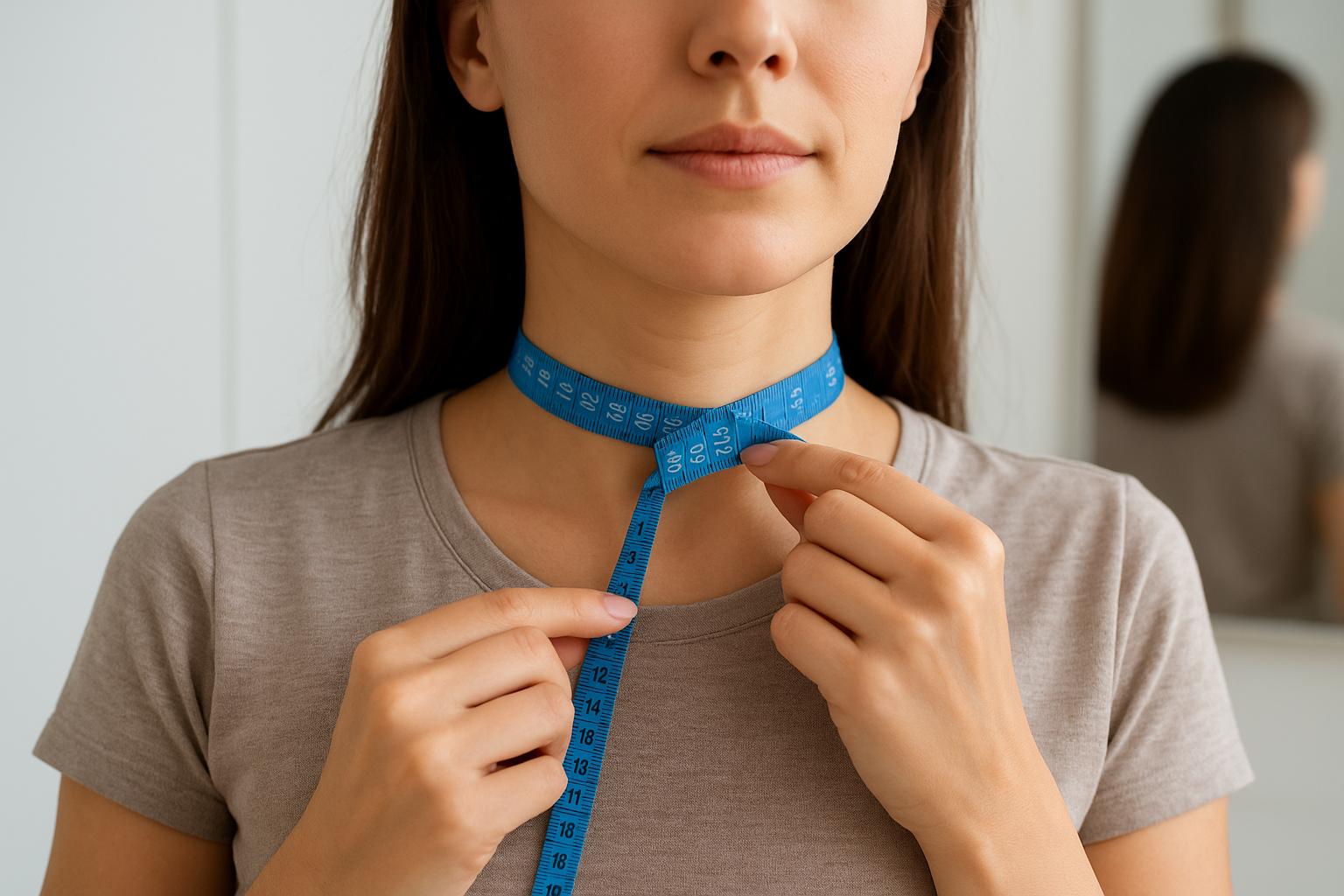
If you're using string instead of a tape measure, wrap the string around your neck at that same position and pinch the point where the two ends meet with your fingers. Lay the string flat against a ruler and read the number where your fingers are pinching. That measurement is your neck circumference.
Write this number down immediately so you don't lose it before you calculate your chain length.
Read and record your measurement
Once you have your neck circumference in inches, you can calculate how much drop any given chain length will give you. The formula is straightforward: subtract your neck circumference from the chain length, then divide by two. That result tells you roughly how far below the base of your neck the chain will hang.
Here's how that plays out across common chain lengths for someone with a 14-inch neck circumference:
| Chain Length | Neck Circumference | Drop Below Neck Base |
|---|---|---|
| 16 inches | 14 inches | ~1 inch |
| 18 inches | 14 inches | ~2 inches |
| 20 inches | 14 inches | ~3 inches |
| 22 inches | 14 inches | ~4 inches |
| 24 inches | 14 inches | ~5 inches |
Using this table alongside your own neck measurement is one of the clearest ways to apply the principles of how to measure necklace chain length before buying. Pair your neck circumference with the drop you're aiming for, and the right chain length becomes an easy choice rather than a guess.
Step 3. Factor in pendants, layers, and extenders
Getting your neck circumference and chain length figured out is a strong start, but a bare chain sits differently than one carrying a pendant or worn alongside other necklaces. Before you finalize any length, consider how you actually plan to wear the piece.
How pendants change where a chain falls
A pendant adds visual weight below the chain itself, which means the focal point of your necklace will sit lower than the chain's stated length suggests. When you're working out how to measure necklace chain length for a pendant setup, the practical rule is to go one size shorter than you'd normally pick for a bare chain. If you typically wear a 20-inch chain on its own and want a pendant to land at that same position on your chest, an 18-inch chain will likely get you there.
The size of the pendant matters too. A small, lightweight charm barely shifts the visual center, but a larger statement pendant can add an inch or more of perceived drop depending on how long the bail is. Measure the pendant from the top of the bail to the bottom before you order, and add that number to your drop calculation.
If your pendant has a long bail, measure the full pendant height and subtract it from your desired drop to find the right chain length.
Planning chain lengths for layering
Layered necklaces look intentional when each chain sits at least 2 inches below the one above it. That spacing gives each piece visual room and prevents them from tangling throughout the day. A classic three-layer setup might use lengths of 16 inches, 18 inches, and 20 inches, with each chain resting at a clearly distinct level on your chest.
Mixing chain styles within a layered look also plays a role in spacing. Thicker, heavier chains like curb or rope styles can overpower a delicate box chain at a similar length, so consider both width and length when choosing pieces to wear together.
Using extenders to fine-tune your fit
Extenders are short sections of chain, usually 1 to 3 inches long, that attach to the clasp and let you adjust the length after you've already bought the piece. They're especially useful if you're between two standard lengths or want the option to wear a chain at different positions depending on your outfit.
When you buy a chain that includes an extender, always measure the base chain length without the extender and treat the added inches as bonus flexibility rather than part of the core fit.
Step 4. Choose a length for your build and style
Your neck size tells you where a chain will land, but your overall build and the look you're going for determine which landing point actually works. The same 20-inch chain reads completely differently on a 5'4" person with a lean build than it does on a 6'2" person with a broader frame. Once you understand how to measure necklace chain length accurately, the next step is matching that number to your body proportions and your personal style goals.
Shorter chains for leaner or smaller frames
People with slimmer necks or smaller frames generally find that shorter chains sit proportionally well. A 16-inch chain that would feel snug on a larger frame can land cleanly at the collarbone on a leaner build, creating a defined, polished look without appearing too tight or too close to the throat. If you have a shorter neck, going up to 18 inches gives you a clean collarbone drop without overwhelming your frame.
A chain that sits at or just below your collarbone tends to look intentional and clean on most builds.
Here's a quick guide to starting lengths by build type:
| Build Type | Suggested Starting Length |
|---|---|
| Lean or petite | 16-18 inches |
| Average frame | 18-20 inches |
| Broader or taller | 20-24 inches |
Longer chains for broader or taller builds
Broader shoulders and taller frames carry longer chains more naturally. A 20-inch chain on a 6-foot frame may sit higher than you expect because the neck circumference is typically larger, consuming more of the total length before any drop occurs. Choosing a 22-inch or 24-inch chain gives you a visible drop below the collarbone and keeps the piece from looking undersized against your frame.
Adding an inch or two beyond what you think you need is a low-risk move when you're buying a versatile everyday chain. Most people with a larger frame find they consistently prefer the extra length once they see it on.
Matching length to your intended look
Your style goal shapes the final decision just as much as your frame does. A chain worn as a standalone statement piece can lean shorter to keep attention near the neckline, while a chain meant to carry a pendant or anchor a layered look works better at 20 inches or longer. Consider the necklines you wear most often before committing:
- Crew necks and high necklines: 20 inches or longer so the chain stays visible
- V-necks and open collars: 16-18 inches for a clean, proportional fit
- Layered looks: start at 16 inches for the top layer and add 2-inch increments for each additional chain
Necklace length chart and where each size sits
A chart gives you a quick visual anchor once you've taken your measurements. Understanding how to measure necklace chain length is only half the work; the other half is knowing how each standard size translates into a specific position on your chest. The table below uses a baseline neck circumference of 14 inches, which falls in the middle of the average adult range, so adjust your expectations up or down by about half an inch for every inch your own neck size differs.
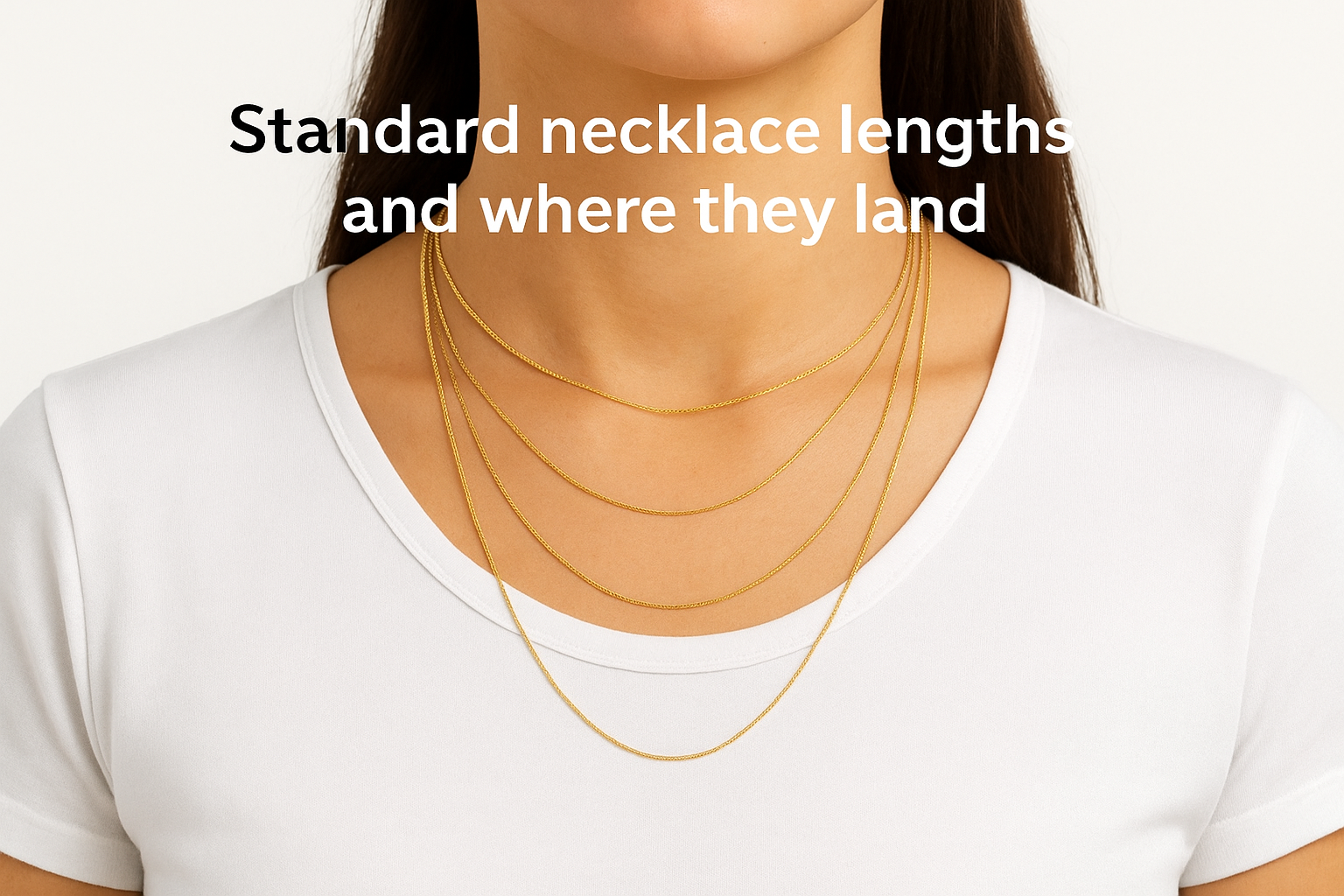
Standard necklace lengths and where they land
Each length in the table below reflects where the bottom of a bare chain typically sits on a person with a 14-inch neck circumference. Pendant placement will always sit lower than the chain position listed here, so factor in your pendant height if you plan to use one.
| Chain Length | Approximate Position on Body | Common Use |
|---|---|---|
| 14 inches | Sits at the base of the throat | Choker fit, close to skin |
| 16 inches | Rests just above the collarbone | Classic women's length |
| 18 inches | Sits at or just below the collarbone | Most popular everyday length |
| 20 inches | Falls 2-3 inches below the collarbone | Versatile for men and women |
| 22 inches | Sits near the top of the chest | Works well with V-necks |
| 24 inches | Falls mid-chest | Pendant chains, layering base |
| 26-28 inches | Drops below mid-chest | Statement or layered looks |
| 30 inches | Reaches the upper stomach area | Long pendants, bold styling |
A 20-inch chain is the most reliable all-purpose starting point for adults with an average neck size.
How to read the chart against your own measurements
Apply the drop formula from Step 2 before you lock in a length. Subtract your neck circumference from the chain length you're considering, divide that number by two, and compare it to the chart positions above. If your neck measures 16 inches and you're looking at a 22-inch chain, your drop works out to 3 inches below the neck base, which puts it roughly at the mid-chest rather than the collarbone.
Use this adjustment any time the chart position doesn't match your expectations. Running through the calculation once before you order takes under a minute and eliminates the guesswork that leads to the wrong length arriving at your door.
Common mistakes and quick fixes
Even when you follow the right steps, a few small errors can throw off your final number and leave you with a chain that doesn't fit the way you expected. Most of these mistakes are easy to avoid once you know what to watch for. Recognizing them before you finalize your measurement is the fastest way to make sure the process actually works.
Measuring only the chain links and skipping the clasp
One of the most frequent errors people make when figuring out how to measure necklace chain length is stopping the tape at the last link on each end instead of measuring all the way to the tip of the clasp hardware. The clasp adds real length, typically between a quarter-inch and a half-inch on each side, and leaving it out makes your measurement read short. When you order based on that number, the chain arrives longer than expected because the listed product length always includes the full clasp.
Always start and end your tape measure at the outermost tip of the clasp on each side, not at the first or last link.
The quick fix here is straightforward: go back to your existing chain, unclasp it completely, and re-measure tip to tip across the entire piece including both clasp ends.
Pulling the tape measure too tight around your neck
When you take your neck circumference, tension matters more than most people realize. Pulling the tape snug enough to sit flat but loose enough for one finger to slide underneath is the target. Pulling it tight compresses the skin and gives you a measurement that reads smaller than your actual neck size, which means any chain you buy based on that number will sit higher and tighter than you want.
Re-take the measurement with the tape sitting comfortably against your skin. A quick check: if the tape leaves a visible mark when you remove it, you applied too much pressure.
Ignoring how pendant height affects the final drop
Buyers often select a chain length based on where they want the chain to sit, then realize too late that the pendant pushes the focal point significantly lower. A 2-inch pendant on an 18-inch chain means the bottom of the pendant falls where a 20-inch bare chain would land.
Before you order, measure your pendant from the top of the bail to its lowest point. Subtract that number from your target drop and use the result to find the correct chain length.
| Desired Pendant Position | Pendant Height | Chain Length to Order |
|---|---|---|
| 2 inches below collarbone | 1 inch | 18 inches |
| 2 inches below collarbone | 2 inches | 16 inches |
| 3 inches below collarbone | 1.5 inches | 18 inches |
| 3 inches below collarbone | 2.5 inches | 16 inches |
Your next step
You now have everything you need to figure out how to measure necklace chain length accurately before you buy. Take your neck circumference, apply the drop formula, factor in any pendant height, and cross-reference the result against the length chart. Those four steps give you a concrete number rather than a guess, and they take under five minutes to complete.
Once you have that number, the right chain becomes an easy choice. British Chains offers sterling silver 925 necklaces in lengths from 8 to 30 inches, so whatever size your measurements point you toward, you'll find it. If you want a bold, everyday piece that sits well at the chest, browse the men's silver chains collection to find a style and width that matches your build. Every chain is genuine sterling silver 925, and the size range means your measurement will translate directly into a piece that fits exactly the way you planned.


