

How To Measure Bracelet Size: Wrist Fit Guide + Chart
A bracelet that's too loose slides around and catches on everything. Too tight, and it digs into your skin. Knowing how to measure bracelet size before you order saves you the hassle of returns and the disappointment of a piece that just doesn't sit right. Whether you're buying for yourself or picking out a sterling silver chain bracelet as a gift, getting the fit right matters.
The good news: you don't need any special tools. A piece of string, a ruler, or a flexible measuring tape is all it takes. This guide walks you through each measurement method step by step, then gives you a sizing chart to match your wrist measurement to the right bracelet length. We built this resource because our customers at British Chains often ask us about sizing before ordering our silver chain bracelets, and we'd rather help you get it right the first time.
Below, you'll find everything from measuring techniques to tips on choosing the right fit based on how you like your bracelet to wear, snug, comfortable, or loose and relaxed. Let's get into it.
What you need and where to measure
Before you start figuring out how to measure bracelet size, gather what you need. The whole process takes under two minutes, and you likely have everything at home already. You don't need a jeweler's tools or anything specialized.
Tools you need
Your best option is a flexible measuring tape, the kind used for sewing. It wraps cleanly around your wrist and gives you an accurate reading in one step. If you don't have one, a strip of paper or a piece of string works just as well. You'll also need a ruler to read the measurement once you've marked it.
Here's what works:
- Flexible measuring tape (most accurate, easiest to use)
- A strip of paper (cut a thin strip about 1 cm wide and 30 cm long)
- String or thin ribbon (mark it with a pen, then lay it flat against a ruler)
- A ruler (to read the final measurement in centimeters or inches)
A flexible sewing tape measure gives you the most reliable result. If you're buying a bracelet as a gift, ask the recipient to measure and send you the number before you order.
Where to measure on your wrist
You want to measure around the bony part of your wrist, just below the wrist bone on the side closest to your hand. That's the narrowest point, and it's where most bracelets naturally sit when you wear them.
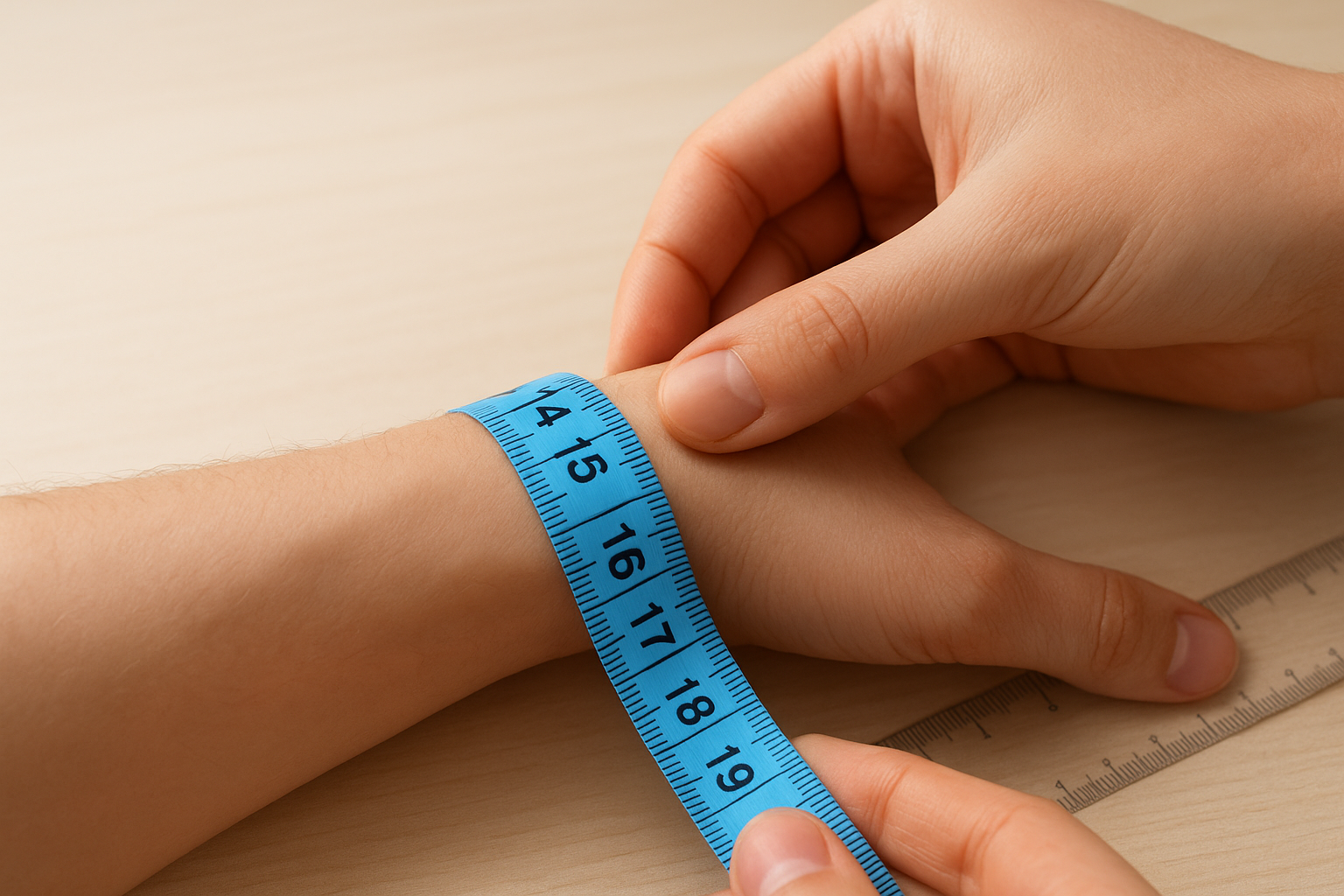
Avoid measuring over the wrist bone itself or too far up toward your forearm. Both spots give you a larger number than where the bracelet will actually rest, and you'll end up ordering a size that fits too loosely.
Step 1. Measure your wrist with a tape measure
A flexible measuring tape is the quickest and most accurate way to figure out how to measure bracelet size at home. Wrap it around your wrist, take a reading, and you're done in under a minute. Make sure the tape lies flat against your skin without any twists or gaps.
How to take the measurement
Follow these steps carefully to get a clean, reliable number you can use throughout this guide. Each step takes only a few seconds, and the whole process gives you a precise wrist circumference you can refer back to.
- Hold your hand relaxed, with your fingers together rather than splayed or clenched.
- Wrap the flexible tape measure around your wrist just below the wrist bone, where the bracelet will naturally sit.
- Slide one finger between the tape and your wrist to build in a comfortable fit allowance.
- Read the number where the tape end meets the rest of the tape.
- Write it down in both centimeters and inches if your ruler shows both scales.
Take the measurement twice to confirm you get the same number each time, especially if you're ordering for someone else.
Your result is your base wrist circumference. You'll use this number in Step 3 to convert it into the right bracelet length.
Step 2. Measure without a tape using string or paper
No measuring tape? No problem. String, thin ribbon, or a strip of paper all work just as well for figuring out how to measure bracelet size at home. The method is nearly identical to using a tape measure, with one extra step at the end.
Using string or ribbon
Wrap a piece of string or ribbon around your wrist just below the wrist bone. Hold it snug but not tight, then pinch the spot where the string meets itself. Lay the string flat against a ruler or straight edge and read the measurement from the end to your pinch mark. Write that number down.
Thin cooking twine or a shoelace works well here, but avoid stretchy materials since they will give you a shorter reading than your actual wrist size.
Using a strip of paper
Cut a narrow strip of paper, roughly 1 cm wide, from any sheet you have on hand. Wrap it around your wrist the same way, mark where the paper overlaps with a pen or pencil, then lay it flat and measure to that mark with a ruler. This method is especially useful if you want to repeat the measurement a couple of times to confirm accuracy.
Step 3. Turn your wrist size into bracelet size
Your wrist circumference is not the same as your bracelet size. Every bracelet needs extra length beyond your actual wrist measurement to slide on comfortably and move naturally when you wear it. The amount you add depends on your fit preference, whether you want the bracelet to sit snug, rest comfortably, or hang loose.
How much to add for fit
The standard rule is to add between 1 cm and 2.5 cm to your wrist measurement. A snug fit works best for chain styles that look intentional sitting close to the skin. A looser fit suits thicker or heavier chains that drape better with some movement. For most everyday silver chain bracelets, adding 1.5 cm gives you a comfortable fit that stays in place without feeling tight.
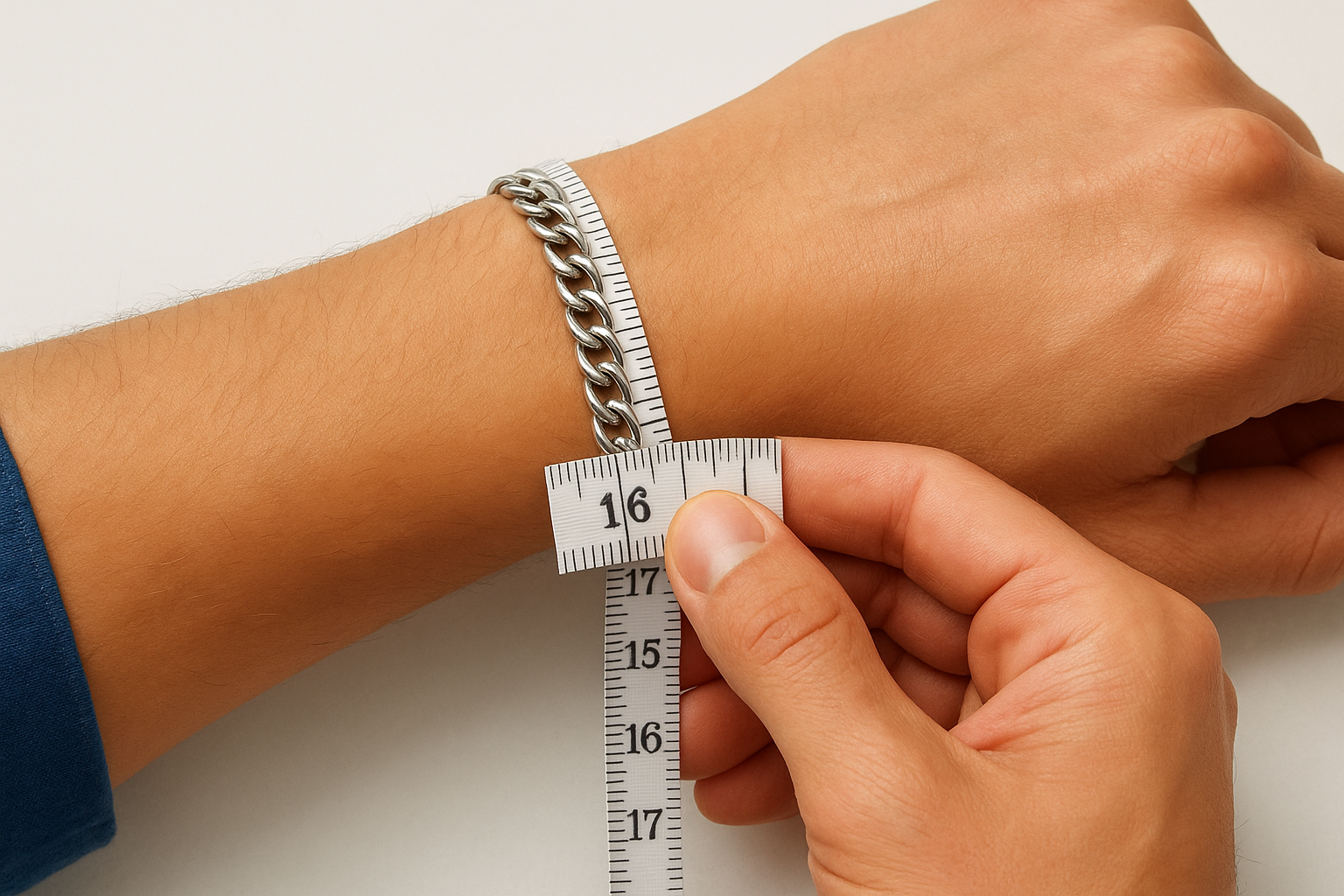
Once you know how to measure bracelet size correctly, adding the right allowance is the step that turns a number into a bracelet that actually fits.
Use this table to pick your bracelet length based on your wrist size and preferred fit:
| Fit Style | Add to Wrist | Example: 16 cm wrist |
|---|---|---|
| Snug | +1 cm | 17 cm |
| Comfortable | +1.5 cm | 17.5 cm |
| Loose | +2 to 2.5 cm | 18 to 18.5 cm |
Step 4. Use the chart and handle tricky bracelet types
Now that you have your wrist measurement and fit preference, use the chart below to find your final bracelet length. This covers the most common adult wrist sizes across all three fit styles.
| Wrist Size | Snug (+1 cm) | Comfortable (+1.5 cm) | Loose (+2 cm) |
|---|---|---|---|
| 14 cm | 15 cm | 15.5 cm | 16 cm |
| 15 cm | 16 cm | 16.5 cm | 17 cm |
| 16 cm | 17 cm | 17.5 cm | 18 cm |
| 17 cm | 18 cm | 18.5 cm | 19 cm |
| 18 cm | 19 cm | 19.5 cm | 20 cm |
| 19 cm | 20 cm | 20.5 cm | 21 cm |
Chain bracelets and fixed-length styles
Sterling silver chain bracelets come in fixed lengths, most often 18 cm, 19 cm, or 20 cm. Once you know how to measure bracelet size, match your result to the closest column in the chart and go up one size if you fall between two options. Chain styles sit better with a small amount of movement rather than pressed flat against the skin.
If you're buying a chain bracelet as a gift without the recipient's measurement, order 19 cm, which fits the widest range of adult wrists comfortably.
Wider and heavier bracelets
Wider bracelets, anything 6 mm or more, need slightly more room than fine or thin styles. Add an extra 0.5 cm to your normal fit preference so the bracelet doesn't pinch when your wrist bends throughout the day.
Thicker chains also tend to feel tighter than they measure, so defaulting to the loose fit column is a reliable choice for any style wider than 8 mm.
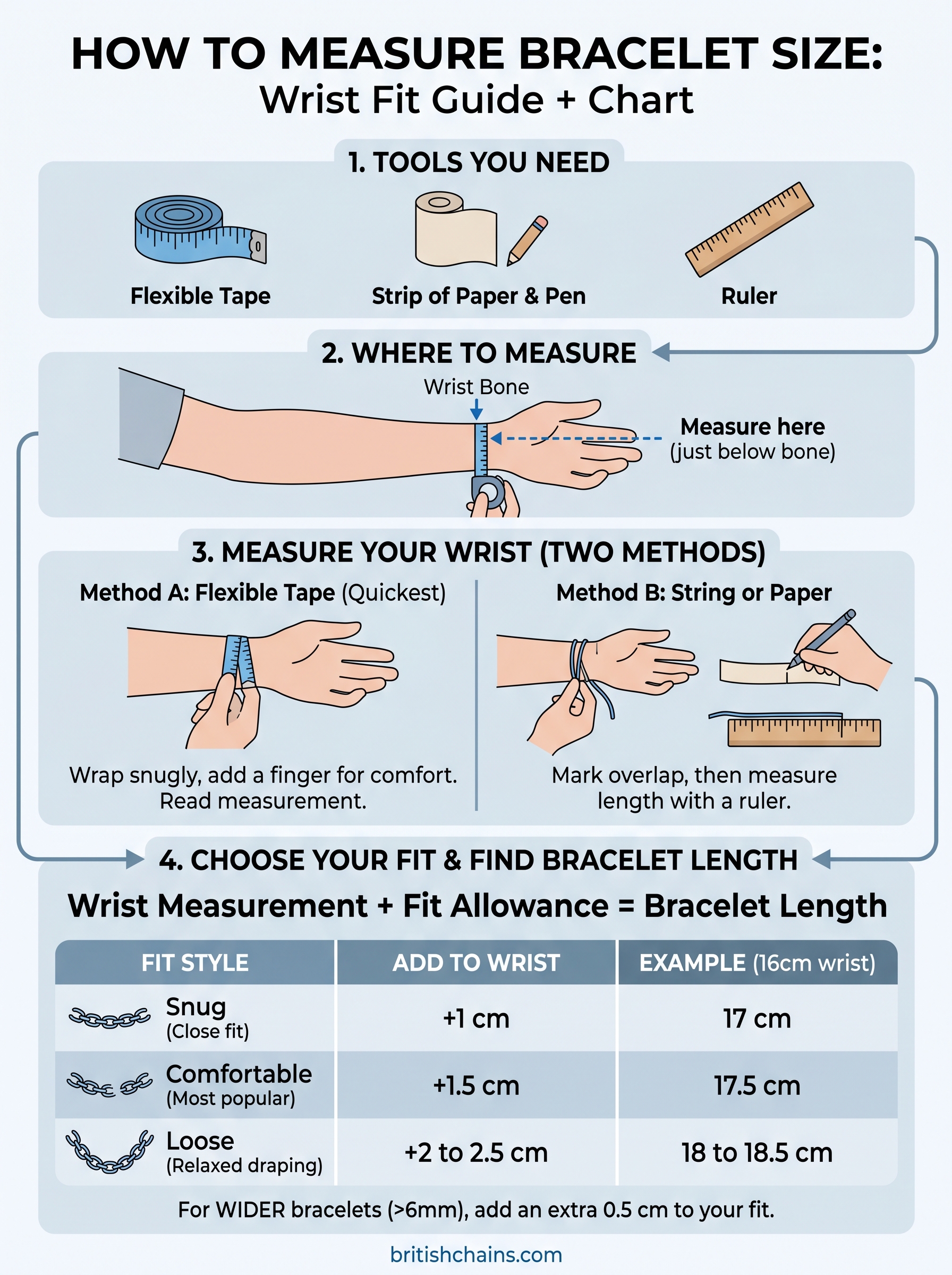
You're ready to choose your bracelet size
You now have everything you need to get the fit right the first time. Knowing how to measure bracelet size at home takes less than two minutes, and the chart in this guide converts your wrist circumference into a specific bracelet length you can order with confidence. No guessing, no returns.
Take your measurement, add your preferred fit allowance, and match it against the chart. If you want a snug fit, add 1 cm to your wrist size. If you prefer a comfortable or relaxed wear, go with 1.5 to 2.5 cm. For wider or heavier chain styles, default to the loose column to avoid any pinching when your wrist moves throughout the day.
Ready to put your measurement to use? Browse our silver curb chain bracelets and pick the length that lines up with your number. Every product page lists available lengths clearly so you can order exactly what fits your wrist.


