

How to match chain length to your body type
For most women, 16–18 inches (40–45 cm) is the flattering starting point; petite frames suit the shorter end, fuller or taller figures generally wear 18–22 inches (45–55 cm) best. Men’s default is 20 inches (50 cm), adjusted up or down by build. If you are buying a gift and have no measurements, 45 cm for women and 50 cm for men with an extender covers the majority of wearers.
Quick-start chart by body type:
| Body type | Suggested starting length |
|---|---|
| Petite / short (under 5’4" / 162 cm) | 16–18 in (40–45 cm) |
| Average height and frame | 18–20 in (45–50 cm) |
| Tall / long torso | 20–24 in (50–60 cm) |
| Fuller / plus-size | 20–24 in (50–60 cm) |
| Short neck | 18–20 in (45–50 cm) — avoid chokers |
| Long neck | 14–18 in (35–45 cm) — chokers and princess lengths both work |
Key takeaways
Matching chain length to body type comes down to three inputs: your height and torso length, your neck circumference, and the neckline you plan to wear most often.
| Point | Details |
|---|---|
| Start by body type | Petite frames: 16–18 in (40–45 cm); average: 18–20 in; tall or fuller: 20–24 in (50–60 cm). |
| Check neck circumference | Wider necks need at least 18 in (45 cm) to sit comfortably; narrow necks can wear shorter lengths. |
| Use extenders when unsure | A 5 cm extender on an 18 in chain covers the 18–20 in range — the safest gift approach. |
| Match length to neckline | V-necks suit 18–20 in; crew necks need under 16 in or over 20 in; turtlenecks need 20 in minimum. |
| Britishchains recommendation | The 2mm curb at 16–18 in suits petite to average frames; the 3mm rope at 20 in suits taller and broader builds. |
Table of Contents
- What the standard necklace length names actually mean
- How to measure your ideal chain length at home
- Matching chain length to body type: specific rules and exact ranges
- Which chain length works with each neckline?
- How chain thickness, pendant size, and clasp position affect the look
- Layering necklaces: how to get the spacing right
- Men’s chain-length quick guide
- Adjusting chain length: extenders, custom cuts, and UK buying notes
- Britishchains sterling silver chains for every body type
- Why hallmarking and gauge matter more than most buyers realise
- How to order from Britishchains with the right length
- Sources
What the standard necklace length names actually mean
The jewellery industry uses five consistent length names, and knowing them saves a lot of confusion when you are browsing product pages. Standard drop points are well established: a choker sits at the throat, a princess at the collarbone, a matinee at mid-chest, an opera at the sternum, and a rope below it.
A standard length chart maps these drops on the average woman’s body: 16 inches lands at the collar, 18 at the collarbone, 20 just below it, 22 at the top of the bust, and 24 at mid-chest. The same chart recommends adding 1–2 inches when wearing a pendant, since the pendant’s own drop shortens the visual length of the chain.
Pro Tip: If you are buying a chain primarily to hold a pendant, measure where you want the pendant to sit, then subtract the pendant’s own length. That gives you the chain length to order, not the total finished drop.
How to measure your ideal chain length at home
You do not need specialist tools. A soft tape measure, a length of cord, and a ruler are enough to get an accurate reading before you buy. Follow these steps for a precise fit:
- Step 1 — Measure your neck circumference. Wrap the tape snugly around the base of your neck. Note the figure in centimetres.
- Step 2 — Add your desired drop. For a close-fitting look, add 2–3 cm. For a chain that sits at the collarbone, add 5–6 cm. For mid-chest, add 10–12 cm.
- Step 3 — Use cord to test. Cut a piece of string to your target length, tie it around your neck, and check it against your usual necklines in a mirror.
- Step 4 — Convert if needed. Multiply centimetres by 0.394 to get inches, or multiply inches by 2.54 for centimetres.
| Neck circumference | Suggested minimum chain length |
|---|---|
| Under 35 cm (14 in) | 40 cm / 16 in |
| 35–40 cm (14–16 in) | 45 cm / 18 in |
| 40–45 cm (16–18 in) | 50 cm / 20 in |
| Over 45 cm (18 in) | 55 cm / 22 in |
People with wider necks often find 16-inch chains uncomfortable; starting at 18 inches gives a more relaxed fit without the chain pulling at the sides of the neck.
Pro Tip: Do the cord test while wearing the neckline you plan to pair the chain with most often. A crew-neck jumper and a V-neck dress call for very different drops, and seeing both at once helps you decide whether one length can do both jobs or whether you need two.
Matching chain length to body type: specific rules and exact ranges
Height and torso length change how a chain falls on the body, which is why a one-size approach rarely works. Shorter frames (generally under 162 cm / 5’4") usually suit 16–20 inch chains, while taller people can carry 22–24 inches and longer without losing proportion.
Petite and short frames
Stick to 16–18 inches (40–45 cm). Longer chains can visually cut the torso in half on a shorter frame, making the body appear wider. A princess-length chain at 17–18 inches sits cleanly at the collarbone and draws the eye upward.
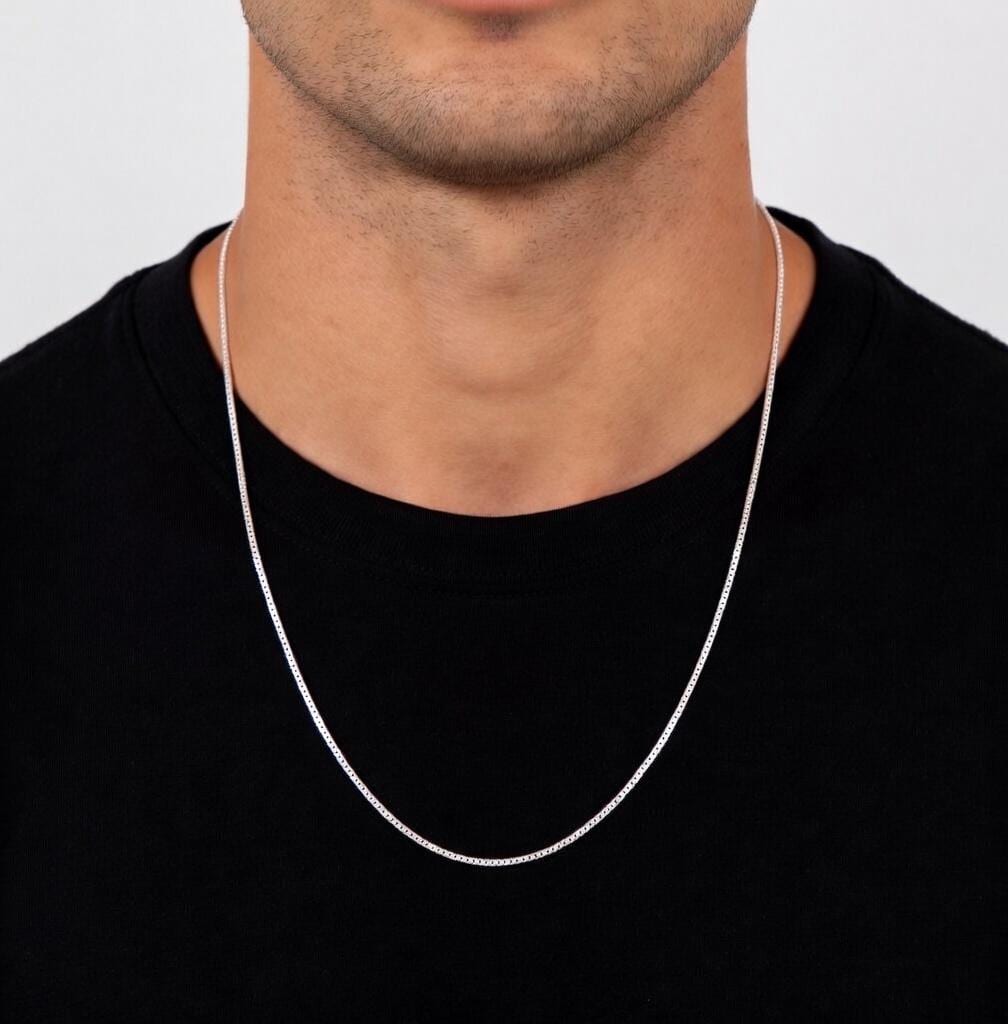
Avoid anything over 22 inches unless you are layering deliberately. A single long chain on a petite frame tends to disappear into clothing or hang at an unflattering mid-torso point.
Average height and frame
The 18–20 inch range (45–50 cm) works for most people in this group. It is the most versatile bracket: long enough to clear most necklines, short enough to stay visible above a crew neck.
Tall and long-torso frames
Longer chains, 20–24 inches (50–60 cm), suit tall frames because they maintain visual proportion across a longer torso. A chain that sits at the collarbone on a petite person will sit noticeably higher on a tall one, so going longer compensates for that shift.
Fuller and plus-size frames
Longer lengths, typically 20–24 inches (50–60 cm), create a vertical line that flatters a fuller frame. Avoid very short chains (under 16 inches) that sit tightly at the throat, as these can emphasise width rather than length. A matinee-length chain at 20–22 inches is a particularly good starting point.
Athletic and muscular frames
Broader shoulders and a more defined chest mean a 20-inch chain can sit higher than expected. Starting at 20–22 inches (50–55 cm) gives a more centred drop. Chain thickness matters here too: a 2–3 mm chain reads in proportion to a broader frame; anything under 1.5 mm can look too delicate.
| Body type | Recommended range | Main avoidance |
|---|---|---|
| Petite / short | 16–18 in / 40–45 cm | Over 22 in as a single chain |
| Average | 18–20 in / 45–50 cm | Very tight chokers if neck is wide |
| Tall / long torso | 20–24 in / 50–60 cm | Short princess lengths that ride too high |
| Fuller / plus-size | 20–24 in / 50–60 cm | Chokers under 16 in |
| Athletic / muscular | 20–22 in / 50–55 cm | Very fine gauges under 1.5 mm |

Pro Tip: These ranges are starting points, not rules. If a 22-inch chain feels right on a petite frame, wear it. Proportion guidelines exist to reduce guesswork, not to override personal preference.
Which chain length works with each neckline?
The neckline of a top or dress sets a visual line, and a chain that crosses that line awkwardly competes with the outfit rather than complementing it. The goal is for the chain to either sit clearly above the neckline or drop well below it.
- Crew neck: The neckline sits high, so a chain needs to be short enough to show above it (14–16 in / 35–40 cm) or long enough to layer over the fabric (20 in+ / 50 cm+). A chain that disappears inside a crew neck is wasted.
- V-neck: 18–20 inches (45–50 cm) mirrors the V-shape and draws the eye downward, which is why this pairing works so consistently. A pendant at this length sits neatly in the V.
- Scoop neck: Similar logic to the V-neck. A 16–18 inch chain sits just above the curve; 18–20 inches follows it. Both work; the deeper the scoop, the longer the chain can go.
- Boat neck / bateau: This wide, shallow neckline suits shorter chains, 14–16 inches, that sit above the neckline and frame the collarbone. Longer chains tend to disappear behind the wide fabric edge.
- Off-shoulder and strapless: The bare décolletage is the focal point. A choker or a short 16-inch chain frames the collarbone and neck without competing. For a bolder look, a chain choker style worn close to the throat reads well against bare skin.
- Turtleneck: The chain must sit on top of the fabric, so matinee to opera lengths (20–24 inches / 50–60 cm) are the practical minimum. Shorter chains vanish under the roll entirely.
- Halter neck: The straps frame the neck, so a close-fitting chain at 14–16 inches or a longer drop at 20–22 inches both work. Mid-lengths (17–18 inches) can clash with the halter strap line.
How chain thickness, pendant size, and clasp position affect the look
Length is only part of the picture. A 2 mm chain and a 5 mm chain at the same length look completely different on the body, and a heavy pendant changes the effective drop of any chain.
Chain gauge and drape
Thicker chains (3 mm and above) hold their shape and drape with more visual weight. A thin chain (1–1.5 mm) can appear to shorten visually because it lies close to the skin and catches less light. For guidance on choosing chain width, a 2–3 mm gauge is the most versatile across body types and outfit weights.
Pendant weight and orientation
Heavy pendants pull the chain downward and can make an 18-inch chain sit where a 20-inch would without a pendant. Elongated pendants hang best at 45–50 cm to keep their vertical orientation; a large or heavy piece often needs extra length to avoid sitting at an awkward point on the bust. Horizontal pendants (bars, discs) are less affected by gravity but need a chain stiff enough to keep them from rotating.
For pairing chain width with pendant size, the general rule is that the chain should be no wider than the pendant’s bail or loop — otherwise the chain overwhelms the piece.
Clasp position
A heavy or bulky clasp can rotate around to the front, especially on lighter chains. If that is happening, the fix is either a heavier chain that resists rotation or a smaller, lighter clasp. An off-centre clasp also shifts the pendant sideways. Checking clasp weight relative to chain weight before buying avoids this.
Layering necklaces: how to get the spacing right
Layering works when each chain is clearly visible as a separate piece. The standard spacing rule is 4–6 cm (roughly 1.5–2.5 inches) between each layer; any less and the chains tangle or merge visually into one.
Starter layering sets
- Two-chain starter: 16 in (40 cm) choker or princess + 20 in (50 cm) matinee. Clean, minimal, works across most body types.
- Three-chain classic: 16 in (40 cm) + 18 in (45 cm) + 22 in (55 cm). Each layer is distinct; the 4–5 cm gaps keep them separated.
- Four-chain statement: 14 in (35 cm) + 18 in (45 cm) + 22 in (55 cm) + 26 in (65 cm). Bolder and best on average to tall frames where the longer drops have room to read.
Mixing chain types
Vary the gauge and style between layers so each piece has its own character. A thin 1.5 mm box chain at 16 inches, a 2 mm curb at 18 inches, and a 3 mm rope at 22 inches create contrast in texture and weight without competing. For dramatic, over-clothing layering, longer chain-link styling shows how statement lengths read in editorial contexts.
On petite frames, keep layering to two or three chains maximum and avoid going below 22 inches for the longest piece. On taller or fuller frames, four layers with a longest drop of 26–28 inches reads proportionately.
Men’s chain-length quick guide
20 inches (50 cm) is the standard starting point for men, sitting just below the collarbone on an average build. From there, adjust by frame rather than height alone — neck size and shoulder width affect the drop more than height does.
| Build | Suggested length | Where it sits |
|---|---|---|
| Slim / lean | 18–20 in / 45–50 cm | Collarbone to just below |
| Average | 20 in / 50 cm | Just below collarbone |
| Athletic / broad | 20–22 in / 50–55 cm | Below collarbone |
| Larger / plus-size | 22–24 in / 55–60 cm | Mid-chest |
- Wearing under a shirt: 20–22 inches keeps the chain visible in the open collar without bunching.
- Wearing over clothing: 24 inches or longer sits on top of fabric cleanly.
- Chain thickness for men: 3–5 mm is the most common range for a chain worn alone; thinner gauges (2–3 mm) suit layering or pendant chains.
For more on men’s chain styling and common fit mistakes, Britishchains covers the key decisions in detail.
Adjusting chain length: extenders, custom cuts, and UK buying notes
Not every chain needs to be the perfect length at purchase. There are practical ways to adjust, and knowing them before you buy gives you more flexibility.
Extenders
A 5 cm or 10 cm extender clips onto the existing clasp and adds length without any permanent alteration. They are the most practical option for gifting, since an 18-inch chain with a 5 cm extender covers the 18–20 inch range. The main limitation is that extenders add a visible extra link at the back, which is rarely noticeable but worth knowing.
- Choose an extender in the same metal as the chain to avoid colour mismatch.
- Sterling silver extenders are widely available from UK jewellers and online.
- A 5 cm extender is the most versatile; a 10 cm extender suits situations where the chain is noticeably too short.
Custom cuts and permanent adjustments
If a chain is consistently too long, a UK jeweller can cut and re-solder it. Ask specifically about:
- Solder quality — silver solder should match the chain’s purity (925 for sterling silver).
- Clasp reattachment — confirm the existing clasp will be reused or replaced with a comparable one.
- Hallmarking — if the chain carries a UK hallmark, a significant alteration may require re-assay. Ask the jeweller whether the altered piece will still carry its hallmark.
Pro Tip: For UK buyers, the sterling silver buying guide from Britishchains explains what to look for in hallmarked silver and what questions to ask before any alteration. A hallmark is your guarantee of metal purity — do not let a resizing remove it without confirmation.
UK hallmarking is administered by the four UK Assay Offices (London, Birmingham, Edinburgh, Sheffield). A hallmarked piece carries a legally verified purity mark, which is worth preserving through any alteration.
Britishchains sterling silver chains for every body type
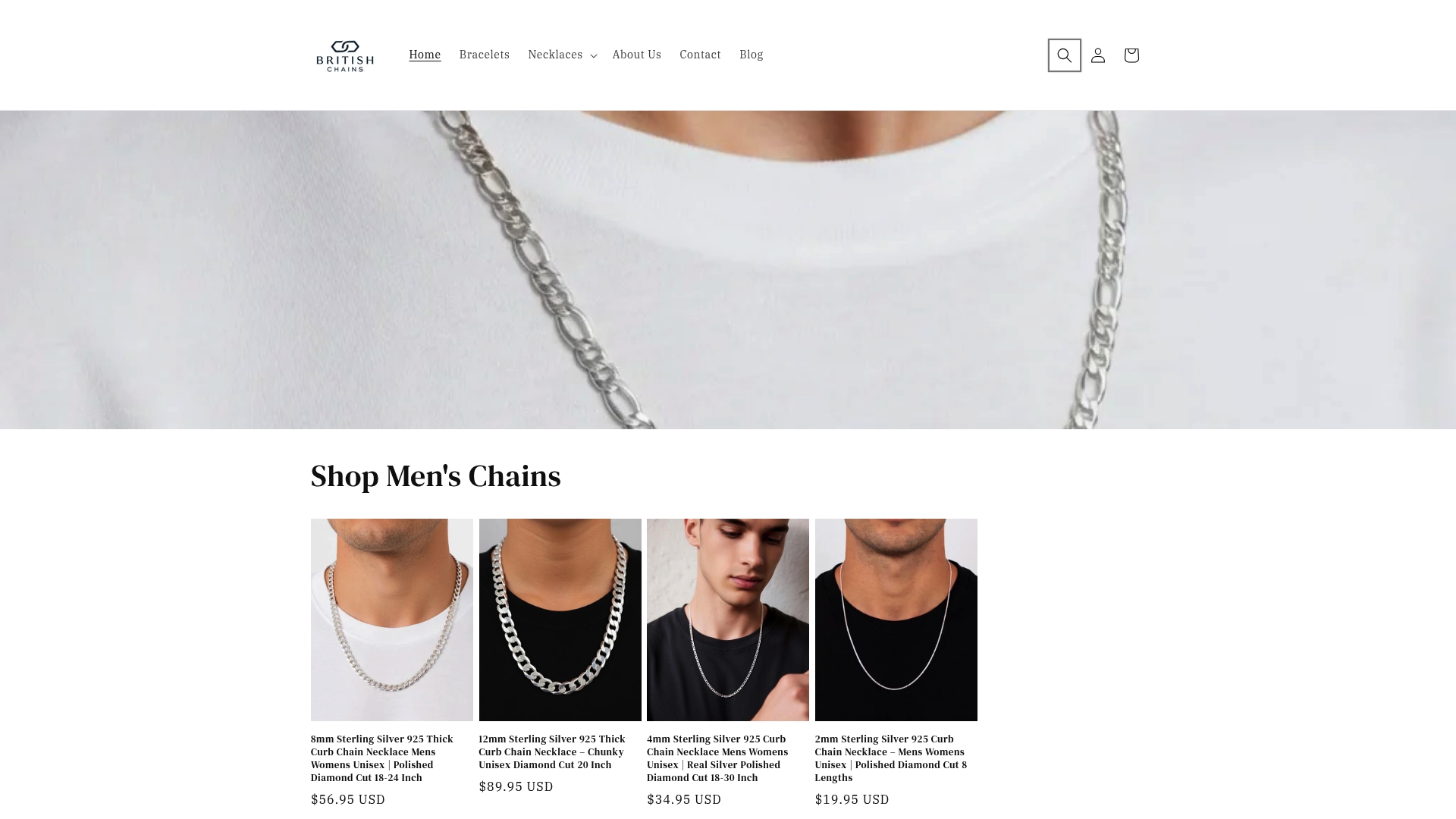
Britishchains offers hallmarked sterling silver 925 chains in a range of lengths and gauges that map directly onto the guidance above. Two examples that cover the most common body-type recommendations:
The 2mm Sterling Silver 925 Curb Chain Necklace is available in multiple lengths and suits petite to average frames at 16–18 inches (40–45 cm). At 2 mm, it is fine enough to layer or wear with a pendant, and the polished diamond-cut finish catches light well on shorter drops. It is unisex, hallmarked to 925 standard, and made in the UK.
The 3mm Sterling Silver Rope Chain at 20 inches (50 cm) suits average to tall frames and broader builds. The rope construction gives it more visual weight than a flat curb at the same gauge, which reads better on longer torsos and fuller frames. At 20 inches it sits just below the collarbone on most wearers, making it a strong default for men and a matinee-adjacent option for women.
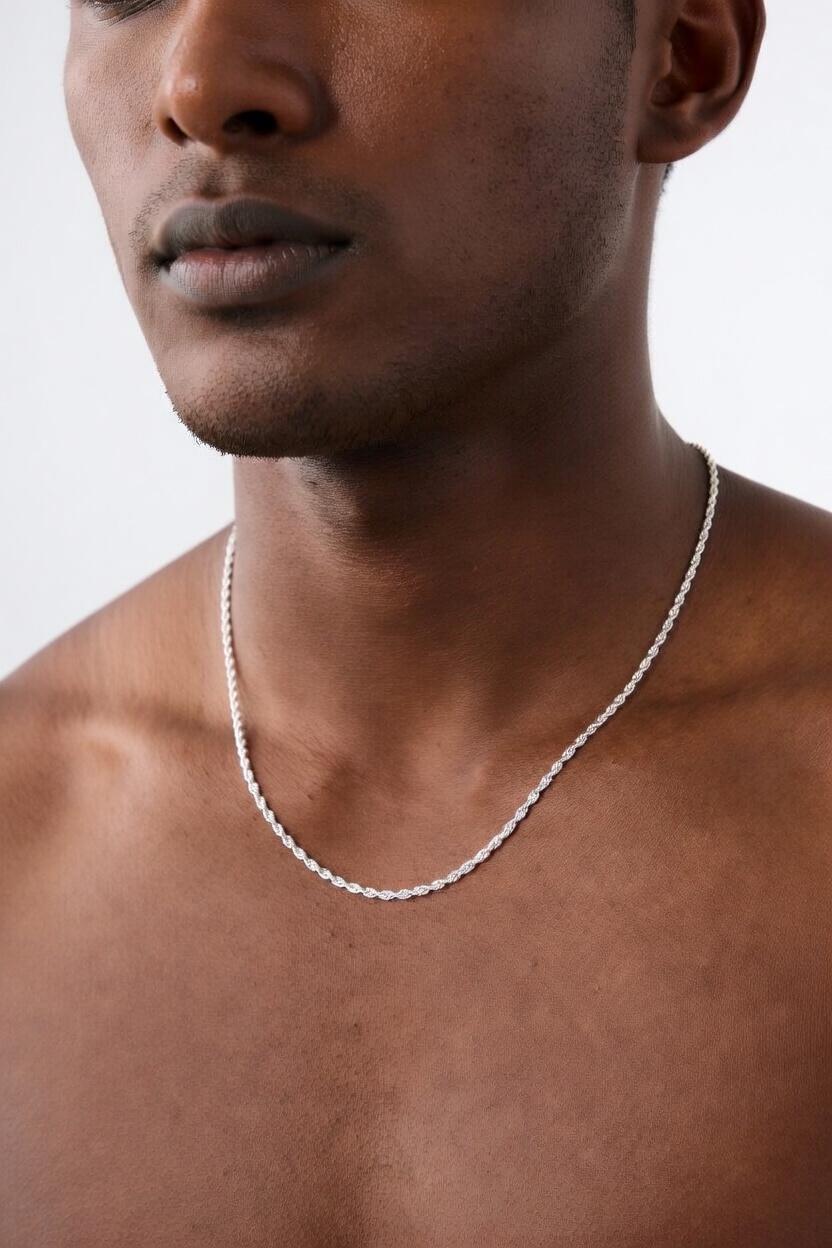
Both chains are available with extender options at checkout, so you can order the shorter length and extend as needed — which is the safer approach when you are unsure between two sizes.
Browse the full range and find your chain length using Britishchains’ measuring guide before you order.
Why hallmarking and gauge matter more than most buyers realise
The conventional advice on chain length focuses almost entirely on aesthetics, and that is fine as far as it goes. But there is a practical dimension that rarely gets mentioned: the relationship between gauge, length, and long-term wear.
A chain that is too short for the wearer’s neck circumference pulls constantly at the clasp. That tension, repeated every time the wearer moves, accelerates metal fatigue at the clasp joint faster than almost any other form of wear. Choosing the right length is not just about how a chain looks on day one — it is about how it holds up over years of wear.
Hallmarking matters for the same reason. That purity level affects how the metal responds to repeated stress: lower-purity alloys are more brittle and crack at stress points sooner. When you buy a hallmarked chain from Britishchains and size it correctly, you are not just making a style choice — you are making a durability one.
Gauge also affects pendant centring. A chain that is too light for a heavy pendant will rotate, pulling the clasp forward and shifting the pendant off-centre. Matching gauge to pendant weight keeps the piece sitting where it should. For any sizing questions, Britishchains’ customer support can advise on the right length and gauge combination before you order.
How to order from Britishchains with the right length
Britishchains ships across the UK with straightforward returns, so ordering the closest standard length and using an extender is a low-risk approach if you are between sizes. Standard lengths are listed on each product page; extenders are available at checkout for most chains.
If you have your neck circumference and preferred drop, those two figures are all the sizing team needs to point you to the right length. Contact Britishchains directly with those measurements and the chain style you are considering.
For a clear next step: browse the full sterling silver chain collection on Britishchains, use the on-site measuring guide, and add an extender at checkout if you are buying as a gift or are unsure between two lengths.
Sources
- Necklace Chain Length Guide: How to Choose (2026)
- Necklace Size Chart - Choosing the Right Necklace Length
- Necklace Chain Length Guide: What Works for You — SageStone


