

Antique vs Modern Hallmarks: How to Tell Them Apart
The quickest way to tell antique and modern British silver hallmarks apart is to count the marks and look for a sovereign’s head. Older pieces often carry a date letter, a town mark and, up to 1890, a duty mark showing a monarch’s profile. Modern pieces carry three compulsory marks: the sponsor’s mark, the fineness mark and the assay office mark. The date letter is now optional. Below, we explain what each mark means, how the rules changed and what a hallmark cannot tell you.
TL;DR
- A modern UK hallmark must have three marks: sponsor’s, fineness and assay office. The date letter and traditional fineness symbol are optional.
- A sovereign’s head duty mark points to silver made before the tax ended in 1890.
- The date letter became optional on 1 January 1999, so a modern piece may legally have no date at all.
- A hallmark proves legal purity and where the piece was tested. It does not prove age, rarity or value on its own.
- For new silver, check the three compulsory marks. For old silver, read the full set and compare it against assay office records.
Table of Contents
- What a modern UK hallmark looks like
- What makes an antique hallmark different
- The duty mark: the clearest antique clue
- Date letters: from standard to optional
- Side by side: antique vs modern
- Why the system changed
- How to read a hallmark step by step
- Does a hallmark prove that silver is antique or valuable?
- Our perspective
- Buying new silver with a modern hallmark
- Shop hallmarked British silver chains
- Quick checklist for buyers and inheritors
- FAQ
- Sources
What a modern UK hallmark looks like
Modern hallmarking sits under the Hallmarking Act 1973, as amended. The government’s hallmarking guidance sets out three compulsory marks:
- The sponsor’s mark. It shows who submitted the item for hallmarking.
- The fineness mark. It gives the purity of the metal in parts per thousand. For sterling silver the figure is 925, meaning 92.5% pure silver.
- The assay office mark. It shows which office tested the piece.
Two more marks are optional: a date letter and a traditional fineness symbol. The same guidance says items described as silver over 7.78 grams must bear a legally recognised hallmark. That rule exists to protect buyers from fraud.
One detail often confuses people. The sponsor’s mark has always been about responsibility. The Goldsmiths’ Company Assay Office explains that it establishes who answers for the piece, not strictly who made it. A retailer or importer can be the sponsor.
If you want to see how this works on a real chain, our guide to verifying British silver hallmarks online walks through the three marks to check before buying.
What makes an antique hallmark different
Older British silver was marked under a longer set of rules. The marks you meet most often are:
- Town or assay office mark. It shows where the piece was tested, such as London, Birmingham, Sheffield or Edinburgh.
- Standard mark. It shows the silver met the required standard.
- Date letter. A letter in a shaped shield that changes every year.
- Maker’s mark. Usually the initials of the maker or firm that registered the mark.
- Duty mark. The sovereign’s head, covered in the next section.
- Commemorative marks. Struck for special occasions, such as a jubilee.
- Import marks. Applied to silver brought into Britain from abroad.
The practical difference is completeness. An antique piece with a full set of marks gives you a place, a year and a maker. A modern piece with only the compulsory three gives you a sponsor, a purity and a testing office. Both are lawful, and they answer different questions.
The duty mark: the clearest antique clue
The sovereign’s head is the most useful single clue when you hold an old piece. Up to 1890, a duty mark was required on British silver to certify that the maker had paid the tax on the piece. The tax was eliminated in 1890.
So if you can see a small monarch’s profile among the marks, the piece was almost certainly hallmarked before the tax ended. If there is no head, that does not make a piece modern, since silver was also made without this mark in other periods. But a head is a reliable pointer to the older end of the range.

Date letters: from standard to optional
For generations the date letter was a fixed part of the set. That changed at the end of the twentieth century. Under the 1998 Hallmarking Regulations, the date letter and the pictorial fineness mark became optional from 1 January 1999.
This is the biggest practical split between antique and modern hallmarks. Before 1999 you could expect a date letter on hallmarked British silver. After it, a piece may have one only if the sponsor asked for it. The London assay office applies the date letter as standard unless otherwise requested, so many London-marked pieces still carry one.
The optional date letter also has a purpose. Sheffield Assay Office says it is useful for dating objects and marking special occasions, which is why a christening or wedding gift often has one.
Date letters change every year on 1 January, and the surrounding shield can also denote the year. That means the letter alone is not enough. You need both the letter and the shield shape, matched against a reliable table for the right assay office.
Side by side: antique vs modern
| Feature | Antique hallmarks | Modern hallmarks (since 1999) |
|---|---|---|
| Compulsory marks | Varied by period, usually a town mark, standard mark and date letter | Sponsor’s, fineness and assay office marks |
| Date letter | Usually present | Optional |
| Duty mark (sovereign’s head) | Present on silver up to 1890 | Never |
| Fineness shown as | Traditional symbol | Number in parts per thousand, such as 925 |
| Maker’s mark | Maker’s or firm’s initials | Sponsor’s mark, showing who is responsible |
| Can you date it from the marks? | Often, to the year | Only if a date letter was added |
In short: antique marks tell a story of tax, place and year. Modern marks tell you who is accountable, how pure the metal is and where it was tested.
Why the system changed
Hallmark rules rarely changed by accident. Many changes followed money. The Goldsmiths’ Company records that the 1697 Britannia standard was introduced to discourage the melting of currency. The duty mark was a tax receipt. The modern system, by contrast, is built around consumer protection and traceability. The Goldsmiths’ Company describes the hallmark as having evolved from a medieval tool for protecting coinage into a modern guarantee of quality and traceability.
That helps you read a piece. An old mark often tells you about the state’s interest in the silver. A modern one tells you about your protection as a buyer.
How to read a hallmark step by step
- Use light and magnification. A 10x loupe and a bright side light make worn marks readable.
- Find the fineness mark. On modern sterling you should see 925. On older silver you may see a symbol instead.
- Identify the assay office mark. This tells you which office to check records for.
- Look for a sovereign’s head. If present, the piece predates the 1890 end of the tax.
- Look for a date letter. Note both the letter and the shape of its shield.
- Read the sponsor or maker’s mark. Compare the initials against the office’s records.
- Check the whole set belongs together. Marks that look scattered, blurred in a way that does not match the metal, or from different periods deserve a second opinion.
Our hallmark verification examples for silver chains show how this looks on real chain clasps and tags. If you are curious about Birmingham’s anchor mark specifically, we explain the clues in our piece on Birmingham anchor hallmarks.
Does a hallmark prove that silver is antique or valuable?
No. A hallmark is evidence of purity and origin. It is not a certificate of age or worth.
There are a few reasons:
- A hallmark can be modern on a traditional design. Makers still produce classic styles, and the three compulsory marks prove only that the piece met legal standards when it was tested.
- Marks can be misleading. A genuine mark can be transferred or imitated on a later piece. The Goldsmiths’ Hallmark Authentication Committee says modern authentication combines expert connoisseurship, comparative hallmark analysis and analytical testing. A quick look at a stamp is not authentication.
- Value depends on more than the mark. Maker, condition, weight, design and demand all play a part. A hallmarked piece is worth at least the silver it contains, but a mark alone does not make it a collectable.
- Overseas hallmarking exists. A Legislative Reform Order that came into law on 8 February 2013 gave UK assay offices the legal right to strike hallmarks outside UK territory. A UK assay mark therefore shows which office tested the metal, not necessarily where the piece was made.
If you suspect that an inherited or bought piece is valuable, ask an assay office or a specialist valuer to examine it. Do not rely on photographs and online matching alone.
Our perspective
When customers ask us about antique and modern hallmarks, we tell them the same thing: for something you will wear every day, the modern system is the one that protects you.
A modern UK hallmark gives you three clear facts you can check: who is responsible, how pure the silver is and which assay office tested it. You do not have to be a collector to use that. You only need to look at the clasp or tag.
That is why we focus on genuine 925 sterling silver with British hallmarking, in curb, rope, Figaro, snake, herringbone and box styles. Antique silver has charm, but a chain you wear against the skin is better when its purity is legally verified and its marks are easy to read.
We also make a point of explaining hallmarks plainly, from what 925 really means to how a laser hallmark compares with a struck one. A mark should help you decide with confidence, not confuse you.
British
Buying new silver with a modern hallmark
If your goal is a chain to wear rather than a piece to collect, the modern rules make shopping simpler. Look for these checks:
- The 925 fineness mark.
- A recognised assay office mark.
- A sponsor’s mark.
- A date letter, if you want one for a gift or anniversary. Remember it is optional.
- A clear product description that tells you the stated purity and sizes.
Weight also matters when comparing chains. Our guide to pricing silver chains with 7.78g hallmarks and live rates shows how the legal threshold interacts with price. And if you are weighing British against imported chains, we explain why hallmarks should come first.
Finish matters too. A polished chain and an oxidised one age differently, which we cover in oxidised vs polished silver. For a broader overview of styles, see our chain jewellery buying guide.
Shop hallmarked British silver chains
Our chains are genuine 925 sterling silver with British hallmarking, with a diamond-cut polish and a choice of lengths and thicknesses. Start with our silver curb chains, or browse the full necklace collection. If you want a versatile everyday option, the 4mm sterling silver curb chain necklace comes in lengths from 18 to 30 inches and suits men and women alike.
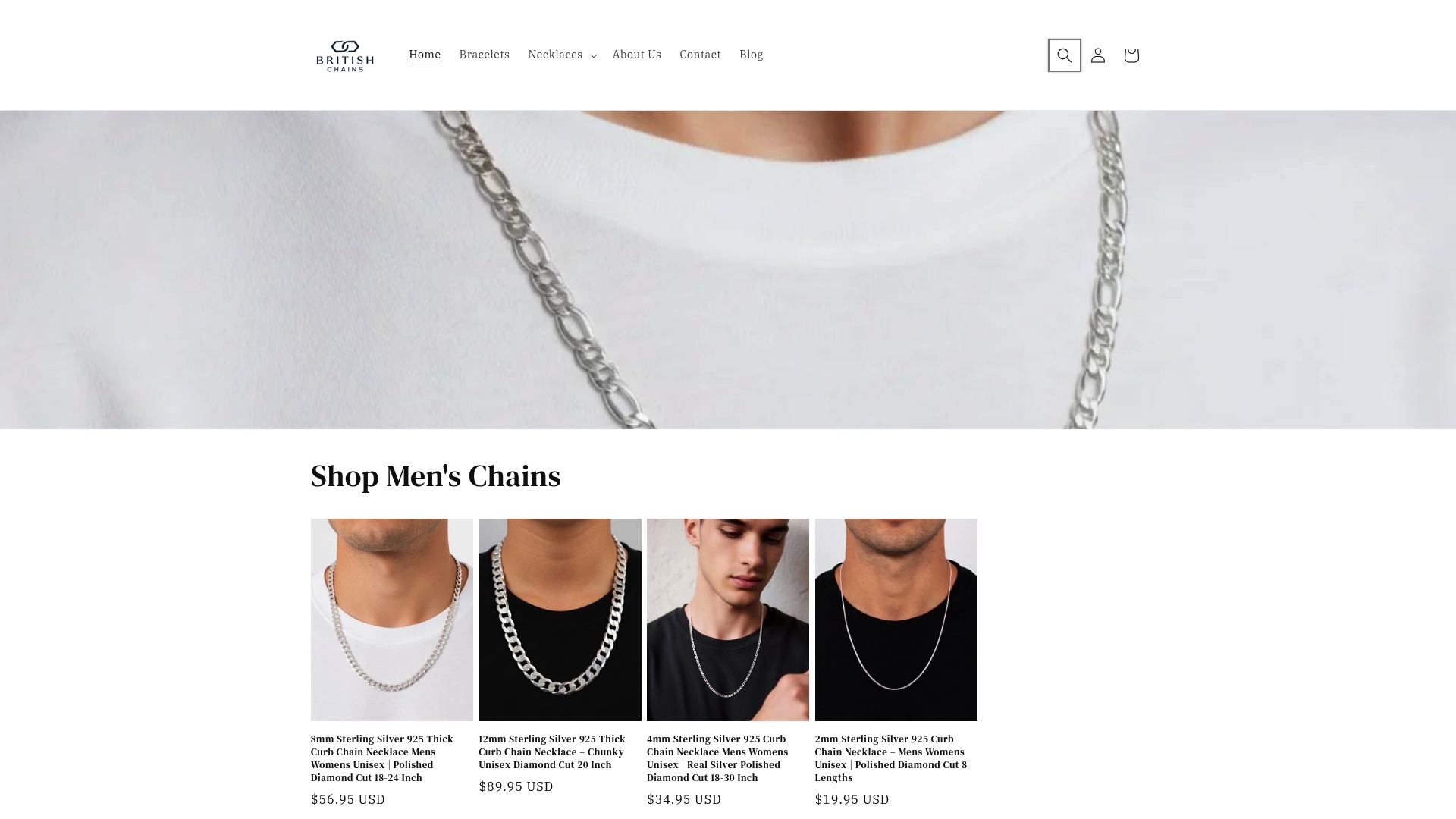
Every piece is a pre-designed item, so you can check the product page for sizes and details before you order.
Quick checklist for buyers and inheritors
If you are buying new silver:
- Confirm the three compulsory marks.
- Do not expect a date letter unless it is stated.
- Check that the description matches the mark. A chain sold as sterling should show 925.
If you have inherited an old piece:
- Photograph the marks in good light before cleaning anything.
- Look for a sovereign’s head, a date letter and a town mark.
- Match the date letter and shield against an assay office table.
- Ask an assay office or a qualified valuer if the piece may be worth more than its silver.
If the marks look odd:
- Blurred, uneven or mismatched marks are a reason to get a second opinion, not to guess.
FAQ
Is the date letter compulsory on modern British silver?
No. The date letter became optional on 1 January 1999, so a modern piece can be fully legal without one. Many sponsors still add it for gifts and special occasions. The compulsory marks are the sponsor’s mark, the fineness mark and the assay office mark.
What does the sovereign’s head mean on silver?
It is a duty mark. It shows that the tax on the silver had been paid, and it was required up to 1890, when the tax was eliminated. If you see one, the piece was hallmarked before that date. You will not find it on modern hallmarked silver.
Can I tell how old a modern silver chain is from its hallmark?
Only if it carries a date letter, because that mark is optional. Without one, the three compulsory marks tell you the sponsor, the purity and the testing office, but not the year. Check the product description or the seller if the age matters to you.
Does a hallmark mean my silver is worth a lot?
Not by itself. A hallmark proves legal purity and origin, but value also depends on the maker, condition, weight, design and demand. If you think a piece is special, ask an assay office or specialist valuer to look at it in person.
Sources
- Hallmarking: practical guidance summary, GOV.UK
- Nineteenth-Century English Silver, The Metropolitan Museum of Art
- The Hallmarking (Hallmarking Act Amendment) Regulations 1998, legislation.gov.uk
- History of Hallmarking, The Goldsmiths’ Company Assay Office
- What is a hallmark, The Goldsmiths’ Company Assay Office
- Hallmark as Hero, The Goldsmiths’ Company Assay Office
- Hallmark Authentication Committee, The Goldsmiths’ Company
- How to trace an historic London hallmark, The Goldsmiths’ Company
- UK Hallmarks, Sheffield Assay Office
- A Guide to Hallmarking, The Royal Mint
- Silver hallmarks, Wikipedia


