

Mix metals chain styling tips: the anchor, contrast, bridge rule
Mixing metal chains looks polished when one metal anchors the look, a second provides contrast, and a bridge piece ties them together. Skip that structure and the same chains that could look curated just read as mismatched, or worse, forgotten in different jewellery boxes for years.
Here’s the checklist to run before you leave the house:
- Pick one dominant metal (this is your anchor, worn most often and heaviest in the mix)
- Add a second metal in smaller doses as an accent, not a competitor
- Include one bridge piece, a two-tone clasp, watch, or pendant, that visually connects the two
- Repeat your accent metal in at least two zones (say, earrings and a ring) so it never looks accidental
For anchor chains, three sterling silver options do the heavy lifting reliably: the 8mm Sterling Silver 925 Thick Figaro Chain Necklace for a statement base, and the slimmer 2mm Curb Chain or 2mm Figaro Chain for mid-layers that sit quietly behind bolder accent pieces.
Key Takeaways
A mixed-metal chain look reads as intentional when one metal anchors, a second contrasts in smaller doses, and a bridge piece visually connects the two.
| Point | Details |
|---|---|
| Follow the anchor, contrast, bridge structure | Let one metal dominate, add a second sparingly, and use a two-tone piece to connect them. |
| Use a 70:30 ratio as a starting point | Keep your anchor metal doing most of the visual work, with accents appearing in smaller doses. |
| Match scale before worrying about colour | A slim chain next to a chunky one will always look subordinate, regardless of which metal you intended to lead. |
| Repeat the accent metal twice | A single gold ring with no other gold in the look reads as forgotten rather than deliberate. |
| Choose sterling silver for your anchor | Britishchains’ hallmarked 925 chains, including the 8mm Figaro and 2mm Curb, hold finish consistency well enough to lead a mix for years. |
Table of Contents
- What are the anchor, contrast, and bridge rules for mixing metals?
- How do different metals and finishes affect the look?
- Which chain styles work best in a mixed-metal stack?
- How do you layer necklaces with mixed metals step by step?
- How do you balance scale and weight across a mixed-metal look?
- How do you mix metals across necklaces, bracelets, rings, and earrings?
- What are good mixed-metal outfit pairings for different occasions?
- What common mistakes ruin a mixed-metal look?
- Why do sterling silver chains make reliable anchors for mixed-metal looks?
- Can you mix metals with beads or gemstones in the same look?
- A stylist’s note on getting mixed metals right
- Ready to build your mixed-metal foundation?
- Sources
What are the anchor, contrast, and bridge rules for mixing metals?
Every well-mixed metal look follows the same three-part hierarchy, whether it’s a stack of five necklaces or a single ring next to a two-tone watch. One metal leads, a second contrasts against it, and a third element, often a two-tone piece, bridges the two so the eye reads them as a single decision rather than two separate outfits collided by accident. Prism News describes this as a reliable structure for layered necklace stacks, and it holds up whether you’re working in gold and silver or silver and rose gold.
The anchor is whichever metal appears most, usually because it’s your heaviest or most frequently worn piece, like a signature chain you never take off. The contrast metal shows up in smaller doses: a slim bracelet, one ring, or a pair of earrings. The bridge is the clever bit. It’s a single item, a clasp, a pendant setting, or a watch case, that physically contains both metals, giving your brain permission to see the rest of the mix as intentional.
Stylists commonly suggest that the dominant metal should clearly outweigh the accent metal, with the accent used in smaller doses for a gentler introduction. The Cut’s advice from professional stylists backs the idea that a dominant metal should do most of the visual work, with the second metal appearing almost as punctuation.
Pro Tip: Repeat your accent metal at least twice in the same look, once is easy to mistake for a mismatch, but twice reads as a choice. A gold ring plus gold hoops next to a silver-heavy necklace stack looks deliberate; a single gold ring on its own can look like you forgot to take it off.
A few ground rules keep this framework simple in practice:
- Choose your anchor metal first, then build everything else around it
- Keep accent pieces smaller in scale or slimmer in width than the anchor
- Use one bridge item, don’t scatter two-tone pieces throughout the whole look
- Echo the accent metal in a second zone (ears, wrist, or a second finger) to avoid a lonely, accidental-looking piece
How do different metals and finishes affect the look?
Yellow gold reads warm and traditional, and it tends to flatter deeper or golden undertones, though plenty of people wear it regardless of skin tone because contrast can be just as flattering as harmony. Silver and white gold read cooler and more contemporary, sitting closer to the skin’s blue and pink undertones. Rose gold splits the difference, warm enough to soften next to gold, cool enough to sit comfortably beside silver, which is exactly why it works so well as an unofficial bridge metal even without a dedicated two-tone piece.
Finish matters as much as the base metal. A high-polish silver chain next to a brushed or matte gold piece creates a subtle, sophisticated contrast because the eye separates them by texture as well as colour. Two high-polish metals side by side can compete for shine and look busier than intended, while two matte finishes together can look flat and lose definition entirely.
Plated pieces complicate things because the base metal often shows through at the edges over time, and a plated gold chain next to solid sterling silver will age differently, one tarnishing evenly, the other losing its gold layer unevenly at friction points like the clasp. Solid sterling silver, by contrast, wears consistently across its whole surface, which is part of why it works so reliably as a long-term anchor metal.
A few finish pairings worth trying:
- Polished silver anchor with matte or brushed gold accents for gentle, textured contrast
- Rose gold as an unofficial bridge between silver and yellow gold pieces
- Vermeil (gold-plated sterling silver) as an accent, since its silver core ages more gracefully than base-metal plating
- Rhodium-plated white gold paired with solid silver, since both read cool and photograph similarly
If you’re building a mix that needs to last years rather than months, prioritise solid metals for anything doing heavy daily wear, and save plated pieces for occasional accent roles.
Which chain styles work best in a mixed-metal stack?
Chain shape changes how much visual weight a piece carries, independent of the metal it’s made from, and that weight is what decides whether a chain reads as an anchor or an accent.
Chunky curb chains and thick Figaro chains, like the 8mm Figaro, carry serious visual weight and work best as anchors. Their large, defined links catch light and attention, which is exactly what you want from the piece leading the composition. Rope chains and box chains sit in the middle, substantial enough to hold their own but flexible enough to pair as a secondary layer against a bolder anchor.
Fine curb, slim Figaro, snake, and paperclip chains read as accents almost by default. Their delicate profile means they add texture and contrast without pulling focus, which makes something like a 2mm Curb Chain a natural mid-layer choice underneath a heavier centrepiece.
A classic pairing: a chunky curb anchor in one metal, then a fine paperclip or slim Figaro accent in the contrast metal sitting shorter or longer against it. The scale difference alone signals hierarchy before the eye even registers the colour change.
Herringbone chains need caution. Their flat, ribbon-like links are prone to kinking against other textured chains, and their reflective surface can visually dominate a stack even at a modest width, throwing off a carefully planned ratio. If you’re mixing metals and want to include herringbone, keep it as the sole statement piece rather than layering it against multiple other textures.
Watch out for two failure points specifically:
- Scale mismatches, pairing two chunky chains in different metals usually looks like a fight for attention, not a considered mix
- Hardware differences, a lobster clasp next to a spring ring clasp is a small detail, but mismatched hardware finishes are one of the fastest ways to make an otherwise good mix look unplanned
How do you layer necklaces with mixed metals step by step?
Building a mixed-metal necklace stack is really about sequencing decisions in the right order, not throwing chains on and hoping they settle.
- Choose your anchor length and metal first. This is usually your longest or heaviest chain, sitting at the base of the stack, roughly 20 to 24 inches depending on your frame.
- Add a mid-length contrast piece, ideally 4 to 6 centimetres shorter than the anchor, in your second metal. This is where a fine chain like the 2mm Figaro earns its place, slim enough not to compete, distinct enough to register as intentional contrast.
- Finish with a short choker-length piece, sitting close to the collarbone, in either metal depending on which one needs reinforcing to hit that 70:30 balance.
- Introduce your bridge piece last, usually a pendant or clasp detail, positioned so it sits visibly rather than hidden behind other layers.
Alison + Aubrey’s layering guidance recommends keeping at least 3 to 5 centimetres of length difference between each layer, close enough to look connected, far enough apart to avoid tangling every time you move. Chains of very similar length are the most common cause of knotting, since they sit at nearly the same point on the chest and rub against each other constantly.
A few practical fixes for keeping a mixed-metal stack neat through the day:
- Use extender chains on your shortest layer to fine-tune spacing without buying a new piece
- A two-tone clasp or connector, Prism News notes, is one of the fastest ways to make the whole stack look deliberate rather than accidental
- Attach a small jump ring in your accent metal to an anchor chain’s clasp if you don’t own a dedicated two-tone connector
- Lay chains flat on a table in your planned order before putting them on, it’s much easier to spot spacing problems before they’re tangled around your neck
For a full guide to sequencing lengths beyond mixed-metal specifics, Britishchains’ necklace layering guide covers the length maths in more depth.
How do you balance scale and weight across a mixed-metal look?
Weight and scale decide which metal appears dominant far more than colour does. A slim gold chain next to a chunky silver curb will read as a silver look with a gold accent, regardless of which metal you’d actually planned as the anchor. If your intended anchor isn’t reading as dominant, the fix is almost always to increase its scale relative to the accent piece, not to add more of it.
Repetition is what turns a mix into a cohesive look rather than a collection of coincidences. The Cut’s stylist advice points to repeating the accent metal in a second or third location, on a ring, an earring, a bracelet clasp, so it reads as a deliberate through-line rather than a one-off.
Think of it in terms of who’s speaking and who’s supporting. One piece should carry the visual conversation (a statement anchor chain, a bold cuff), while everything else quietly reinforces it. Two loud pieces in different metals fighting for attention is the single fastest way to undo an otherwise sound framework.
Quick scale-balancing rules:
- If your anchor metal isn’t reading as dominant, go up in width or thickness, not quantity
- Match hardware weight to chain weight; a delicate lobster clasp on a chunky chain looks like an afterthought
- Let only one piece per outfit carry maximum visual weight; everything else should support it
How do you mix metals across necklaces, bracelets, rings, and earrings?
Consistency across at least two zones is what separates a styled look from scattered accessories. If your necklace stack anchors in silver with gold accents, echo that exact split somewhere else, gold stud earrings with a silver hoop, or a silver ring stack with one gold band mixed in.
Ears are a forgiving place to experiment first. The Cut suggests starting mixed-metal experiments in low-risk zones like ears or rings before committing to a full necklace stack, since a mismatched earring pair is far easier to fix mid-morning than an elaborate layered necklace.
A two-tone watch or bracelet does double duty as a natural bridge, connecting your wrist to whatever’s happening at your neckline without needing a dedicated pendant. If you already own one, build your whole mixed-metal system around its two colours rather than introducing a third.
Quick do’s and don’ts:
- Do repeat your dominant necklace metal somewhere on your hands or ears
- Do use a two-tone watch as your bridge piece if you have one, it saves buying a separate connector
- Don’t mix three or more metals across zones, that’s where cohesion breaks down fastest
- Don’t let a ring stack run its own separate metal logic from the rest of the look
What are good mixed-metal outfit pairings for different occasions?
Casual and daily wear favours restraint. A single fine gold chain layered under a dominant silver piece, Britishchains’ everyday styling examples show several low-fuss combinations, keeps the mix subtle enough for a busy day without needing constant adjustment.
Work settings call for polish over statement. A slim curb or Figaro anchor in silver, paired with small gold stud earrings and a matching gold detail on a watch strap, reads intentional without looking like jewellery is the main event in a meeting.
Evening occasions are where stronger contrast earns its place. A chunky anchor chain like the 8mm Figaro, paired confidently with gold cuffs or a two-tone statement ring, can carry a whole outfit. Evening lighting is also far more forgiving of bold contrast than daylight, so this is the one setting where breaking the 70:30 ratio slightly, closer to 60:40, tends to look deliberate rather than unbalanced.
Occasion checklist:
- Daytime: one subtle accent, dominant metal does 80% of the visible work
- Work: polished, matched hardware, minimal accent pieces (one or two small items maximum)
- Evening: bolder contrast permitted, anchor chain can be the outfit’s focal point
What common mistakes ruin a mixed-metal look?
The lonely accent is the most frequent error: a single gold ring with no other gold in sight looks forgotten rather than intentional. Fix it by repeating that accent metal in one more place, earrings or a bracelet clasp usually does it.
A 50/50 split between two metals is a close second. Without a clear leader, the eye can’t settle, and the whole look reads unresolved. Fix it by picking one metal to dominate and scaling the other back to genuinely secondary status.
Mismatched hardware, different clasp finishes, jump ring colours, or trigger styles, quietly undermines an otherwise good mix. Swap clasps where you can, or use a bridge connector to cover the inconsistency.
Scale clashes, two chunky chains competing in different metals, are usually fixed by swapping one for a finer piece rather than removing it entirely.
Before leaving the house, run this quick check:
- Take a photo. Balance problems that feel fine in a mirror often become obvious at thumbnail size
- Confirm your accent metal appears at least twice across the whole outfit
- Check that one piece clearly leads and nothing else competes with it
Why do sterling silver chains make reliable anchors for mixed-metal looks?
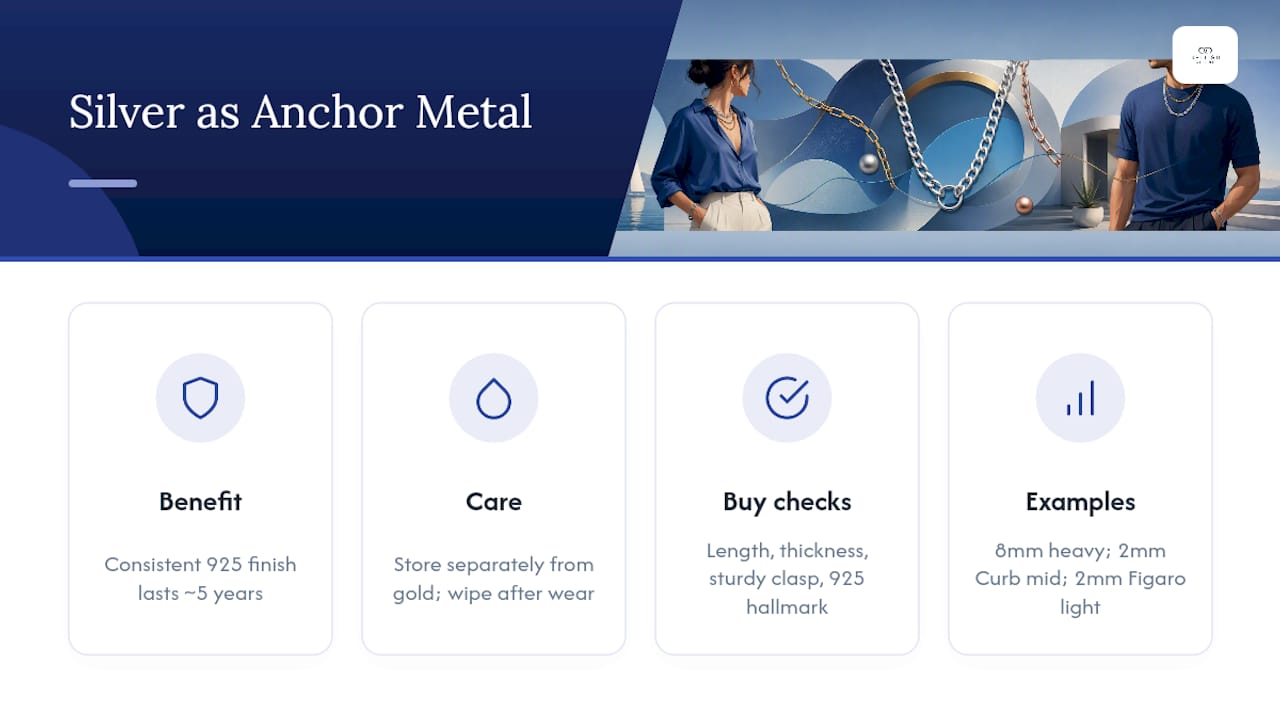
Sterling silver’s biggest advantage as an anchor metal is consistency. A solid 925 chain wears evenly across its entire surface, unlike plated pieces that thin unevenly at friction points, which means the finish you buy is close to the finish you’ll have in five years with basic care. That reliability matters more for an anchor than for an accent, since it’s the piece doing the most visible work and getting worn the most often.
To prevent tarnish while mixing metals, store silver chains separately from gold and gold-plated pieces to avoid surface scratching between different hardness levels, and wipe them with a soft polishing cloth after wear, especially if they’ve been in contact with perfume or lotion. Britishchains’ cleaning guide covers the specifics of keeping a polished finish intact.
When buying an anchor chain, check four things: the length suits your intended layering position, the thickness matches the visual weight you want it to carry, the clasp is a sturdy lobster or trigger style rather than a flimsy spring ring, and it carries proper hallmarking confirming genuine 925 silver. The 8mm Thick Figaro, 2mm Curb, and 2mm Figaro chains each hit a different point on the anchor-to-accent spectrum, so which one to check first depends on the visual weight you need it to carry.
Can you mix metals with beads or gemstones in the same look?
Beads and gemstones follow the same anchor, contrast, bridge logic as metals, they just add another variable: colour. A strand of coloured beads or a gemstone pendant can function as your bridge piece just as easily as a two-tone clasp, especially when the setting itself combines two metals, like a gold-bezel pendant on a silver chain.
The safest approach is to let the gemstone or bead colour echo something already in your outfit, rather than introducing a third unrelated hue into a two-metal mix. A turquoise or lapis bead against silver and gold works because the stone’s cool undertone sits comfortably next to silver while its warmth doesn’t clash with gold.
Freshwater pearls are particularly versatile because their neutral, slightly warm tone bridges silver and gold almost as effectively as a dedicated two-tone connector, without needing an actual mixed-metal setting.
Where this goes wrong is usually scale, not colour. A large statement gemstone pendant next to a chunky metal anchor chain creates two competing focal points. If you’re adding a beaded or gemstone piece to a mixed-metal stack, treat it as either the anchor or the bridge, never as a second accent competing with your metal accent for attention. Keep it to one role, and the rest of the framework holds.
A stylist’s note on getting mixed metals right
Most people overthink the metal and underthink the scale. When someone asks why their mix of gold and silver feels off, the answer is rarely the colours, it’s usually two pieces of nearly identical weight fighting for the same visual space. Fix the scale first, then worry about which metal goes where.
The habit that changes everything is the photo check. A mirror flatters you; a phone camera doesn’t, and it will show a lonely accent or a 50/50 standoff in a way your reflection just won’t. Every mixed-metal decision, in the end, comes back to the same three questions: what’s leading, what’s contrasting, and what’s bridging the two.
Ready to build your mixed-metal foundation?
A strong mix starts with a strong anchor, and that’s where a lot of mixed-metal experiments quietly fail before they’ve even begun: the base chain is either too flimsy to lead or too similar in weight to whatever you’re pairing it against. Britishchains focuses entirely on solid, hallmarked sterling silver chains built to hold that anchor role for years, not just until the plating wears through.
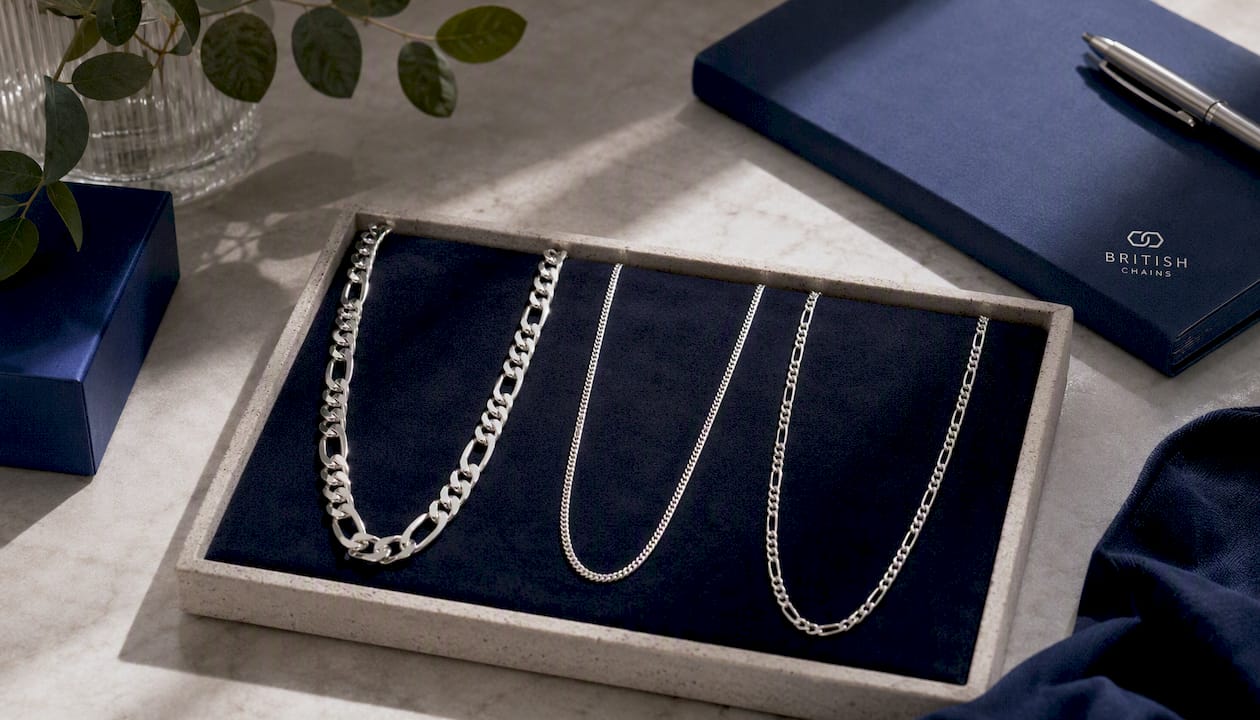
Three chains are worth inspecting closely if you’re building a mixed-metal system from scratch. The 8mm Thick Figaro gives you a statement anchor with real presence. The 2mm Curb Chain, available across eight lengths, slots in as a flexible mid-layer. The 2mm Figaro offers a finer link shape for subtler contrast work.
Before buying any anchor chain, check five things: the length against your intended layering position, the thickness against the visual weight you need, the clasp type (lobster or trigger clasps outlast basic spring rings), the hallmark confirming genuine 925 silver, and finish consistency across the whole chain, not just the sections visible in product photos. Browse the full sterling silver chain range to find the anchor that fits your mix.


