

2–3mm Matters: Herringbone or Snake Chain for Daily Wear
For everyday wear and pendants, choose a snake chain. For a flat, mirror finish statement piece, choose a herringbone. The snake’s tubular build resists kinking and holds a pendant well, while the herringbone’s flat, faceted links catch light beautifully but bend permanently if twisted or overloaded. The rest of this guide explains why, plus how to care for and style each one.
TL;DR:
- Snake chains are more durable and resistant to kinking, making them ideal for everyday wear, pendants, and frequent handling.
- Herringbone chains offer a high-shine, flat mirror finish that is best suited for formal occasions and statement looks, but they are more prone to creasing and permanent kinks.
- Both chains require gentle cleaning and proper storage, with snake chains being hung or laid flat, and herringbone chains kept flat to prevent damage.
- Thinner herringbone chains (2-3mm) sit comfortably around the collarbone, while wider ones over 4mm are more rigid and less flexible.
- For durability and versatility, the double snake chain worn in layers provides a similar visual effect as herringbone without its high maintenance.
Table of Contents
- Snake chain vs herringbone chain: what a snake chain actually is
- What is a herringbone chain? Understanding the flat, mirror finish look
- Herringbone chain vs snake chain: comparing shape, shine, and drape
- How flexible is each chain, and how does it sit on the neck?
- Do herringbone chains kink? Durability and repair realities
- Herringbone chain repair, pendants, and everyday wearability
- Herringbone chain care and snake chain maintenance that actually works
- Styling and layering: pairing herringbone or snake chains with outfits
- Snake vs herringbone: which chain should you choose?
- Why trust this guide on herringbone chain care and construction
- A brief editorial note on the trade-off
- Product spotlight: our 2mm sterling silver herringbone chain
- Sources
Snake chain vs herringbone chain: what a snake chain actually is
A snake chain is built from tightly linked rounded plates or rings that fit together into a smooth, continuous tube. There are no visible individual links from a normal viewing distance, just an unbroken metal surface that moves like a rope of mercury. That tubular construction is what gives it a 3D drape rather than a flat lie, and it’s also why the chain holds up so well over years of daily wear.
- Even, continuous shimmer instead of sharp mirror flashes
- Bends and twists in any direction without creasing
- Rounded profile means a pendant bail slides freely without snagging
- Naturally forgiving if it gets tangled in a drawer or jewellery box
The three-dimensional shape distributes stress around the whole tube rather than concentrating it on one flat face, which is the mechanical reason it copes so well with pendants and rough handling.
What is a herringbone chain? Understanding the flat, mirror finish look
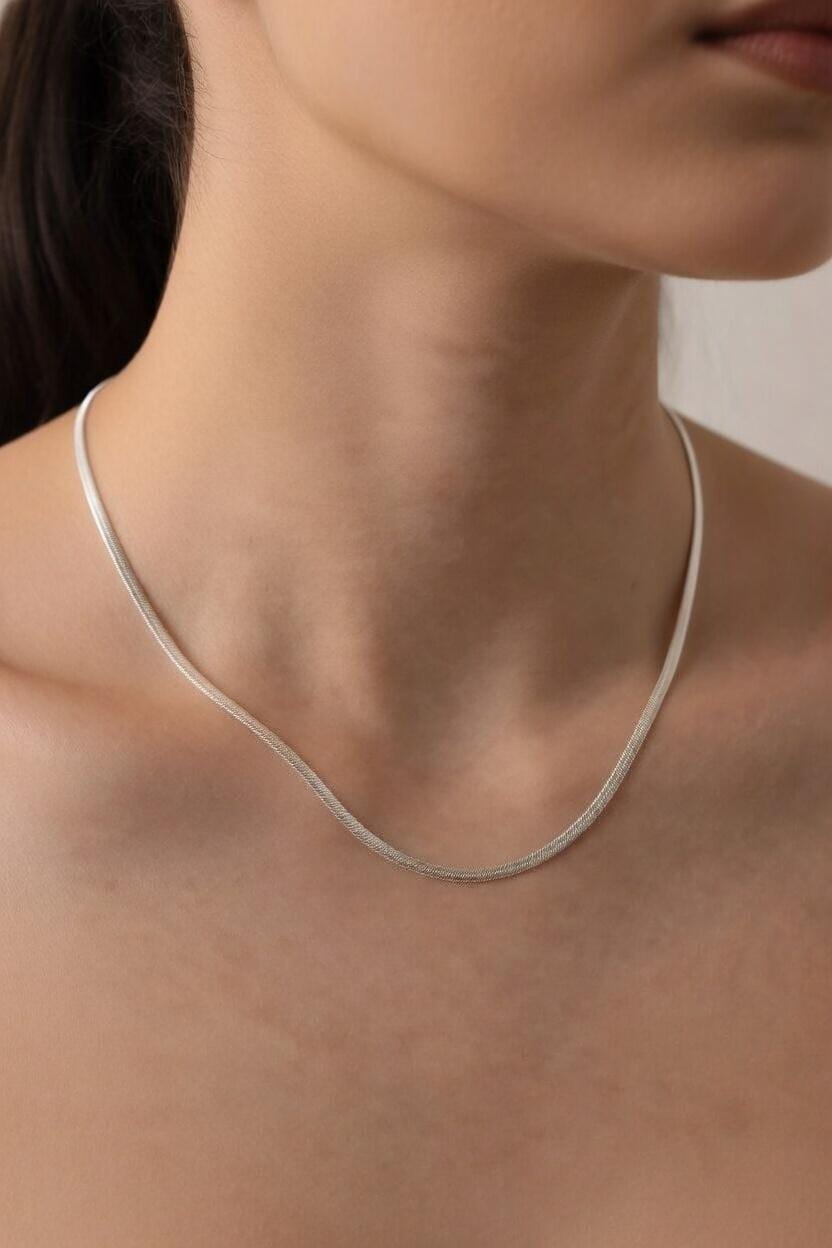
A herringbone chain uses flat, slanted links arranged in alternating V shapes, woven so tightly that the chain lies flush against the skin like a ribbon rather than a rope. That flatness is exactly what produces the signature mirror-bright surface: light bounces off one continuous plane instead of scattering across rounded links.
- Ribbon-like profile that sits flush against the neckline
- High-shine, mirror-like reflection when the chain catches light
- Slim and lightweight compared with bulkier link styles
- Bends easily forward and back, but resists sideways twisting
That last point matters more than it sounds. Herringbone links are built to flex in one plane only. Push them sideways, and the chain can crease permanently rather than spring back.
Herringbone chain vs snake chain: comparing shape, shine, and drape
Put the two side by side and the differences come down to geometry. A herringbone is essentially a flattened ribbon; a snake chain is a rounded tube. That single structural fact explains almost every practical difference between them.
Herringbone follows the flat plane of your chest, giving a structured, almost architectural look that suits fitted necklines and evening wear. Snake chains follow movement, curving with the body in three dimensions, which is why they read as more casual and versatile against a T-shirt or a jumper.
- Shape and profile: herringbone is flat; snake is tubular
- Light and shine: herringbone gives sharp mirror flashes; snake gives a softer, continuous glow
- Drape: herringbone lies flat; snake curves naturally with the neck
- Best occasions: herringbone for structured, statement looks; snake for daily layering
- Feel on the skin: herringbone can feel cool and rigid; snake feels supple and rounded
Neither shape is objectively better. It’s a question of whether you want the ribbon effect or the rope effect, and how much handling care you’re prepared to put in afterwards.
How flexible is each chain, and how does it sit on the neck?
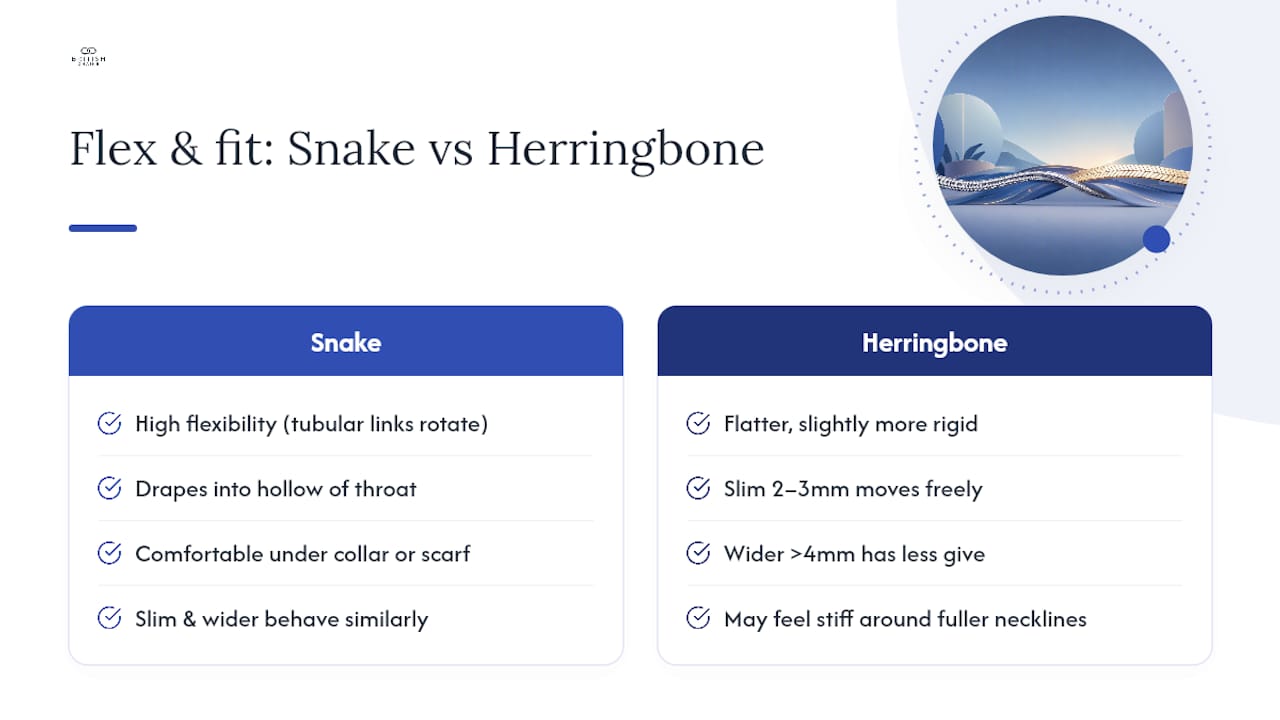
Snake chains drape in a genuine curve because the tubular links can rotate slightly against each other in every direction, so the chain settles naturally into the hollow of the throat. That’s the same flexibility that makes it comfortable under a collar or scarf without pulling awkwardly.
Herringbone lies flatter and can feel slightly more rigid, particularly at wider widths above 4mm, where the ribbon has less give around a fuller neckline. Slimmer widths around 2mm to 3mm move more freely and suit most body types. As a rough guide, a 16 to 18 inch length sits at the collarbone for both styles, while 20 inches and above works better for layering.
Do herringbone chains kink? Durability and repair realities
Herringbone chains kink because the links are engineered to bend forward and back only. Twist one sideways, catch it on a jumper, or hang a heavy pendant off it, and the flat plates can crease permanently rather than settle back into shape. That’s the trade-off for the mirror finish.
Snake chains resist this almost entirely. The tubular structure spreads stress around the circumference rather than concentrating it on one face, so the chain tolerates twisting, tangling, and daily knocks far better.
- Herringbone kinks: usually irreversible once creased; a jeweller can sometimes smooth a small one but a deep crease means replacement
- Snake chain kinks: rare, and minor tangles usually work themselves loose with gentle handling
- Both chains can be professionally resized or have clasps replaced, but structural kinks in herringbone are the one thing repair can’t reliably fix
Herringbone chain repair, pendants, and everyday wearability
Snake chains are a strong choice for pendants. The rounded profile lets a bail slide and rotate without distorting the chain’s shape, so you can add a pendant and remove it repeatedly with no real risk.
Herringbone chains are generally best worn alone. A hanging pendant concentrates weight on a handful of flat links, and that’s a common cause of the kinks people later struggle to fix. If you want the flat, liquid look with pendant flexibility, a double snake chain worn as a pair gives a similar visual effect while keeping the durability of a tubular build.
Herringbone chain care and snake chain maintenance that actually works
Sterling silver in either style benefits from the same basic cleaning routine: a soft polishing cloth after wear, and an occasional bath in lukewarm water with a mild soap for plated or gemstone-set pieces. Avoid harsh chemicals and ultrasonic cleaners on delicate links.
- Wipe the chain gently after each wear to remove skin oils and residue.
- Store herringbone chains flat, ideally in a lined tray or pouch, never coiled or hung.
- Snake chains can be hung on a hook or laid gently in a pouch since their tubular shape resists kinking.
- Remove any liquid-style chain before sleeping, showering, or exercising, since pressure during movement causes most kinks.
- If a herringbone kinks, stop wearing it and take it to a jeweller rather than trying to flatten it yourself.
Pro Tip: If your snake chain tangles into a knot, don’t pull. Lay it flat on a table and use two pins to gently work the loops apart. Pulling under tension is what turns a simple tangle into a real kink.
Styling and layering: pairing herringbone or snake chains with outfits
Herringbone suits fitted necklines, blazers, and evening wear where its flat shine reads as polished and deliberate. It works best worn solo or as the hero piece in a stack, since layering competes with its clean lines. Snake chains are the better everyday layering piece: their rounded profile sits comfortably under or over other necklaces without catching.
A reliable layering formula is one snake chain at 16 inches close to the throat, a second at 20 inches, and a pendant on the longer one. For a gender-neutral look, keep widths under 3mm for a subtle stack, or go bolder with a single 4mm to 5mm snake chain worn alone.
Snake vs herringbone: which chain should you choose?
- Everyday wear, pendants, or first-time buyers: go with a snake chain for its resilience and pendant compatibility
- A statement piece for events, evening wear, or layering solo: choose herringbone and accept the extra care it needs
- Still not sure: a durable snake chain or a double snake worn together gives you a flatter, liquid look with far less kink risk than a true herringbone
Why trust this guide on herringbone chain care and construction
Britishchains specialises in hallmarked sterling silver chains, including herringbone, snake, and box chain styles, and lists exact measurements, purity, and finish on every product page. The styling and care advice above draws on that product experience and on how these constructions actually behave once they leave the box. For precise widths, lengths, and hallmark details on any specific piece, the product pages themselves are the most reliable reference.
A brief editorial note on the trade-off
If pushed to choose one chain for daily life, the snake wins on resilience alone. Herringbone earns its place for occasions where the mirror finish matters more than convenience. Always check width and length against your own neckline in person before buying either.
— British
Product spotlight: our 2mm sterling silver herringbone chain
If the flat, mirror finish sold you on herringbone, This product offers proper hallmarked sterling silver 925 with a genuine polished diamond cut, not a plated alternative that dulls within a season.

The 2mm Sterling Silver 925 Herringbone Chain Necklace comes in multiple lengths, so you can match it to a fitted neckline or a longer, layered look without sacrificing shine. It suits anyone who wants that structured, statement flash of light but is prepared to store it flat and handle it with a bit of care. Skip heavy pendants on this one; wear it as the hero piece and it’ll hold its mirror finish for years. Check the length options on the product page and pick the size that sits right at your own collarbone before you order.
Sources
- What is the Difference Between a Snake Chain and a Herringbone Chain? | The Diamond Reserve
- Snake Chain vs Herringbone
- Best Herringbone Necklaces 2026: Buying & Care Guide – AJLuxe


