

3mm vs 5mm chain: which thickness actually suits you?
Pick 3mm if you want a chain that sits quietly under a collar, carries a small or medium pendant without fighting it, and layers easily with other necklaces. Pick 5mm if you want something that reads as jewellery from across a room, holds a heavier pendant without looking flimsy, and can be worn alone without needing anything else to make a statement.
If you have a slighter frame or a slim neck, 3mm usually looks proportionate; a larger frame or broader shoulders can carry 5mm without it looking oversized. Buying a gift for someone who prefers understated pieces? Go 3mm. Buying for someone who already wears bold jewellery? 5mm won’t feel like a stretch.
- Everyday, subtle, pendant-first: 3mm
- Bold, standalone, gift-that-makes-an-impression: 5mm
- Layering with other chains: 3mm as the base, thicker piece on top
There’s a full comparison table further down covering appearance, comfort, durability and price, alongside a decision checklist if you want to work through it properly before buying.
Key Takeaways
Choosing between 3mm and 5mm chains comes down to matching visual weight and durability to your intended use, whether that’s daily subtlety, pendant support, or a standalone statement.
| Point | Details |
|---|---|
| 3mm suits everyday wear | Lightweight, layers well, and fits standard pendant bails without modification. |
| 5mm suits statement wear | Higher tensile strength and visual presence, ideal for larger pendants or wearing alone. |
| Body frame changes the fit | Slimmer frames tend to suit 3mm; broader or taller frames carry 5mm more naturally. |
| Check construction, not just width | Solid, soldered links with hallmarking last longer than hollow or pressed alternatives at the same mm. |
| Britishchains offers both widths | Sterling Silver 925 chains from 2mm curb and Figaro styles up to 8mm thick curb, hallmarked with a returns option. |
Table of Contents
- Understanding chain thickness: what does 3mm vs 5mm chain actually mean?
- 3mm chain: pros, cons and where it wins
- 5mm chain: pros, cons and where it wins
- 3mm vs 5mm chain: side-by-side comparison
- How to style 3mm and 5mm chains together
- Does material and construction change how long a chain lasts?
- Why does 5mm look so much bigger than 3mm in photos?
- Buying for someone else: gifts, occasions and getting it right
- Try both sizes and see which one actually suits you
- Frequently asked questions
- Sources
Understanding chain thickness: what does 3mm vs 5mm chain actually mean?
The “mm” measurement refers to the width of the chain, taken across the links, not the length. It sounds like a small technical detail, but it’s the single number that determines how a chain looks, how it feels around the neck, and what it can physically support.
Here’s the part most buyers underestimate: a 2mm jump doesn’t feel like a 2mm jump. Metal volume increases roughly with the square of the width, so moving from 3mm to 5mm can more than double the actual amount of silver in the chain. That extra volume changes how light bounces off it, how it drapes, and how much weight sits on your collarbone. A 3mm chain reads as understated and everyday, while a 5mm chain reads as a deliberate, visible piece.
Broadly, three visual bands are worth knowing:
- Delicate (1mm to 2mm): fine, close to the skin, almost invisible until you look closely.
- Classic (3mm): described in most sizing guides as the everyday go-to width, versatile enough for pendants and layering.
- Statement (5mm and up): thick enough to stand alone, often the choice when someone wants the chain itself to be the piece, not just the support for a pendant.
Pro Tip: Before buying a pendant separately from its chain, measure the bail opening (the small loop the chain passes through) with a ruler. Anything under about 3mm generally slips onto a standard chain easily; wider or heavier pendants often need a chain closer to 4mm to 5mm, or a custom bail.
3mm chain: pros, cons and where it wins
A 3mm chain is the width most people default to when they want jewellery that works with everything, and for good reason. It’s light enough to wear all day without you noticing it’s there, slim enough to layer two or three deep without looking cluttered, and it fits the bail on the vast majority of pendants without any modification.
Where 3mm genuinely wins:
- Everyday wear where you want the chain to disappear into your outfit rather than dominate it.
- Layering multiple necklaces at different lengths, since thinner chains stack without competing for attention.
- Supporting small to medium pendants, where a thinner chain matches the bail size without a workaround.
- Lower material cost, since less silver goes into each link.
Where it falls short:
- Lower tensile strength than a thicker chain, which matters if you wear it constantly or work with your hands.
- Can look underwhelming under a heavy or oversized pendant. The pendant ends up doing all the visual work and the chain almost vanishes.
- On its own, without a pendant, it doesn’t carry much presence as a statement piece.
If you’re slim-framed or prefer minimalist style, 3mm tends to sit better proportionally. Before buying, check three things: the length suits your neckline (shorter for layering, longer for solo wear), the clasp is a proper lobster or spring-ring rather than a flimsy stamped fitting, and the chain is described as solid rather than hollow.
Pro Tip: Pair a 3mm chain with a pendant no heavier than a small coin. If you’re layering, vary the lengths by at least 5cm between chains so each one is visible rather than bunching together.
5mm chain: pros, cons and where it wins
A 5mm chain is a different category of jewellery, not just a thicker version of 3mm. It has enough visual weight to work on its own, no pendant required, and enough physical strength to hold a heavier pendant without the chain looking like the weak link.
Where 5mm genuinely wins:
- Durability. More metal volume across the link means better resistance to bending, twisting, and everyday wear.
- Visual presence. A 5mm chain functions as a statement piece rather than a support structure for something else.
- Supporting larger or heavier pendants without the mismatch you’d get pairing a big pendant with a thin chain.
- Works well worn solo, which suits people who don’t want to layer.
Where it falls short:
- Heavier for genuine all-day wear. It’s noticeable on the neck in a way a 3mm chain isn’t, which some people love and others find tiring after a full day.
- Larger pendants and bails are often required to match the scale of the chain visually, which narrows your pendant options.
- Higher material cost, simply because there’s more silver in every link.
Broader frames and taller wearers tend to carry 5mm comfortably, and it suits anyone who wants a chain to do the talking rather than accessorising a pendant. Checklist before buying: confirm solid construction (not hollow tubing, which dents), check the clasp is robust enough for the extra weight, and confirm it carries proper hallmarking for silver purity.
Pro Tip: If you’re unsure whether 5mm will feel too heavy, try a shorter length first (16 to 18 inches) rather than committing to a long chain. The weight is far more noticeable over 24 inches than over 16.
3mm vs 5mm chain: side-by-side comparison
| Dimension | 3mm | 5mm |
|---|---|---|
| Appearance | Subtle, refined, blends with outfit | Bold, immediately visible, statement piece |
| Weight & comfort | Light, comfortable for all-day wear | Noticeably heavier, still comfortable for most, less so over long hours |
| Pendant suitability | Best with small to medium pendants | Best with medium to large or heavier pendants |
| Body/neck fit | Suits slimmer frames and necks well | Suits broader frames and taller wearers well |
| Durability | Good, but more prone to bending under strain | Higher tensile strength, holds up better long-term |
| Typical price impact | Lower, less silver per length | Higher, since material volume increases sharply between widths |
| Layering compatibility | Excellent, stacks with other chains | Usually worn alone or as the anchor piece |
Run through this before you buy:
- What’s it for? Everyday wear points to 3mm; occasional statement wear points to 5mm.
- Is there a pendant? Heavy pendant, go 5mm. Light or delicate pendant, stay with 3mm.
- What’s your frame? Slighter build, 3mm; broader build or taller height, 5mm sits more naturally.
- Layering or solo? Layering favours 3mm. Wearing one chain alone favours 5mm.
- What’s the budget? 3mm costs less to produce and buy; factor that in if you’re choosing between two otherwise similar pieces.
If you want pendant-first versatility, choose 3mm. If you want the chain itself to make the impression, choose 5mm. There isn’t a single objectively better width; it’s a matter of matching the chain to what you actually want it to do.
How to style 3mm and 5mm chains together
Layering works best when thickness increases as you move away from the neck. Put a 3mm chain closest to the collar and a thicker piece further down; the contrast in scale creates hierarchy instead of two chains competing for the same visual space.
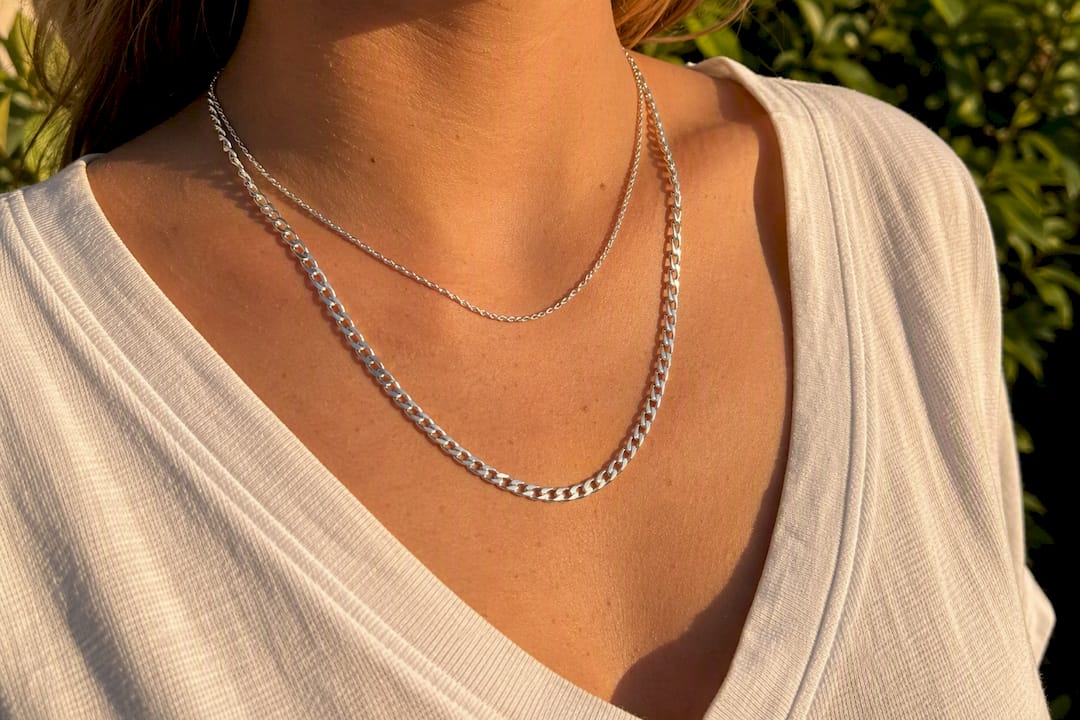
For pendants, match scale rather than just taste. Small charms and delicate motifs suit 3mm. Larger medallions, initials, or chunkier pendant designs need the extra bail room a 5mm chain provides.
Neckline matters more than people expect. A crew neck or shirt collar suits a shorter 3mm chain that peeks above the fabric. An open collar or V neck gives a 5mm chain room to sit visibly, which is where it earns its keep. For evening wear, a solo 5mm chain often reads as more deliberate than a stack of thin ones.
Pro Tip: Mix finishes, not just widths. A polished 5mm chain next to a matte or diamond-cut 3mm chain reads as intentional styling rather than mismatched jewellery.
Does material and construction change how long a chain lasts?
Thickness only tells half the story. A solid sterling silver 925 chain in either width will outlast a hollow or plated equivalent of the same measurement, because the metal itself resists bending and stretching rather than just wrapping around a hollow core. Two chains at the same millimetre width can have very different real-world lifespans depending on whether the links are soldered shut or simply pressed closed.
Before buying, check for:
- Solid link construction rather than hollow tubing, which dents and can collapse under pressure.
- Soldered joins, not just closed links, since open links are the most common failure point.
- A robust clasp. Lobster or bolt-ring fittings handle daily use far better than lightweight spring clasps, especially on 5mm pieces.
- Full British hallmarking confirming silver purity and origin.
For care, sterling silver of either width needs the same basic treatment: a soft polishing cloth after wear and storage away from humidity to slow tarnishing. Thinner 3mm chains are more prone to kinking and, over years of wear, gradual stretching at the clasp point. Thicker 5mm chains resist stretching but are more expensive to repair if a link does fail, simply because there’s more metal to rework.
Why does 5mm look so much bigger than 3mm in photos?
The numbers suggest a small difference. The reality on your neck is bigger, because a wider chain reflects more light across a larger surface and occupies more visual space against your skin or clothing. That’s why a 5mm chain reads as a different category of jewellery rather than simply “3mm plus a bit.”
To judge this properly before buying online, do two things. First, place a coin, a 1p or 2p, next to a ruler and photograph your own neck at the length you’re considering; that gives you real scale rather than guessing from a product photo alone. Second, drape a similar-weight item, even a spare necklace or cord, over a T shirt or shirt collar to see how it sits against your own proportions.
Pro Tip: When buying online, ask the seller for a close-up photo of the chain next to a 1p or 2p coin, or a 1cm ruler marking. It’s the fastest way to visualise chain thickness without seeing it in person.
Buying for someone else: gifts, occasions and getting it right
Reading recipient cues matters more than picking a “safer” size. Look at what they already wear: someone who layers delicate pieces will likely prefer 3mm, while someone who wears one bold necklace and nothing else is signalling 5mm.
For milestone gifts (birthdays, anniversaries), a 5mm chain feels intentional and substantial. For everyday or “just because” gifts, 3mm is easier to wear immediately without adjusting a wardrobe around it. If you’re genuinely torn, buying one length in each width and returning whichever doesn’t suit is a pragmatic option most retailers accommodate.
Try both sizes and see which one actually suits you
Britishchains sells both ends of this comparison in full Sterling Silver 925, hallmarked to British standards, so you’re not choosing on guesswork between a product photo and your own neck. If subtlety and pendant flexibility matter most, the 2mm Sterling Silver 925 Curb Chain Necklace or the 2mm Figaro Chain Necklace gives you that everyday, layerable width in multiple lengths.
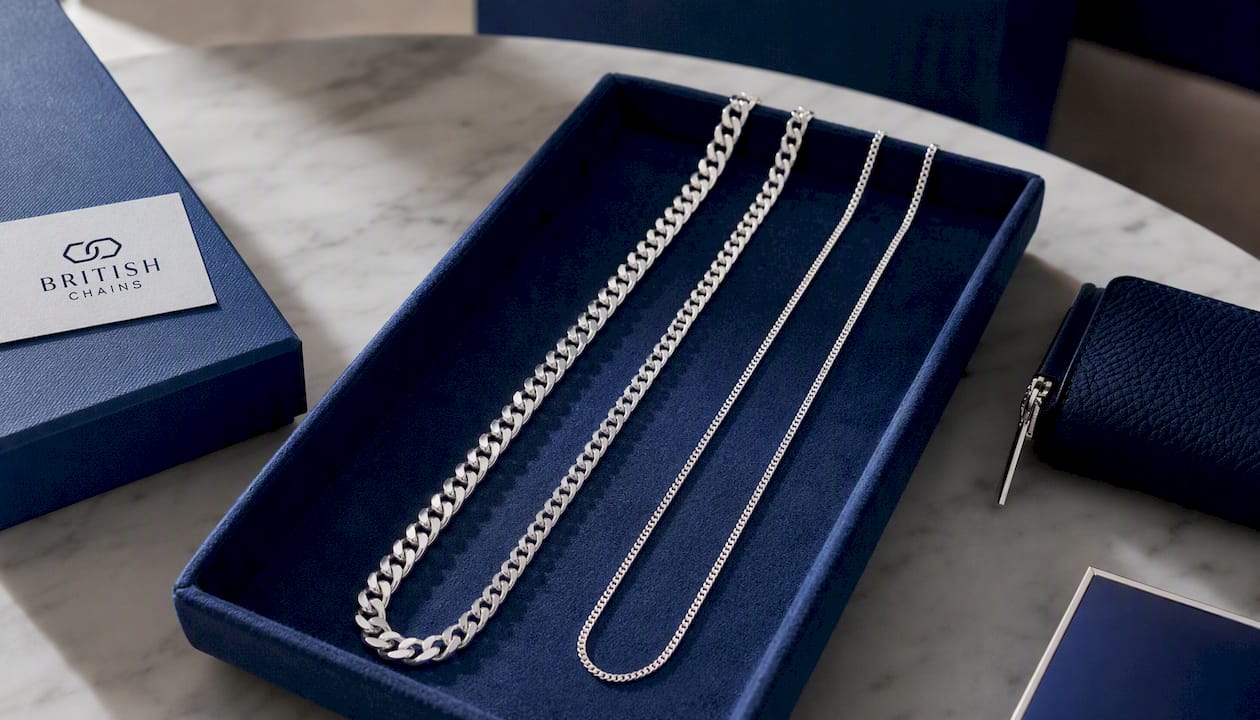
Want the statement end instead? The 8mm Sterling Silver 925 Thick Curb Chain shows exactly how a heavier width reads on its own, no pendant needed, across sizes from 18 to 24 inches. Every piece carries full hallmarking and a straightforward returns policy, so if a width doesn’t sit right once it’s on your neck, sending it back isn’t a fight. Order one of each width if you’re still deciding. It’s the only way to settle a millimetre argument for good.
Frequently asked questions
Is 3mm or 5mm better for everyday wear? 3mm is generally better for all-day comfort since it’s lighter and less noticeable, though 5mm holds up better under constant physical wear if you don’t mind the extra weight.
How thick is a 3mm chain compared to 4mm or 5mm? A 3mm chain is noticeably slimmer than 4mm and considerably slimmer than 5mm; each millimetre adds disproportionately more metal volume rather than a simple linear increase.
Which chain size should I choose for a pendant? Match the chain to the pendant’s bail size. Small to medium pendants generally sit well on 3mm, while larger or heavier pendants need the extra support a 5mm chain provides.
Can I visualise chain thickness online before buying? Yes. Ask for a close-up photo of the chain next to a coin or a ruler, and compare that scale against a similar item you already own.
Is 5mm too thick for women’s necklaces? No. Thickness suitability depends on personal style and frame rather than gender; many women choose 5mm specifically for its statement presence.
Sources
- The ultimate guide to chain thickness guide for men – Natural Selection London
- 3mm chain vs 5mm: Which size is right for you? – VersusGuy


